Alessandrino Francesco, Goncalves Nicole, Metalonis Sarah Wishnek, Luna Cibele, Mason Matthew M, Lyu Jiangnan, Huang Marilyn
Department of Radiology, University of Miami, Miami, FL, United States.
University of Miami Miller School of Medicine, Miami, FL, United States.
Front Oncol. 2023 May 9;13:1066427. doi: 10.3389/fonc.2023.1066427. eCollection 2023.
Uterine serous carcinoma (USC) is an aggressive subtype of endometrial carcinoma which has been increasing at alarming rates, particularly among Asian, Hispanic and Black women. USC has not been well characterized in terms of mutational status, pattern of metastases and survival.
To investigate the association between sites of recurrence and metastases of USC, mutational status, race, and overall survival (OS).
This single-center retrospective study evaluated patients with biopsy-proven USC that underwent genomic testing between January 2015 and July 2021. Association between genomic profile and sites of metastases or recurrence was performed using χ2 or Fisher's exact test. Survival curves for ethnicity and race, mutations, sites of metastasis/recurrence were estimated using the Kaplan-Meier method and compared with log-rank test. Cox proportional hazard regression models were used to examine the association between OS with age, race, ethnicity, mutational status, and sites of metastasis/recurrence. Statistical analyses were performed using SAS Software Version 9.4.
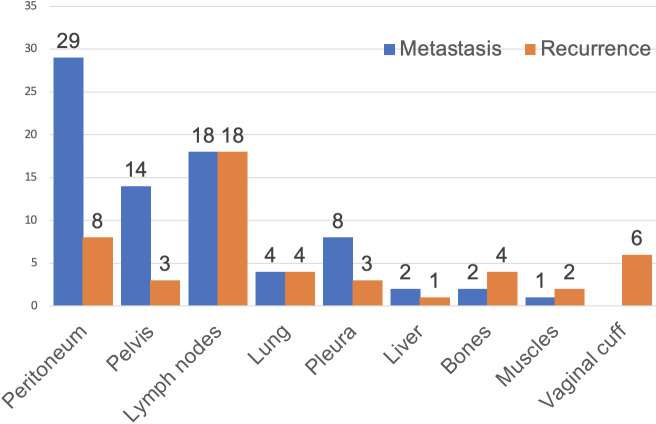
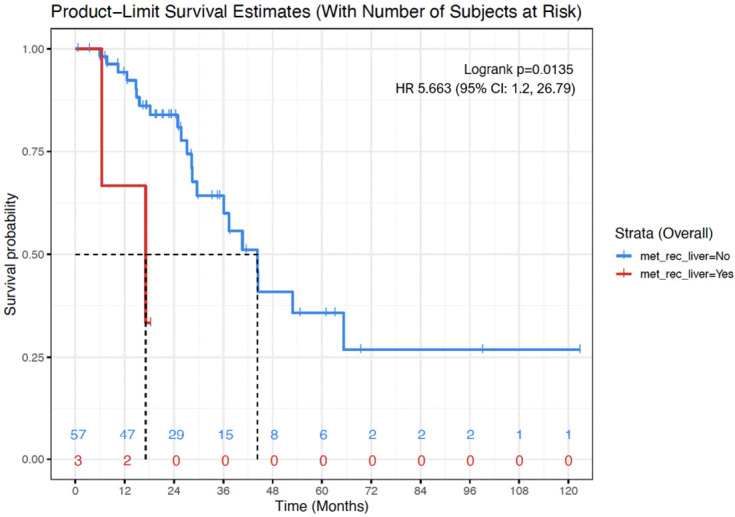
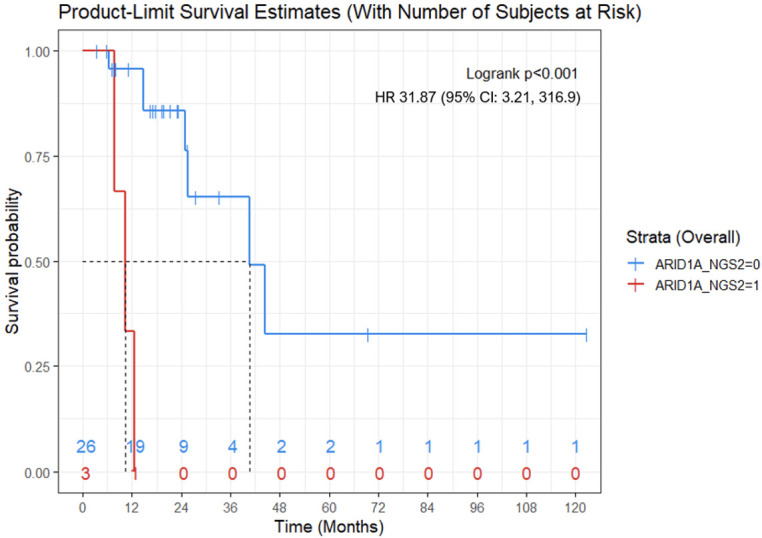
The study included 67 women (mean age 65.8 years, range 44-82) with 52 non-Hispanic women (78%) and 33 Black women (49%). The most common mutation was (55/58 women, 95%). The peritoneum was the most common site of metastasis (29/33, 88%) and recurrence (8/27, 30%). PR expression was more common in women with nodal metastases (p=0.02) and non-Hispanic women (p=0.01). alterations were more common in women with vaginal cuff recurrence (p=0.02), while mutation was more common in women with liver metastases (p=0.048). mutation and presence of recurrence or metastases to the liver were associated with lower OS (Hazard Ratio (HR): 31.87; 95%CI: 3.21, 316.9; p<0.001 and HR: 5.66; 95%CI: 1.2, 26.79; p=0.01, respectively). In the bivariable Cox model, the presence of metastasis/recurrence to the liver and/or the peritoneum were both independent significant predictors of OS (HR: 9.8; 95%CI: 1.85-52.7; p=0.007 and HR: 2.7; 95%CI: 1.02-7.1; p=0.04, respectively).
is often mutated in USC, which most commonly metastasize and recur in the peritoneum. OS was shorter in women with mutations and with metastasis/recurrence to the liver. The presence of metastasis/recurrence to liver and/or peritoneum were independently associated with shorter OS.
子宫浆液性癌(USC)是子宫内膜癌的一种侵袭性亚型,其发病率正以惊人的速度上升,尤其是在亚洲、西班牙裔和黑人女性中。USC在突变状态、转移模式和生存率方面尚未得到充分的特征描述。
研究USC复发和转移部位、突变状态、种族与总生存期(OS)之间的关联。
这项单中心回顾性研究评估了2015年1月至2021年7月期间接受基因检测且活检证实为USC的患者。使用χ2检验或Fisher精确检验分析基因谱与转移或复发部位之间的关联。采用Kaplan-Meier方法估计种族、突变、转移/复发部位的生存曲线,并通过对数秩检验进行比较。使用Cox比例风险回归模型检验OS与年龄、种族、民族、突变状态以及转移/复发部位之间的关联。使用SAS软件9.4版进行统计分析。
该研究纳入了67名女性(平均年龄65.8岁,范围44-82岁),其中52名非西班牙裔女性(78%)和33名黑人女性(49%)。最常见的突变是(55/58名女性,95%)。腹膜是最常见的转移部位(29/33,88%)和复发部位(8/27,30%)。PR表达在有淋巴结转移的女性(p=0.02)和非西班牙裔女性(p=0.01)中更常见。改变在阴道断端复发的女性中更常见(p=0.02),而突变在有肝转移的女性中更常见(p=0.048)。突变以及肝转移或复发与较低的OS相关(风险比(HR):31.87;95%置信区间:3.21,316.9;p<0.001和HR:5.66;95%置信区间:1.2,26.79;p=0.01)。在双变量Cox模型中,肝和/或腹膜转移/复发的存在均是OS的独立显著预测因素(HR:9.8;95%置信区间:1.85-52.7;p=0.007和HR:2.7;95%置信区间:1.02-7.1;p=0.04)。
在USC中常发生突变,其最常见的转移和复发部位是在腹膜。有突变以及肝转移/复发的女性OS较短。肝和/或腹膜转移/复发的存在与较短的OS独立相关。