Department of Pathology, School of Basic Medical Science, Guangzhou Medical University, Guangzhou, China.
Department of Pathology, Third Affiliated Hospital, Guangzhou Medical University, Guangzhou, China.
BMC Cancer. 2021 Feb 12;21(1):154. doi: 10.1186/s12885-021-07834-4.
Uterine serous carcinoma (USC) is an aggressive type of endometrial cancer that accounts for up to 40% of endometrial cancer deaths, creating an urgent need for prognostic biomarkers.
USC RNA-Seq data and corresponding patients' clinical records were obtained from The Cancer Genome Atlas and Genotype-Tissue Expression datasets. Univariate cox, Lasso, and Multivariate cox regression analyses were conducted to forge a prognostic signature. Multivariable and univariable cox regression analysis and ROC curve evaluated the prediction efficiency both in the training and testing sets.
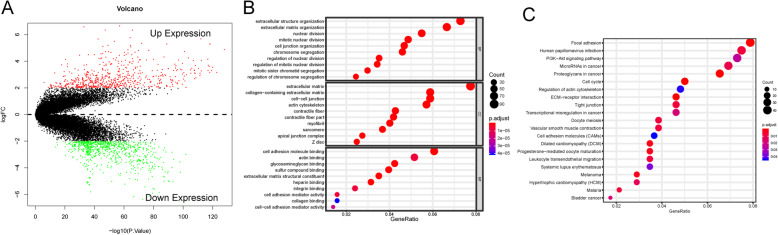
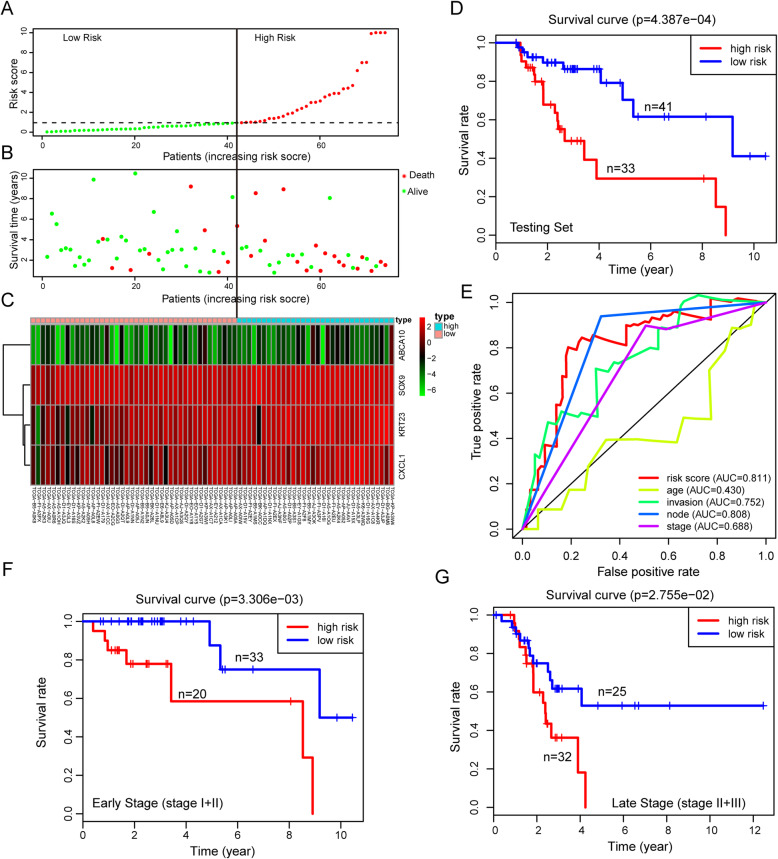
We uncovered 1385 genes dysregulated in 110 cases of USC tissue relative to 113 cases of normal uterine tissue. Functional enrichment analysis of these genes revealed the involvement of various cancer-related pathways in USC. A novel 4-gene signature (KRT23, CXCL1, SOX9 and ABCA10) of USC prognosis was finally forged by serial regression analyses. Overall patient survival (OS) and recurrence-free survival (RFS) were significantly lower in the high-risk group relative to the low-risk group in both the training and testing sets. The area under the ROC curve of the 4-gene signature was highest among clinicopathological features in predicting OS and RFS. The 4-gene signature was found to be an independent prognostic indicator in USC and was a superior predictor of OS in early stage of USC.
Our findings highlight the potential of the 4-gene signature as a guide for personalized USC treatment.
子宫浆液性癌(USC)是一种侵袭性子宫内膜癌,约占子宫内膜癌死亡人数的 40%,因此迫切需要预后生物标志物。
从癌症基因组图谱和基因型组织表达数据集获取 USC RNA-Seq 数据和相应的患者临床记录。进行单变量 Cox、Lasso 和多变量 Cox 回归分析,以构建预后标志。多变量和单变量 Cox 回归分析和 ROC 曲线评估了在训练集和测试集中的预测效率。
我们发现 110 例 USC 组织相对于 113 例正常子宫组织中存在 1385 个基因失调。对这些基因的功能富集分析表明,各种癌症相关途径参与了 USC。最终通过一系列回归分析构建了一个新的 USC 预后 4 基因标志物(KRT23、CXCL1、SOX9 和 ABCA10)。在训练集和测试集中,高风险组的总患者生存率(OS)和无复发生存率(RFS)均显著低于低风险组。在预测 OS 和 RFS 方面,ROC 曲线下的面积在临床病理特征中最高。该 4 基因标志物被发现是 USC 的一个独立预后指标,并且是 USC 早期 OS 的更好预测指标。
我们的研究结果强调了 4 基因标志物作为 USC 个体化治疗指南的潜力。