Li Kun, Ouyang Miao, Zhan Jiangshan, Tian Ruilin
Department of Medical Neuroscience, School of Medicine, Southern University of Science and Technology, Shenzhen, Guangdong Province 518055, China.
Key University Laboratory of Metabolism and Health of Guangdong, Southern University of Science and Technology, Shenzhen, Guangdong Province 518055, China.
Cell Genom. 2023 Apr 18;3(5):100300. doi: 10.1016/j.xgen.2023.100300. eCollection 2023 May 10.
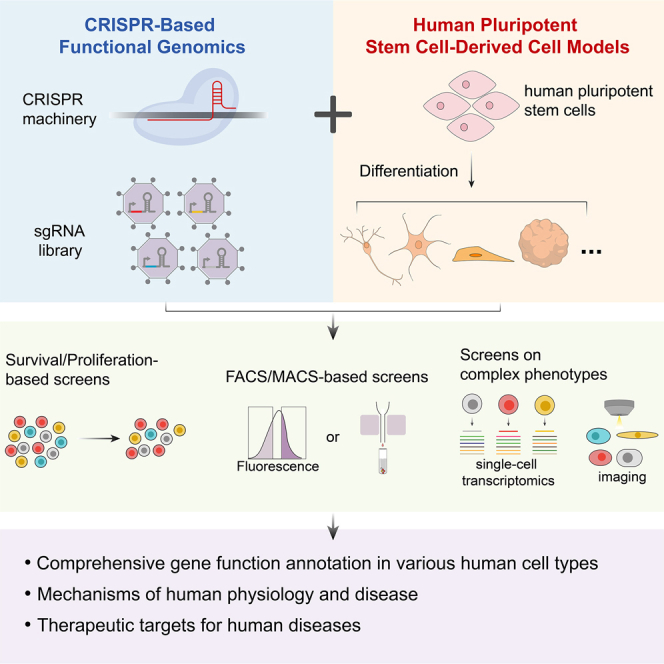
While our knowledge of gene expression in different human cell types is rapidly expanding with advances in transcriptomic profiling technologies, the next challenge is to understand gene function in each cell type. CRISPR-Cas9-based functional genomics screening offers a powerful approach to determine gene function in a high-throughput manner. With the maturation of stem cell technology, a variety of human cell types can be derived from human pluripotent stem cells (hPSCs). Recently, the integration of CRISPR screening with hPSC differentiation technologies opens up unprecedented opportunities to systematically examine gene function in different human cell types and identify mechanisms and therapeutic targets for human diseases. This review highlights recent progress in the development and applications of CRISPR-Cas9-based functional genomics screening in hPSC-derived cell types, discusses current challenges and limitations, and outlines future directions for this emerging field.
随着转录组分析技术的进步,我们对不同人类细胞类型中基因表达的了解正在迅速扩展,下一个挑战是了解每种细胞类型中的基因功能。基于CRISPR-Cas9的功能基因组学筛选提供了一种以高通量方式确定基因功能的强大方法。随着干细胞技术的成熟,可以从人类多能干细胞(hPSC)中衍生出多种人类细胞类型。最近,CRISPR筛选与hPSC分化技术的整合为系统研究不同人类细胞类型中的基因功能、识别人类疾病的机制和治疗靶点带来了前所未有的机遇。本综述重点介绍了基于CRISPR-Cas9的功能基因组学筛选在hPSC衍生细胞类型中的开发和应用方面的最新进展,讨论了当前的挑战和局限性,并概述了这一新兴领域的未来方向。