Department of Medical Oncology, BR Ambedkar Institute Rotary Cancer Hospital, All India Institute of Medical Sciences, Delhi 110029, India.
Department of Surgical Oncology, BR Ambedkar Institute Rotary Cancer Hospital, All India Institute of Medical Sciences, Delhi 110029, India.
Curr Oncol. 2023 Apr 28;30(5):4563-4574. doi: 10.3390/curroncol30050345.
Carcinoma penis is a rare neoplasm, and the literature is scarce on long-term survival and its predictors. The aim of the study was to determine the clinical profile and management patterns, identify predictors of survival, and the impact of education and rural/urban dwelling on survival.
Patients with a histological diagnosis of carcinoma penis from January 2015 to December 2019 were included in the study. Demographics, clinical profile, education status, primary residence address, and outcomes were obtained from the case records. Distance from the treatment centre was obtained from the postal code. The primary objectives were to assess relapse-free survival (RFS) and overall survival (OS). The secondary objectives were to identify the predictors of RFS and OS and to determine the clinical profile and treatment patterns in patients with carcinoma penis in India. Time-to-event was calculated by Kaplan-Meir analysis and survival was compared by the log-rank test. Univariate and multivariable Cox regression analyses were used to find independent predictors of relapse and mortality. Logistic regression analyses to examine the associations of rural residence, education status, and distance from the treatment centre with the relapse adjusting for measured confounding variables.
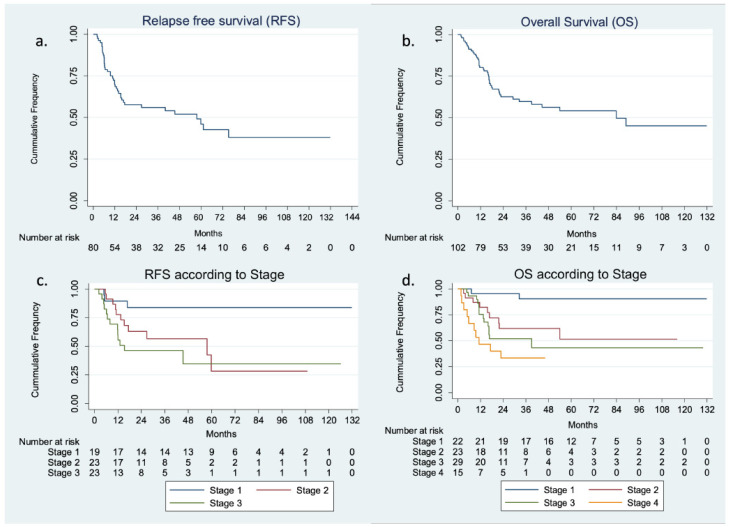
Case records of 102 patients treated during the above period were retrieved. The median age was 55.5 (interquartile range [IQR] 42-65 years). Ulcero-proliferative growth (65%), pain (57%), and dysuria (36%) were the most common presenting features. Clinical examination or imaging revealed inguinal lymphadenopathy in 70.6% of patients, however, only 42% of these lesions were pathologically involved. A total of 58.8% of patients were from rural areas, 46.9% had no formal education, and 50.9% had a primary residence ≥100 km from the hospital. Patients with lower education and rural households had higher TNM stages and nodal involvement. Median RFS and OS were 57.6 months (15.8 months to not reached) and 83.9 months (32.5 months to not reached), respectively. On univariate analysis tumor stage, involvement of lymph nodes, T stage, performance status, and albumin was predictive for relapse and survival. However, on multivariate analysis, the stage remained the only predictor of RFS and nodal involvement, and metastatic disease was a predictor of OS. Education status, rural habitation, and distance from the treatment centre were not predictors for relapse or survival.
Patients with carcinoma have locally advanced disease at presentation. Rural dwellings and lower education were associated with the advanced stage but did not have a significant bearing on the survival outcomes. The stage at diagnosis and nodal involvement is the most important predictor of RFS and OS.
阴茎癌是一种罕见的肿瘤,文献中关于长期生存及其预测因素的内容很少。本研究的目的是确定临床特征和管理模式,确定生存的预测因素,以及教育和城乡居住对生存的影响。
纳入 2015 年 1 月至 2019 年 12 月期间经组织学诊断为阴茎癌的患者。从病历中获取人口统计学、临床特征、教育状况、常住地址和结局等信息。从邮政编码中获取距离治疗中心的距离。主要目的是评估无复发生存率(RFS)和总生存率(OS)。次要目标是确定 RFS 和 OS 的预测因素,并确定印度患者的阴茎癌临床特征和治疗模式。通过 Kaplan-Meier 分析计算时间事件,并通过对数秩检验比较生存情况。采用单因素和多因素 Cox 回归分析寻找复发和死亡的独立预测因素。采用逻辑回归分析,在校正测量混杂变量后,检验农村居住、教育状况和距治疗中心的距离与复发的关系。
检索到上述期间治疗的 102 例患者的病历记录。中位年龄为 55.5(四分位间距 [IQR] 42-65 岁)。最常见的临床表现为溃疡增殖性生长(65%)、疼痛(57%)和排尿困难(36%)。临床检查或影像学检查显示 70.6%的患者存在腹股沟淋巴结肿大,但只有 42%的病变存在病理性受累。58.8%的患者来自农村地区,46.9%没有接受过正规教育,50.9%的常住地距离医院≥100 公里。受教育程度较低和农村家庭的患者分期较高,淋巴结受累较多。中位 RFS 和 OS 分别为 57.6 个月(15.8 个月至未达到)和 83.9 个月(32.5 个月至未达到)。单因素分析显示,肿瘤分期、淋巴结受累、T 分期、一般状况和白蛋白是复发和生存的预测因素。然而,多因素分析显示,分期仍然是 RFS 和淋巴结受累的唯一预测因素,转移性疾病是 OS 的预测因素。教育状况、农村居住和距治疗中心的距离不是复发或生存的预测因素。
阴茎癌患者就诊时即存在局部晚期疾病。农村居民和较低的教育程度与晚期疾病相关,但对生存结果没有显著影响。诊断时的分期和淋巴结受累是 RFS 和 OS 的最重要预测因素。
