Zhou Yun, Chen Siyu, Wu Yuchen, Li Lanqing, Lou Qinqin, Chen Yongyi, Xu Songxiao
Physical Examination Center, The Cancer Hospital of the University of Chinese Academy of Sciences (Zhejiang Cancer Hospital), The Key Laboratory of Zhejiang Province for Aptamers and Theranostics, Institute of Basic Medicine and Cancer (IBMC), Chinese Academy of Sciences, Hangzhou, Zhejiang, China.
The Clinical Laboratory Department, The Cancer Hospital of the University of Chinese Academy of Sciences (Zhejiang Cancer Hospital), The Key Laboratory of Zhejiang Province for Aptamers and Theranostics, Institute of Basic Medicine and Cancer (IBMC), Chinese Academy of Sciences, Hangzhou, Zhejiang, China.
Front Oncol. 2023 May 10;13:1171837. doi: 10.3389/fonc.2023.1171837. eCollection 2023.
It is significant to develop effective prognostic strategies and techniques for improving the survival rate of gallbladder carcinoma (GBC). We aim to develop the prediction model from multi-clinical indicators combined artificial intelligence (AI) algorithm for the prognosis of GBC.
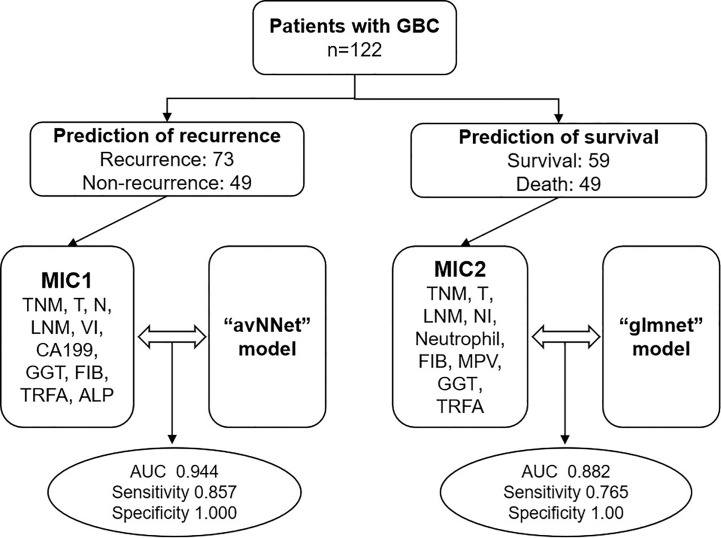
A total of 122 patients with GBC from January 2015 to December 2019 were collected in this study. Based on the analysis of correlation, relative risk, receiver operator characteristic curve, and importance by AI algorithm analysis between clinical factors and recurrence and survival, the two multi-index classifiers (MIC1 and MIC2) were obtained. The two classifiers combined eight AI algorithms to model the recurrence and survival. The two models with the highest area under the curve (AUC) were selected to test the performance of prognosis prediction in the testing dataset.
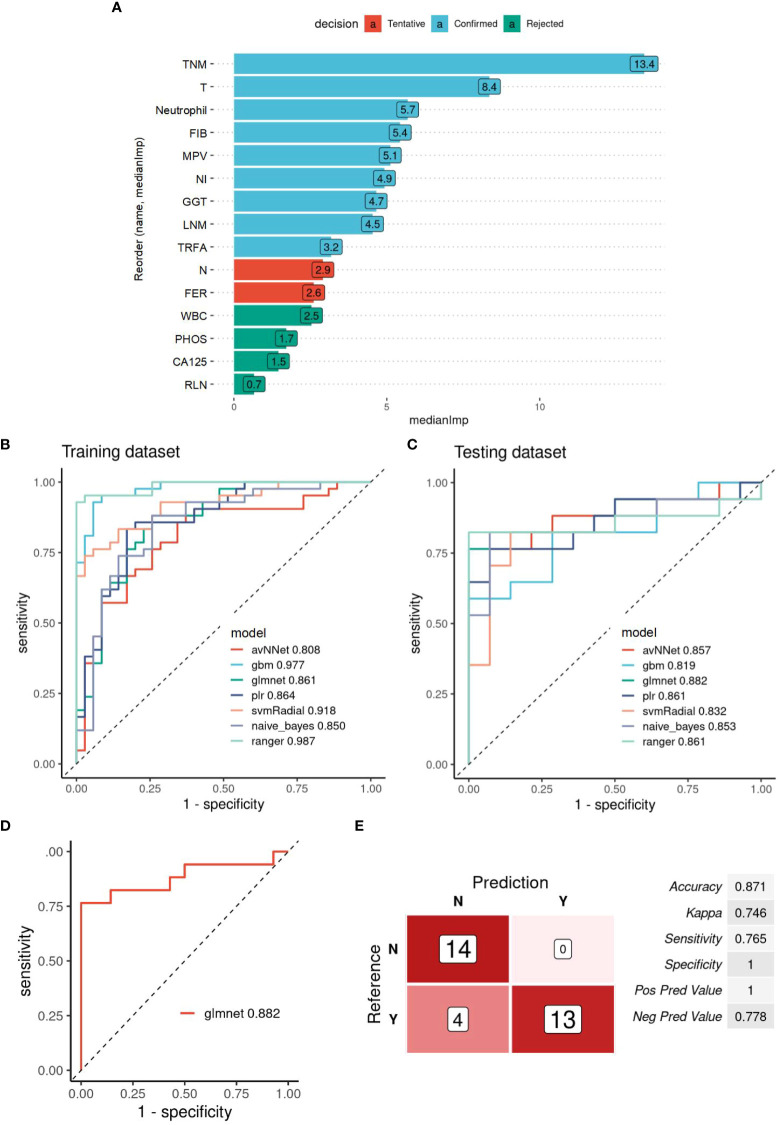
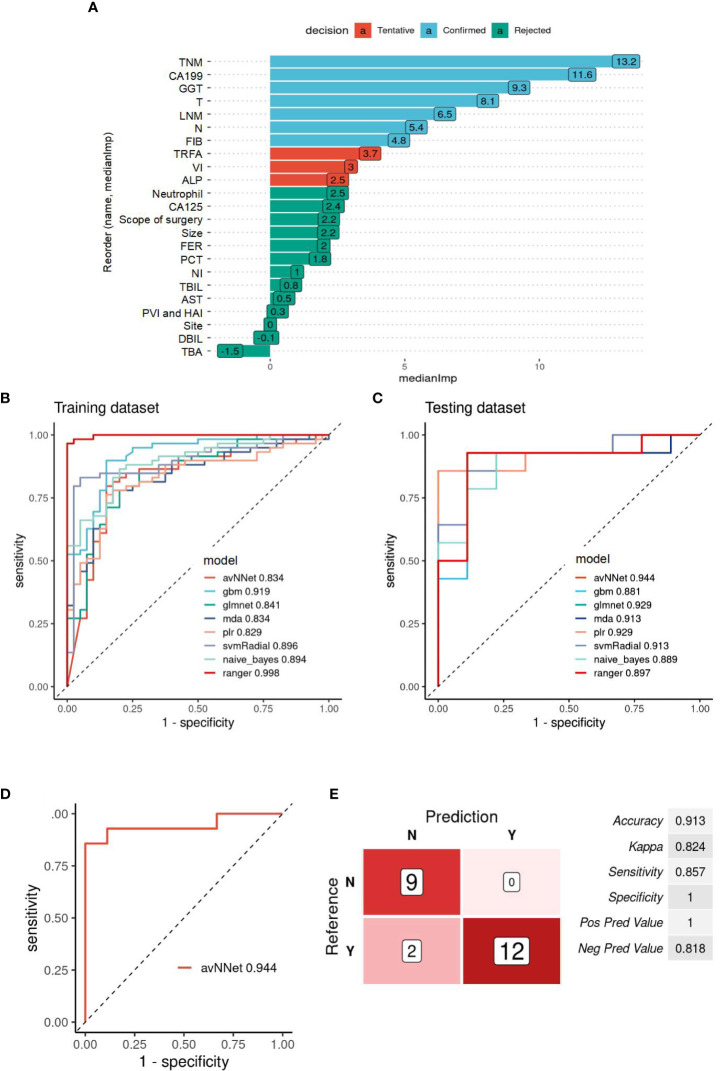
The MIC1 has ten indicators, and the MIC2 has nine indicators. The combination of the MIC1 classifier and the "avNNet" model can predict recurrence with an AUC of 0.944. The MIC2 classifier and "glmet" model combination can predict survival with an AUC of 0.882. The Kaplan-Meier analysis shows that MIC1 and MIC2 indicators can effectively predict the median survival of DFS and OS, and there is no statistically significant difference in the prediction results of the indicators (MIC1: χ = 6.849, P = 0.653; MIC2: χ = 9.14, P = 0.519).
The MIC1 and MIC2 combined with avNNet and mda models have high sensitivity and specificity in predicting the prognosis of GBC.
开发有效的预后策略和技术对于提高胆囊癌(GBC)的生存率具有重要意义。我们旨在通过结合人工智能(AI)算法的多临床指标来开发GBC预后的预测模型。
本研究收集了2015年1月至2019年12月期间的122例GBC患者。通过AI算法分析临床因素与复发及生存之间的相关性、相对风险、受试者工作特征曲线和重要性,获得了两个多指标分类器(MIC1和MIC2)。这两个分类器结合了八种AI算法对复发和生存进行建模。选择曲线下面积(AUC)最高的两个模型在测试数据集中测试预后预测性能。
MIC1有十个指标,MIC2有九个指标。MIC1分类器与“avNNet”模型相结合可预测复发,AUC为0.944。MIC2分类器与“glmet”模型相结合可预测生存,AUC为0.882。Kaplan-Meier分析表明,MIC1和MIC2指标可有效预测DFS和OS的中位生存期,指标的预测结果无统计学显著差异(MIC1:χ = 6.849,P = 0.653;MIC2:χ = 9.14,P = 0.519)。
MIC1和MIC2与avNNet和mda模型相结合在预测GBC预后方面具有较高的敏感性和特异性。