Gupta Vivek Kumar, Park Uichang, Siddiqi Nikhat J, Huh Yun Suk, Sharma Bechan
Department of Biochemistry, University of Allahabad, Prayagraj 211002, India.
NanoBio High-Tech Materials Research Center, Department of Biological Sciences and Bioengineering, Inha University, Incheon 22212, Republic of Korea.
Toxics. 2023 May 22;11(5):472. doi: 10.3390/toxics11050472.
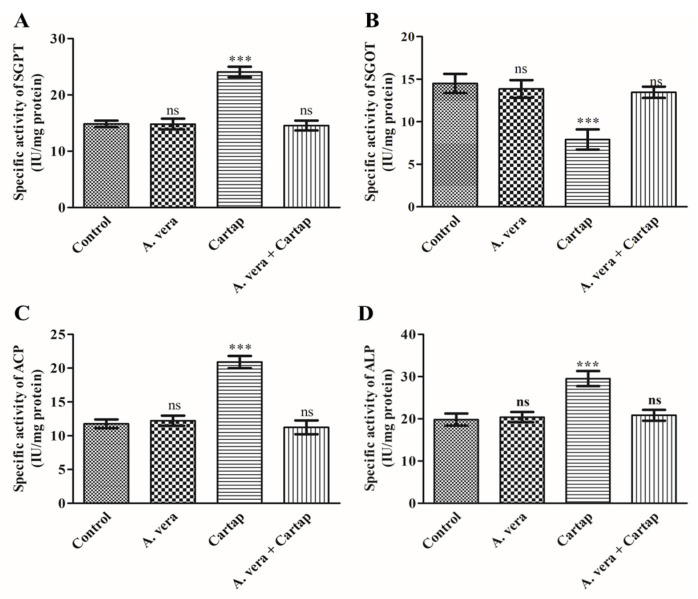
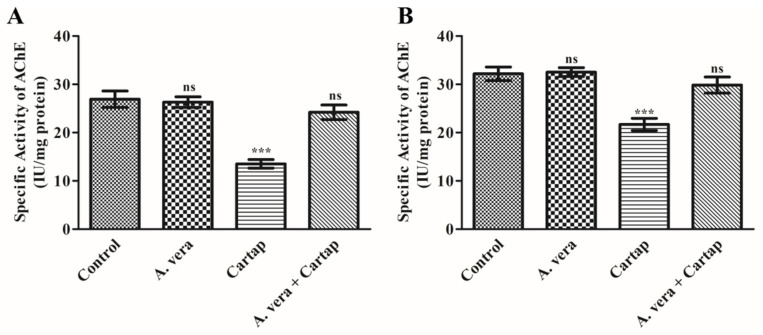
Pesticide exposure can pose a serious risk to nontarget animals. Cartap is being broadly used in agricultural fields. The toxic effects of cartap on the levels of hepatotoxicity and neurotoxicity have not been properly studied in mammalian systems. Therefore, the present work focused on the effect of cartap on the liver and brain of Wistar rats and made an assessment of the ameliorating potential of . The experimental animals were divided into 4 groups, comprising six rats in each: Group 1-Control; Group 2-; Group 3-Cartap; and Group 4- + Cartap. The animals orally given cartap and were sacrificed after 24 h of the final treatment and histological and biochemical investigations were conducted in liver and brain of Wistar rats. Cartap at sublethal concentrations caused substantial decreases in CAT, SOD, and GST levels in the experimental rats. The activity levels of transaminases and phosphatases in cartap group were also found to be substantially altered. The AChE activity was recorded as decreasing in RBC membrane and brain of the cartap-treated animals. The TNF-α and IL-6 level in serum were increased expressively in the cartap challenged groups. Histological investigation of liver showed disorganized hepatic cords and severely congested central veins due to cartap. However, the extract was observed to significantly protect against the effects of cartap toxicity. The protective impact of against cartap toxicity may be due to the existence of antioxidants in it. These findings suggest that may be developed as a potential supplement to the appropriate medication in the treatment of cartap toxicity.
接触农药会对非靶标动物构成严重风险。杀螟丹在农业领域广泛使用。杀螟丹对哺乳动物系统肝脏毒性和神经毒性水平的毒性作用尚未得到充分研究。因此,本研究聚焦于杀螟丹对Wistar大鼠肝脏和大脑的影响,并评估了[具体物质]的改善潜力。将实验动物分为4组,每组6只大鼠:第1组为对照组;第2组为[具体物质]组;第3组为杀螟丹组;第4组为[具体物质] + 杀螟丹组。在末次处理24小时后,对口服给予杀螟丹和[具体物质]的动物进行处死,并对Wistar大鼠的肝脏和大脑进行组织学和生化研究。亚致死浓度的杀螟丹导致实验大鼠的CAT、SOD和GST水平大幅下降。还发现杀螟丹组的转氨酶和磷酸酶活性水平发生了显著改变。在杀螟丹处理动物的红细胞膜和大脑中,AChE活性记录为下降。在杀螟丹攻击组中,血清中的TNF-α和IL-6水平显著升高。肝脏组织学研究显示,由于杀螟丹的作用,肝索紊乱,中央静脉严重充血。然而,观察到[具体物质]提取物可显著保护免受杀螟丹毒性的影响。[具体物质]对杀螟丹毒性的保护作用可能归因于其中存在抗氧化剂。这些发现表明,[具体物质]可能被开发为治疗杀螟丹毒性的适当药物的潜在补充剂。