
2014 - 2019年哥伦比亚西南部登革热聚集性病例在部门、市和地方层面的空间分析
Spatial Analysis of Dengue Clusters at Department, Municipality and Local Scales in the Southwest of Colombia, 2014-2019.
作者信息
Marceló-Díaz Catalina, Lesmes María Camila, Santamaría Erika, Salamanca José Alejandro, Fuya Patricia, Cadena Horacio, Muñoz-Laiton Paola, Morales Carlos Andrés
机构信息
Grupo de Entomología, Instituto Nacional de Salud, Bogotá 111321, Colombia.
Facultad de Ciencias Ambientales y de la Sostenibilidad, Programa de Ingeniería Geográfica y Ambiental, Universidad de Ciencias Aplicadas y Ambientales, UDCA, Bogotá 111166, Colombia.
出版信息
Trop Med Infect Dis. 2023 May 2;8(5):262. doi: 10.3390/tropicalmed8050262.
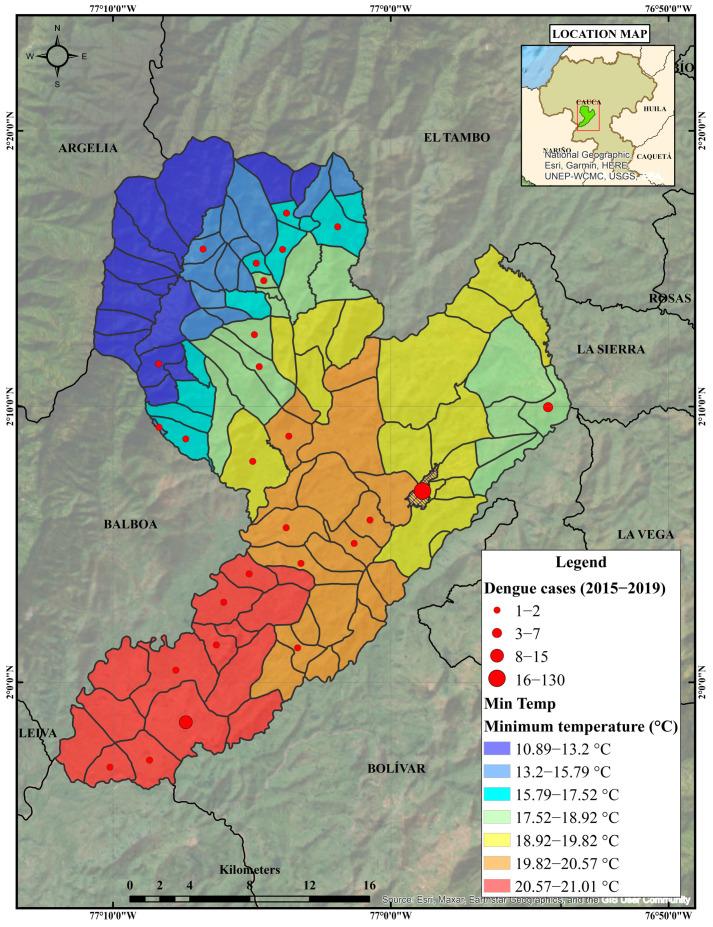
Dengue is an arbovirus transmitted by mosquitoes of the genus and is one of the 15 main public health problems in the world, including Colombia. Where limited financial resources create a problem for management, there is a need for the department to prioritize target areas for public health implementation. This study focuses on a spatio-temporal analysis to determine the targeted area to manage the public health problems related to dengue cases. To this end, three phases at three different scales were carried out. First, for the departmental scale, four risk clusters were identified in Cauca (RR ≥ 1.49) using the Poisson model, and three clusters were identified through Getis-Ord Gi* hotspots analysis; among them, Patía municipality presented significantly high incidence rates in the time window (2014-2018). Second, on the municipality scale, altitude and minimum temperature were observed to be more relevant than precipitation; considering posterior means, no spatial autocorrelation for the Markov Chain Monte Carlo was found (Moran test ˂ 1.0), and convergence was reached for b-b with 20,000 iterations. Finally, on the local scale, a clustered pattern was observed for dengue cases distribution (nearest neighbour index, NNI = 0.202819) and the accumulated number of pupae (G = 0.70007). Two neighbourhoods showed higher concentrations of both epidemiological and entomological hotspots. In conclusion, the municipality of Patía is in an operational scenario of a high transmission of dengue.
登革热是一种由伊蚊属蚊子传播的虫媒病毒,是包括哥伦比亚在内的世界15个主要公共卫生问题之一。在财政资源有限给管理带来问题的地方,该部门需要对公共卫生实施的目标区域进行优先排序。本研究侧重于时空分析,以确定管理与登革热病例相关的公共卫生问题的目标区域。为此,在三个不同尺度上进行了三个阶段的研究。首先,在部门尺度上,使用泊松模型在考卡省识别出四个风险聚集区(相对风险≥1.49),并通过Getis-Ord Gi*热点分析识别出三个聚集区;其中,帕蒂亚市在时间窗口(2014 - 2018年)呈现出显著高的发病率。其次,在市尺度上,观察到海拔和最低温度比降水量更具相关性;考虑后验均值,马尔可夫链蒙特卡罗方法未发现空间自相关性(莫兰检验˂1.0),并且在进行20,000次迭代后b - b达到收敛。最后,在局部尺度上,观察到登革热病例分布呈聚集模式(最近邻指数,NNI = 0.202819)以及蛹的累计数量呈聚集模式(G = 0.70007)。两个社区显示出更高浓度的流行病学和昆虫学热点。总之,帕蒂亚市处于登革热高传播的运行情景中。




 Zotero 插件