Centro Nacional de Programas Preventivos y Control de Enfermedades (CENAPRECE), Ministry of Health, Mexico.
Collaborative Unit for Entomological Bioassays (UCBE), Campus de Ciencias Biologicas y Agropecuarias, Universidad Autonoma de Yucatan, Merida, Yucatan, Mexico.
Lancet Planet Health. 2021 May;5(5):e277-e285. doi: 10.1016/S2542-5196(21)00030-9.
Effective Aedes aegypti control is limited, in part, by the difficulty in achieving sufficient intervention coverage. To maximise the effect of vector control, areas with persistently high numbers of Aedes-borne disease cases could be identified and prioritised for preventive interventions. We aimed to identify persistent Aedes-borne disease hotspots in cities across southern Mexico.
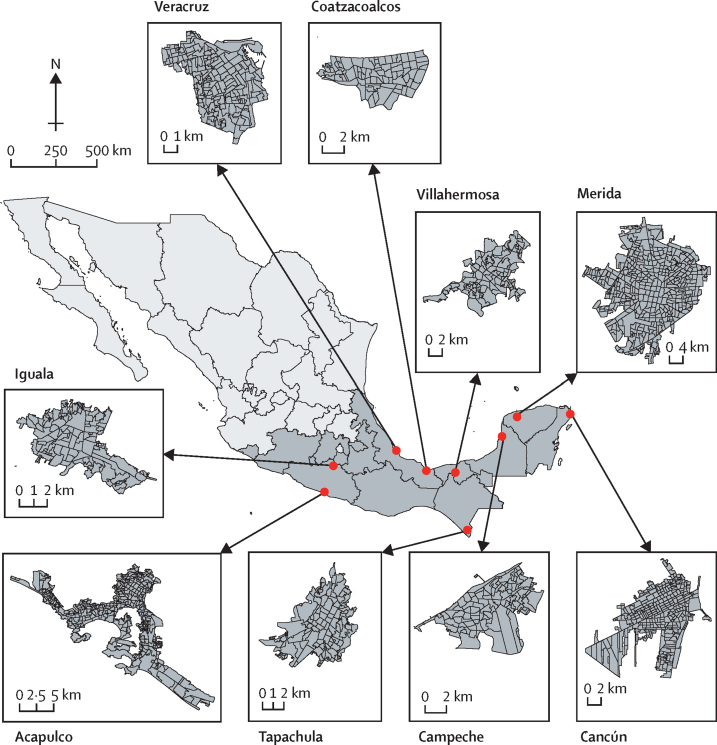
In this spatial analysis, geocoded cases of dengue, chikungunya, and Zika from nine endemic Mexican cities were aggregated at the census-tract level. We included cities that were located in southern Mexico (the arbovirus endemic region of Mexico), with a high burden of dengue cases (ie, more than 5000 cases reported during a 10-year period), and listed as high priority for the Mexican dengue control and prevention programme. The Getis-Ord Gi*(d) statistic was applied to yearly slices of the dataset to identify spatial hotspots of each disease in each city. We used Kendall's W coefficient to quantify the agreement in the distribution of each virus.
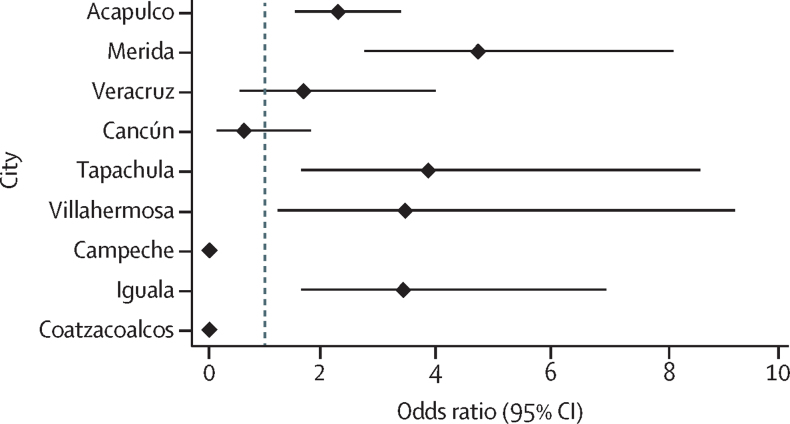
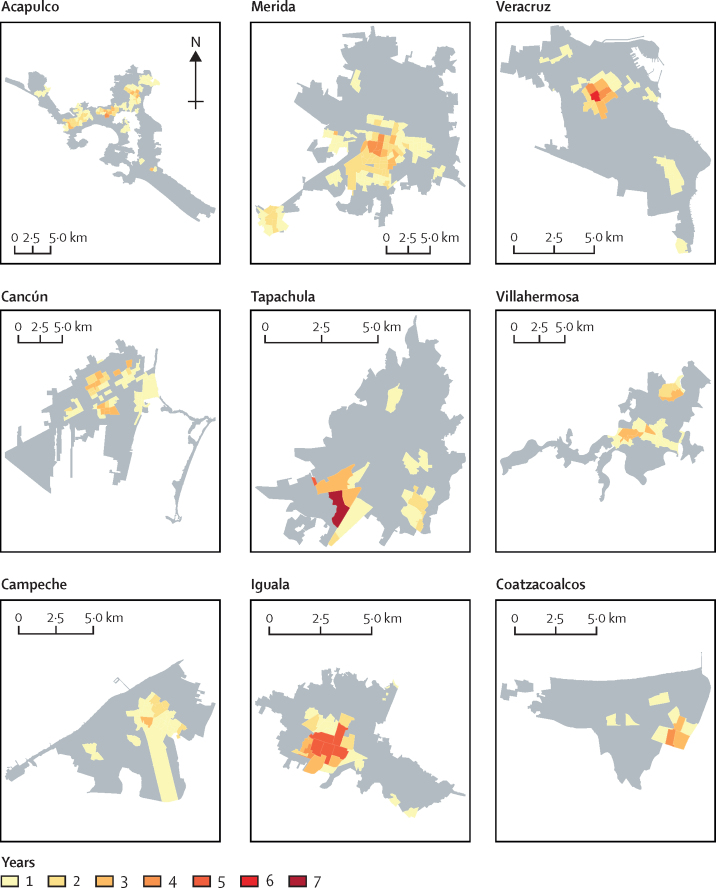
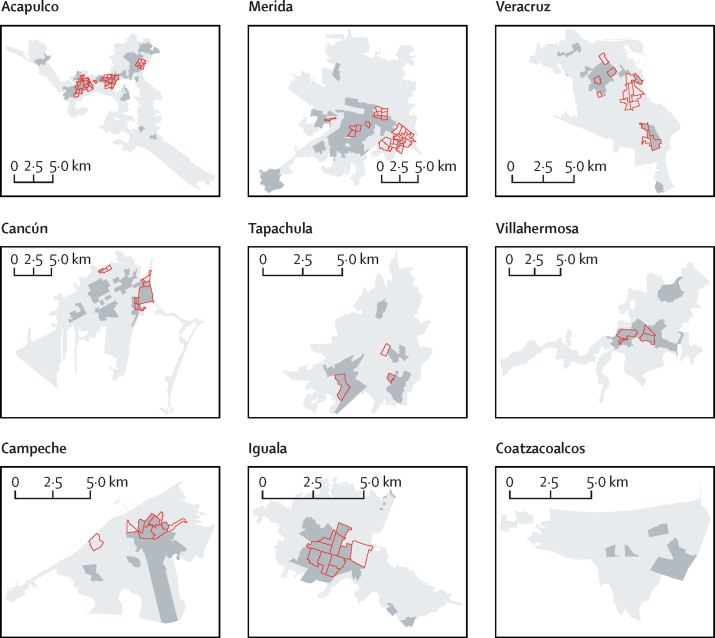
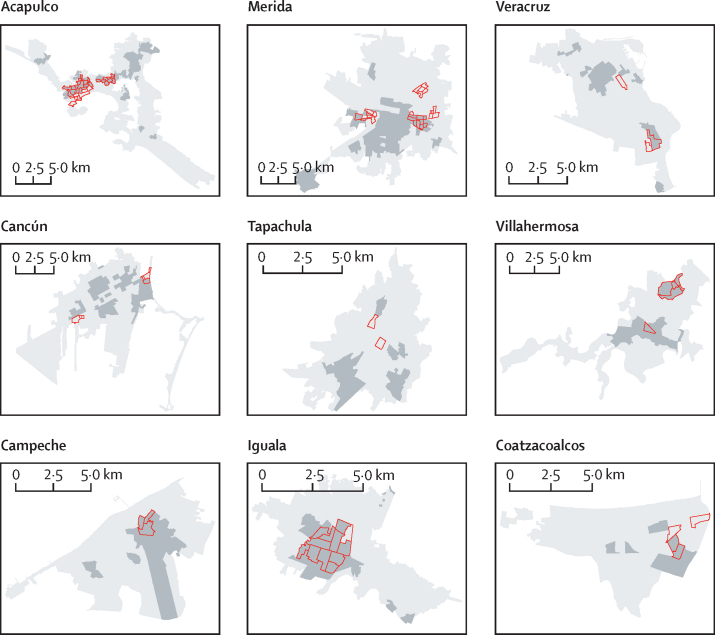
128 507 dengue, 4752 chikungunya and 25 755 Zika clinical cases were reported between Jan 1, 2008, and Dec 31, 2016. All cities showed evidence of transmission heterogeneity, with a mean of 17·6% (SD 4·7) of their total area identified as persistent disease hotspots. Hotspots accounted for 25·6% (SD 9·7; range 12·8-43·0) of the population and 32·1% (10·5; 19·6-50·5) of all Aedes-borne disease cases reported. We found an overlap between hotspots of 61·7% for dengue and Zika and 53·3% for dengue and chikungunya. Dengue hotspots in 2008-16 were significantly associated with dengue hotspots detected during 2017-20 in five of the nine cities. Heads of vector control confirmed hotspot areas as problem zones for arbovirus transmission.
This study provides evidence of the overlap of Aedes-borne diseases within geographical hotspots and a methodological framework for the stratification of arbovirus transmission risk within urban areas, which can guide the implementation of surveillance and vector control.
USAID, the US Centers for Disease Control and Prevention, the Canadian Institutes of Health Research, International Development Research Centre, Fondo Mixto CONACyT (Mexico)-Gobierno del Estado de Yucatan, and the US National Institutes of Health.
For the Spanish translation of the abstract see Supplementary Materials section.
有效控制埃及伊蚊受到一定限制,部分原因是难以实现足够的干预覆盖率。为了最大限度地提高病媒控制效果,可以确定并优先考虑持续存在大量埃及伊蚊传播疾病病例的地区,采取预防措施。本研究旨在确定墨西哥南部城市中持续存在的埃及伊蚊传播疾病热点地区。
在这项空间分析中,我们将来自墨西哥 9 个流行地区城市的登革热、基孔肯雅热和寨卡热病例进行了地理编码,并在普查区进行了汇总。我们纳入了位于墨西哥南部(墨西哥虫媒病毒流行地区)、登革热负担沉重(即 10 年间报告超过 5000 例病例)且被列为墨西哥登革热控制和预防计划高度优先地区的城市。我们应用 Getis-Ord Gi*(d)统计量对每年的数据集切片进行分析,以确定每个城市中每种疾病的空间热点。我们使用 Kendall's W 系数来量化每种病毒分布的一致性。
2008 年 1 月 1 日至 2016 年 12 月 31 日期间报告了 128507 例登革热、4752 例基孔肯雅热和 25755 例寨卡热临床病例。所有城市都显示出传播异质性的证据,其总面积的平均 17.6%(标准差 4.7)被确定为持续存在疾病的热点地区。热点地区占总人口的 25.6%(标准差 9.7;范围 12.8-43.0),占报告的所有埃及伊蚊传播疾病病例的 32.1%(10.5;19.6-50.5)。我们发现登革热和寨卡热热点地区之间存在 61.7%的重叠,登革热和基孔肯雅热热点地区之间存在 53.3%的重叠。在九个城市中,有五个城市的 2008-16 年登革热热点地区与 2017-20 年检测到的登革热热点地区存在显著关联。病媒控制负责人证实,热点地区是虫媒病毒传播的问题区域。
本研究提供了证据表明,在地理热点地区存在埃及伊蚊传播疾病的重叠,以及在城市地区分层虫媒病毒传播风险的方法框架,这可以指导监测和病媒控制的实施。
美国国际开发署、美国疾病控制与预防中心、加拿大卫生研究院、国际发展研究中心、墨西哥国家卫生研究院(CONACyT)-尤卡坦州政府基金、美国国立卫生研究院。