Department of Epidemiology and Global Health, Umeå University, Umeå, Sweden.
Department of Clinical Science, Obstetrics and Gynaecology, Umeå University, Umeå, Sweden.
BMC Public Health. 2023 May 26;23(1):976. doi: 10.1186/s12889-023-15829-y.
Abnormal birth weight - small for gestational age (SGA) and large for gestational age (LGA) - are important indicators for newborn health. Due to changes in lifestyle in recent decades, it is essential to keep up-to-date with the latest information on maternal factors linked to abnormal birth weight. The aim of this study is to investigate SGA and LGA in relation to maternal individual, lifestyle and socioeconomic characteristics. .
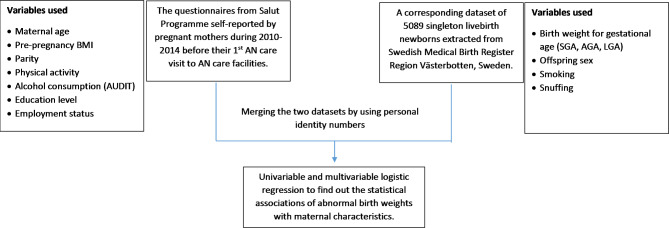
This is a register-based cross-sectional study. Self-reported data from Sweden's Salut Programme maternal questionnaires (2010-2014) were linked with records in the Swedish Medical Birth Register (MBR). The analytical sample comprised 5089 singleton live births. A Swedish standard method using ultrasound-based sex-specific reference curves defines the abnormality of birth weight in MBR. Univariable and multivariable logistic regressions were used to examine crude and adjusted associations between abnormal birth weights and maternal individual, lifestyle and socioeconomic characteristics. A sensitivity analysis, using alternative definitions of SGA and LGA under the percentile method, was undertaken.
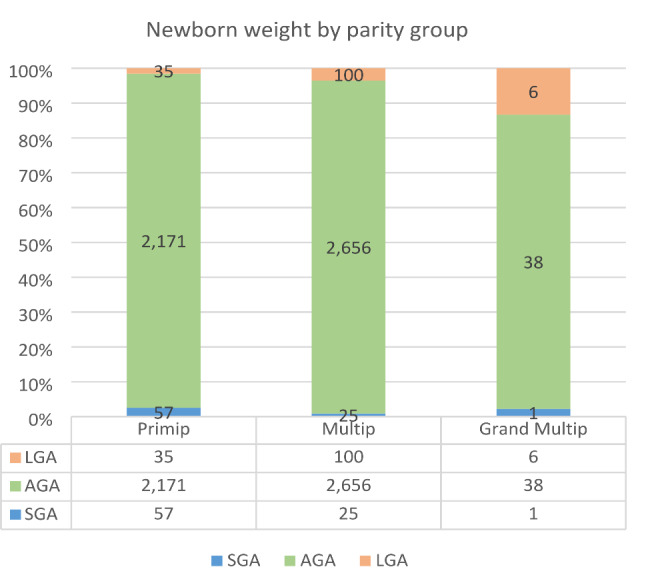
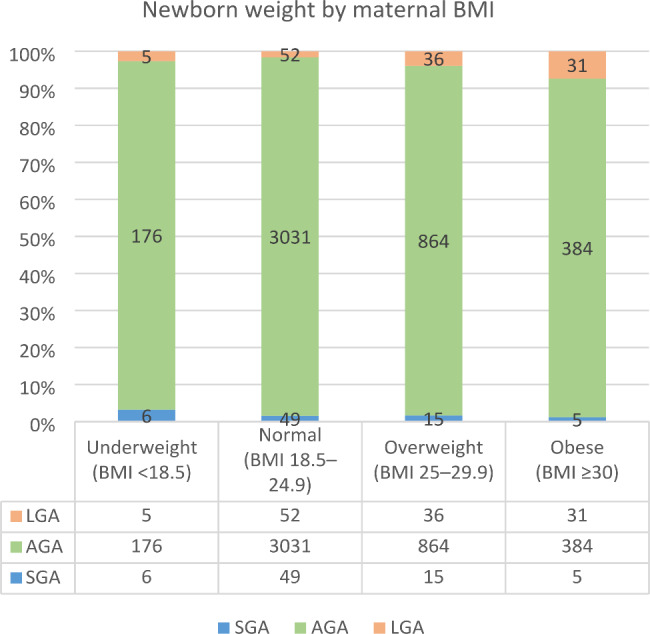
In multivariable logistic regression, maternal age and parity were associated with LGA (aOR = 1.05, CI = 1.00, 1.09) and (aOR = 1.31, CI = 1.09, 1.58). Maternal overweight and obesity were strongly associated with LGA (aOR = 2.28, CI = 1.47, 3.54) and (aOR = 4.55, CI = 2.85, 7.26), respectively. As parity increased, the odds of delivering SGA babies decreased (aOR = 0.59, CI = 0.42, 0.81) and preterm deliveries were associated with SGA (aOR = 9.46, CI = 5.67, 15.79). The well-known maternal determinants of abnormal birthweight, such as unhealthy lifestyles and poor socioeconomic factors, were not statistically significant in this Swedish setting.
The main findings suggest that multiparity, maternal pre-pregnancy overweight and obesity are strong determinants for LGA babies. Public health interventions should address modifiable risk factors, especially maternal overweight and obesity. These findings suggest that overweight and obesity is an emerging public health threat for newborn health. This might also result in the intergenerational transfer of overweight and obesity. These are important messages for public health policy and decision making.
异常出生体重 - 小于胎龄儿(SGA)和大于胎龄儿(LGA) - 是新生儿健康的重要指标。由于近几十年来生活方式的变化,及时了解与异常出生体重相关的最新孕产妇因素信息至关重要。本研究旨在探讨 SGA 和 LGA 与孕产妇个体、生活方式和社会经济特征的关系。
这是一项基于登记的横断面研究。将瑞典 Salut 计划孕产妇问卷(2010-2014 年)中的自报数据与瑞典医疗出生登记处(MBR)的记录相链接。分析样本包括 5089 例单胎活产。瑞典采用超声性别特异性参考曲线的标准方法来定义 MBR 中出生体重的异常。使用单变量和多变量逻辑回归检查异常出生体重与孕产妇个体、生活方式和社会经济特征之间的粗关联和调整关联。使用百分位法下替代 SGA 和 LGA 的定义进行了敏感性分析。
在多变量逻辑回归中,母亲年龄和产次与 LGA 相关(aOR=1.05,CI=1.00,1.09)和(aOR=1.31,CI=1.09,1.58)。母亲超重和肥胖与 LGA 强烈相关(aOR=2.28,CI=1.47,3.54)和(aOR=4.55,CI=2.85,7.26)。随着产次的增加,分娩 SGA 婴儿的几率降低(aOR=0.59,CI=0.42,0.81),早产与 SGA 相关(aOR=9.46,CI=5.67,15.79)。在这种瑞典环境中,出生体重异常的已知孕产妇决定因素,如不健康的生活方式和较差的社会经济因素,在统计学上并不显著。
主要发现表明,多产、母亲孕前超重和肥胖是 LGA 婴儿的重要决定因素。公共卫生干预措施应针对可改变的危险因素,特别是母亲超重和肥胖。这些发现表明,超重和肥胖是新生儿健康的一个新出现的公共卫生威胁。这也可能导致超重和肥胖在代际间传递。这些对公共卫生政策和决策制定具有重要意义。