Buonsenso Danilo, Valentini Piero, Mariani Francesco, Di Noi Silvia, Mazza Sofia, Palucci Ivana, Sanguinetti Maurizio, Sali Michela
Department of Woman and Child Health and Public Health, Fondazione Policlinico Universitario A Gemelli IRCCS, 00168 Rome, Italy.
Global Health Research Institute, Istituto di Igiene, Università Cattolica del Sacro Cuore, 00168 Rome, Italy.
Children (Basel). 2023 May 19;10(5):899. doi: 10.3390/children10050899.
During the COVID-19 pandemic, the use of salivary swabs (SS) to detect the SARS-CoV-2 virus has been implemented and widely studied in adults and children. However, the role of SS in detecting other common respiratory viruses in children is poorly investigated.
Children younger than 18 years of age admitted with respiratory signs and symptoms underwent both nasopharyngeal and SS procedures. Sensitivity, specificity, positive predictive value (PPV), and negative predictive value (NPV) of SS were calculated, considering the nasopharyngeal swab result as the gold standard.
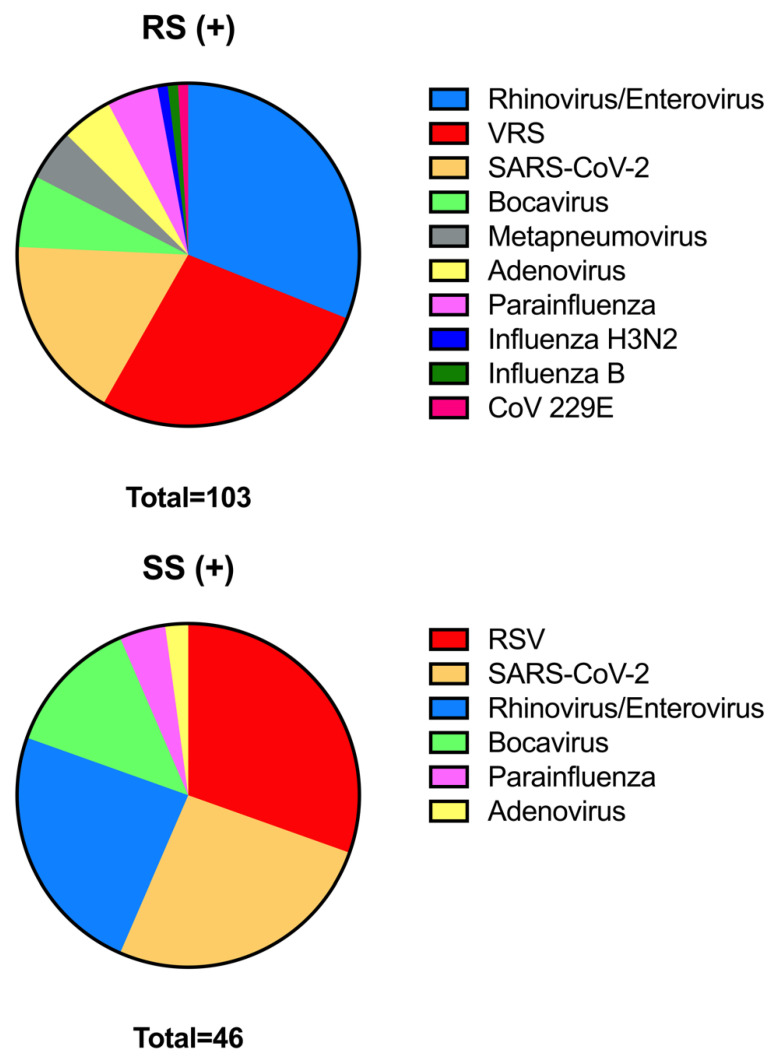
A total of 83 patients (44 females, 53%) underwent both nasopharyngeal and SS procedures. Overall, the sensitivity of SS was 49.4%. Sensitivity according to different respiratory viruses ranged from 0% to 71.43%, while the specificity ranged from 96% to 100%. Negative predictive value ranged from 68.06% to 98.8%, while positive predictive value ranged from 0 to 100%. SS sensitivity in patients younger than 12 months of age was 39.47%, while in patients older than or equal to 12 months of age it was 57.78%. Patients with negative SS had a significantly lower median age (8.5 months (15.25) vs. 23 months (34), = 0.001) and a significantly lower quantity of median saliva collected for salivary analysis (0 μL (213) vs. 300 μL (100), < 0.001).
SS has a relatively low sensitivity in detecting common respiratory viruses in children with LRTI, with a lower probability in younger children (and in particular those younger than 6 months of age) or those from whom we have collected lesser amounts of saliva. New strategies to improve saliva collection are needed for testing on a larger study population.
在新冠疫情期间,唾液拭子(SS)用于检测严重急性呼吸综合征冠状病毒2(SARS-CoV-2)病毒已在成人和儿童中得到应用并广泛研究。然而,SS在检测儿童其他常见呼吸道病毒方面的作用研究较少。
有呼吸道症状和体征的18岁以下儿童同时接受鼻咽拭子和唾液拭子检测。以鼻咽拭子检测结果为金标准,计算唾液拭子的敏感性、特异性、阳性预测值(PPV)和阴性预测值(NPV)。
共有83例患者(44例女性,占53%)同时接受了鼻咽拭子和唾液拭子检测。总体而言,唾液拭子的敏感性为49.4%。根据不同呼吸道病毒的敏感性范围为0%至71.43%,而特异性范围为96%至100%。阴性预测值范围为68.06%至98.8%,而阳性预测值范围为0至100%。12个月以下儿童唾液拭子的敏感性为39.47%,而12个月及以上儿童为57.78%。唾液拭子检测结果为阴性的患者中位年龄显著更低(8.5个月(标准差15.25)对23个月(标准差34),P = 0.001),且用于唾液分析的中位唾液采集量显著更少(0微升(标准差213)对300微升(标准差100),P < 0.001)。
唾液拭子在检测下呼吸道感染(LRTI)儿童常见呼吸道病毒方面敏感性相对较低,在年幼儿童(尤其是6个月以下儿童)或唾液采集量较少的儿童中检测概率更低。需要新的策略来改进唾液采集,以便在更大规模的研究人群中进行检测。