Department of Physiotherapy and Occupational Therapy, Copenhagen University Hospital-Bispebjerg and Frederiksberg, 2400 Copenhagen, Denmark.
Neurocognition and Emotion in Affective Disorders (NEAD) Centre, Department of Psychology, University of Copenhagen-Mental Health Services, Capital Region of Denmark, 1172 Copenhagen, Denmark.
Int J Environ Res Public Health. 2023 May 18;20(10):5866. doi: 10.3390/ijerph20105866.
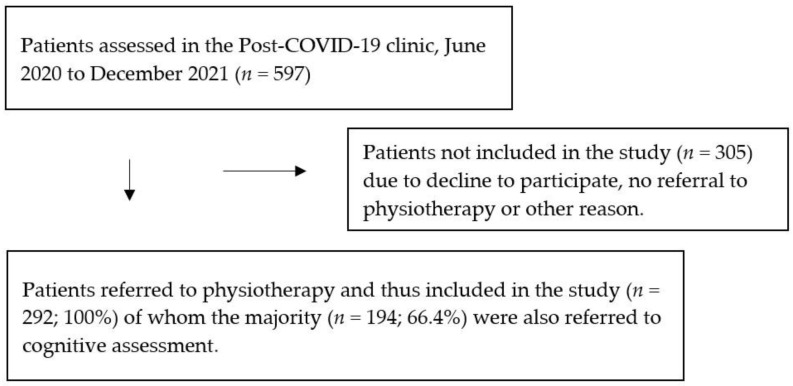
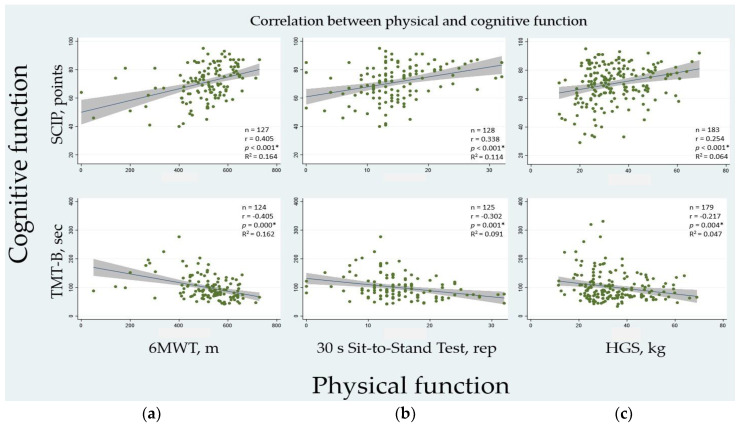
Patients with long-term health sequelae of COVID-19 (post-COVID-19 condition) experience both physical and cognitive manifestations. However, there is still uncertainty about the prevalence of physical impairment in these patients and whether there is a link between physical and cognitive function. The aim was to assess the prevalence of physical impairment and investigate the association with cognition in patients assessed in a post-COVID-19 clinic. In this cross-sectional study, patients referred to an outpatient clinic ≥ 3 months after acute infection underwent screening of their physical and cognitive function as part of a comprehensive multidisciplinary assessment. Physical function was assessed with the 6-Minute Walk Test, the 30 s Sit-to-Stand Test and by measuring handgrip strength. Cognitive function was assessed with the Screen for Cognitive Impairment in Psychiatry and the Trail Making Test-Part B. Physical impairment was tested by comparing the patients' performance to normative and expected values. Association with cognition was investigated using correlation analyses and the possible explanatory variables regarding physical function were assessed using regression analyses. In total, we included 292 patients, the mean age was 52 (±15) years, 56% were women and 50% had been hospitalised during an acute COVID-19 infection. The prevalence of physical impairment ranged from 23% in functional exercise capacity to 59% in lower extremity muscle strength and function. There was no greater risk of physical impairment in previously hospitalised compared with the non-hospitalised patients. There was a weak to moderate association between physical and cognitive function. The cognitive test scores had statistically significant prediction value for all three outcomes of physical function. In conclusion, physical impairments were prevalent amongst patients assessed for post-COVID-19 condition regardless of their hospitalisation status and these were associated with more cognitive dysfunction.
患有 COVID-19(新冠后)长期健康后遗症的患者会出现身体和认知方面的表现。然而,对于这些患者身体损伤的普遍程度以及身体和认知功能之间是否存在联系,仍存在不确定性。本研究旨在评估身体损伤的患病率,并调查在新冠后门诊评估的患者中,身体损伤与认知功能之间的关联。在这项横断面研究中,将急性感染后≥3 个月就诊的门诊患者作为研究对象,对其进行了身体和认知功能的筛查,作为全面多学科评估的一部分。身体功能通过 6 分钟步行测试、30 秒坐站测试和手握力测量来评估。认知功能通过精神科认知障碍筛查和连线测试 B 部分来评估。通过将患者的表现与正常值和预期值进行比较来测试身体损伤。使用相关分析来调查与认知的关联,并使用回归分析来评估与身体功能相关的可能解释变量。共纳入 292 名患者,平均年龄为 52(±15)岁,56%为女性,50%在急性 COVID-19 感染期间住院。身体损伤的患病率从功能性运动能力的 23%到下肢肌肉力量和功能的 59%不等。与非住院患者相比,曾住院的患者身体损伤的风险没有更高。身体和认知功能之间存在弱到中度的关联。认知测试分数对身体功能的所有三个结果都具有统计学显著的预测价值。总之,无论其住院状况如何,新冠后门诊评估的患者中普遍存在身体损伤,且这些损伤与更多的认知功能障碍相关。