• 文献检索
  • 文档翻译
  • 深度研究
  • 学术资讯
  • Suppr Zotero 插件Zotero 插件
  • 邀请有礼
  • 套餐&价格
  • 历史记录
应用&插件
Suppr Zotero 插件Zotero 插件浏览器插件Mac 客户端Windows 客户端微信小程序
定价
高级版会员购买积分包购买API积分包
服务
文献检索文档翻译深度研究API 文档MCP 服务
关于我们
关于 Suppr公司介绍联系我们用户协议隐私条款
关注我们

Suppr 超能文献

核心技术专利:CN118964589B侵权必究
粤ICP备2023148730 号-1Suppr @ 2026

文献检索

告别复杂PubMed语法,用中文像聊天一样搜索,搜遍4000万医学文献。AI智能推荐,让科研检索更轻松。

立即免费搜索

文件翻译

保留排版,准确专业,支持PDF/Word/PPT等文件格式,支持 12+语言互译。

免费翻译文档

深度研究

AI帮你快速写综述,25分钟生成高质量综述,智能提取关键信息,辅助科研写作。

立即免费体验

学龄前儿童中可能的睡眠磨牙症患病率及其与社会和口面部因素的关联。

Prevalence of Possible Sleep Bruxism and Its Association with Social and Orofacial Factors in Preschool Population.

作者信息

Diéguez-Pérez Montserrat, Ticona-Flores Jesús Miguel, Prieto-Regueiro Beatriz

机构信息

Department of Preclinical Dentistry, Faculty of Biomedical and Health Sciences, Universidad Europea de Madrid, Villaviciosa de Odón, 28670 Madrid, Spain.

Faculty of Biomedical and Health Sciences, Universidad Europea de Madrid, Villaviciosa de Odón, 28670 Madrid, Spain.

出版信息

Healthcare (Basel). 2023 May 16;11(10):1450. doi: 10.3390/healthcare11101450.

DOI:10.3390/healthcare11101450
PMID:37239736
原文链接:https://pmc.ncbi.nlm.nih.gov/articles/PMC10218582/
Abstract

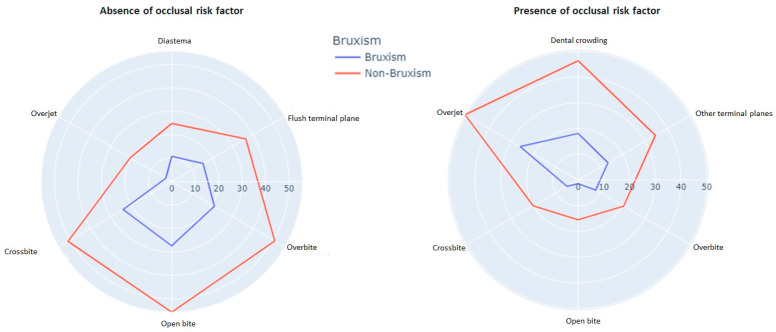
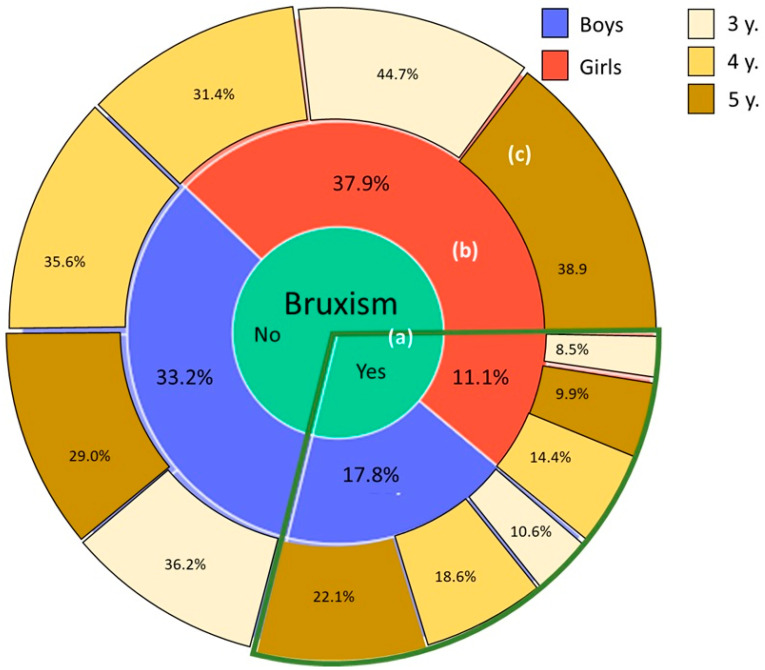
The prevalence of bruxism in the preschool population varies according to different investigations. The aim of this study was to investigate the prevalence of sleep bruxism and its relationship with social and orofacial factors in children aged 3 to 5 years. Three hundred forty-three preschool children were divided into two groups, one with nocturnal bruxism, as reported by parents, and another without this disorder. Questionnaires were distributed to the parents to determine the children's family social status and parafunctional habits at the time of the study. The clinical inspection confirmed the presence of certain parafunctional habits and the children's occlusal characteristics. The data obtained were analysed using descriptive statistics such as frequency chi-square tests to identify the influence of qualitative variables. Of the total sample, 28.9% of preschoolers presented sleep bruxism. The highest prevalence was observed in boys (61.6%) at the age of 5 years (41.4%). Characteristics associated with this pathology were lip incompetence, open bite, crossbite, and overbite, with < 0.05. Sleep bruxism in preschool children has a higher prevalence in boys and is more frequently expressed from 5 years of age. Open bite, overbite, and crossbite should be considered factors associated with parafunction.

摘要

根据不同调查,学龄前儿童磨牙症的患病率有所不同。本研究的目的是调查3至5岁儿童睡眠磨牙症的患病率及其与社会因素和口面部因素的关系。343名学龄前儿童被分为两组,一组是家长报告有夜间磨牙症的儿童,另一组是无此病症的儿童。在研究期间,向家长发放问卷以确定孩子的家庭社会地位和副功能习惯。临床检查确认了某些副功能习惯的存在以及儿童的咬合特征。使用描述性统计方法(如频率卡方检验)对获得的数据进行分析,以确定定性变量的影响。在总样本中,28.9%的学龄前儿童存在睡眠磨牙症。在5岁的男孩中患病率最高(61.6%)(41.4%)。与这种病症相关的特征是唇功能不全、开(牙合)、反(牙合)和深覆(牙合),P<0.05。学龄前儿童睡眠磨牙症在男孩中患病率较高,且在5岁起更频繁出现。开(牙合)、深覆(牙合)和反(牙合)应被视为与副功能相关的因素。
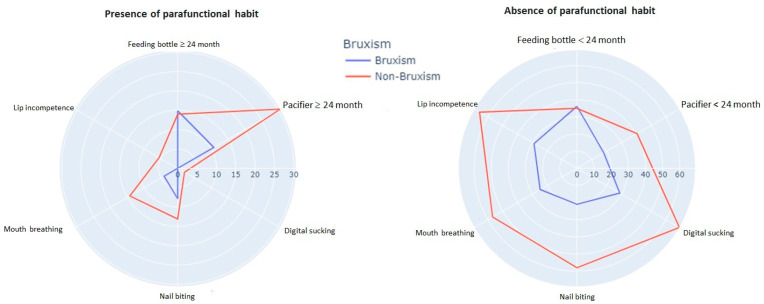
https://cdn.ncbi.nlm.nih.gov/pmc/blobs/6335/10218582/006088f6642e/healthcare-11-01450-g006.jpg
https://cdn.ncbi.nlm.nih.gov/pmc/blobs/6335/10218582/1e4ec3dddba8/healthcare-11-01450-g001.jpg
https://cdn.ncbi.nlm.nih.gov/pmc/blobs/6335/10218582/dc8b427f11bb/healthcare-11-01450-g002.jpg
https://cdn.ncbi.nlm.nih.gov/pmc/blobs/6335/10218582/022b9df57cdc/healthcare-11-01450-g003.jpg
https://cdn.ncbi.nlm.nih.gov/pmc/blobs/6335/10218582/dcce253bf96c/healthcare-11-01450-g004.jpg
https://cdn.ncbi.nlm.nih.gov/pmc/blobs/6335/10218582/6ad347b6b1b2/healthcare-11-01450-g005.jpg
https://cdn.ncbi.nlm.nih.gov/pmc/blobs/6335/10218582/006088f6642e/healthcare-11-01450-g006.jpg
https://cdn.ncbi.nlm.nih.gov/pmc/blobs/6335/10218582/1e4ec3dddba8/healthcare-11-01450-g001.jpg
https://cdn.ncbi.nlm.nih.gov/pmc/blobs/6335/10218582/dc8b427f11bb/healthcare-11-01450-g002.jpg
https://cdn.ncbi.nlm.nih.gov/pmc/blobs/6335/10218582/022b9df57cdc/healthcare-11-01450-g003.jpg
https://cdn.ncbi.nlm.nih.gov/pmc/blobs/6335/10218582/dcce253bf96c/healthcare-11-01450-g004.jpg
https://cdn.ncbi.nlm.nih.gov/pmc/blobs/6335/10218582/6ad347b6b1b2/healthcare-11-01450-g005.jpg
https://cdn.ncbi.nlm.nih.gov/pmc/blobs/6335/10218582/006088f6642e/healthcare-11-01450-g006.jpg

相似文献

1
Prevalence of Possible Sleep Bruxism and Its Association with Social and Orofacial Factors in Preschool Population.学龄前儿童中可能的睡眠磨牙症患病率及其与社会和口面部因素的关联。
Healthcare (Basel). 2023 May 16;11(10):1450. doi: 10.3390/healthcare11101450.
2
The prevalence of posterior crossbite, deep bite, and sleep or awake bruxism in temporomandibular disorder (TMD) patients compared to a non-TMD population: A retrospective study.颞下颌关节紊乱病(TMD)患者与非 TMD 人群相比,后牙反合、深覆合和睡眠或清醒时磨牙症的患病率:一项回顾性研究。
Cranio. 2021 Sep;39(5):398-404. doi: 10.1080/08869634.2019.1650217. Epub 2019 Aug 2.
3
Association between posterior crossbite and/or deep bite and temporomandibular disorders among Palestinian adolescents: A sex comparison.巴勒斯坦青少年中后牙反合和/或深覆合与颞下颌关节紊乱之间的关联:性别比较
Cranio. 2021 Jan;39(1):29-34. doi: 10.1080/08869634.2019.1574962. Epub 2019 Feb 7.
4
Bruxism in children and transverse plane of occlusion: is there a relationship or not?儿童磨牙症与咬合横平面:是否存在关联?
Dental Press J Orthod. 2014 Sep-Oct;19(5):67-73. doi: 10.1590/2176-9451.19.5.067-073.oar.
5
Association of gender, oral habits, and poor sleep quality with possible sleep bruxism in schoolchildren.性别、口腔习惯和睡眠质量差与儿童可能发生的睡眠磨牙症的关系。
Braz Oral Res. 2020 Mar 16;34:e019. doi: 10.1590/1807-3107bor-2020.vol34.0019. eCollection 2020.
6
Sleep bruxism associated with obstructive sleep apnea syndrome in children.儿童阻塞性睡眠呼吸暂停综合征相关的睡眠磨牙症
Cranio. 2015 Oct;33(4):251-5. doi: 10.1080/08869634.2015.1097299. Epub 2015 Dec 29.
7
Factors associated with preschool children's sleep bruxism.与学龄前儿童磨牙症相关的因素。
Cranio. 2024 Jan;42(1):48-54. doi: 10.1080/08869634.2021.1903663. Epub 2021 Mar 25.
8
Mother's Work Status on Children's Bruxism in a Subset of Saudi Population.沙特部分人群中母亲的工作状态与儿童磨牙症的关系
J Int Soc Prev Community Dent. 2017 Nov;7(Suppl 3):S170-S178. doi: 10.4103/jispcd.JISPCD_384_17. Epub 2017 Nov 30.
9
Relationship between orofacial function, dentofacial morphology, and bite force in young subjects.年轻受试者口腔面部功能、牙颌面形态与咬合力之间的关系。
Oral Dis. 2014 Sep;20(6):567-73. doi: 10.1111/odi.12174. Epub 2013 Sep 19.
10
Probable Sleep Bruxism in Children and its Relationship with Harmful Oral Habits, Type of Crossbite and Oral Breathing.儿童可能存在的睡眠磨牙症及其与有害口腔习惯、反咬合类型和口呼吸的关系。
J Clin Pediatr Dent. 2020;44(1):66-69. doi: 10.17796/1053-4625-44.1.12.

引用本文的文献

1
Clinical Manifestations of Temporomandibular Disorders and Their Relationship with Sleep Disturbances and Emotional Disorders in a Spanish Pediatric Population: A Cross-Sectional Study.西班牙儿科人群颞下颌关节紊乱病的临床表现及其与睡眠障碍和情绪障碍的关系:一项横断面研究
J Clin Med. 2025 May 21;14(10):3599. doi: 10.3390/jcm14103599.
2
Global Prevalence of Sleep Bruxism and Awake Bruxism in Pediatric and Adult Populations: A Systematic Review and Meta-Analysis.儿童和成人人群中睡眠磨牙症和清醒磨牙症的全球患病率:一项系统评价和荟萃分析。
J Clin Med. 2024 Jul 22;13(14):4259. doi: 10.3390/jcm13144259.
3
Prevalence and Characteristics of Sleep Disorders in Children Aged 7-17: Insights from Parental Observations at the Dental Office.

本文引用的文献

1
Prevalence of Bruxism in Brazilian Children: A Systematic Review and Meta-Analysis.巴西儿童磨牙症的患病率:系统评价和荟萃分析。
Pediatr Dent. 2022 Jan 15;44(1):8-20.
2
Investigating the effect of bruxism on maxillary arch length and width in children using three-dimensional digital model analysis.运用三维数字模型分析探讨磨牙症对儿童上颌弓长度和宽度的影响。
Prog Orthod. 2022 Jan 10;23(1):2. doi: 10.1186/s40510-021-00396-y.
3
Management of idiopathic sleep bruxism in children and adolescents: A systematic review of the literature.
7至17岁儿童睡眠障碍的患病率及特征:来自牙科诊所家长观察的见解
Children (Basel). 2024 May 20;11(5):609. doi: 10.3390/children11050609.
儿童和青少年特发性睡眠磨牙症的管理:文献系统综述。
Arch Pediatr. 2022 Jan;29(1):12-20. doi: 10.1016/j.arcped.2021.11.014. Epub 2021 Dec 23.
4
Sleep Bruxism in Children: Etiology, Diagnosis, and Treatment-A Literature Review.儿童磨牙症:病因、诊断和治疗——文献综述。
Int J Environ Res Public Health. 2021 Sep 10;18(18):9544. doi: 10.3390/ijerph18189544.
5
A world panorama of bruxism in children and adolescents with emphasis on associated sleep features: A bibliometric analysis.以相关睡眠特征为重点的儿童和青少年磨牙症世界全景:文献计量分析
J Oral Rehabil. 2021 Nov;48(11):1271-1282. doi: 10.1111/joor.13249. Epub 2021 Sep 15.
6
Prevalence of clinical signs and symptoms of the masticatory system and their associations in children with sleep bruxism: A systematic review and meta-analysis.磨牙症儿童咀嚼系统临床体征和症状的流行情况及其相关性:系统评价和荟萃分析。
Sleep Med Rev. 2021 Jun;57:101468. doi: 10.1016/j.smrv.2021.101468. Epub 2021 Mar 12.
7
Factors associated with preschool children's sleep bruxism.与学龄前儿童磨牙症相关的因素。
Cranio. 2024 Jan;42(1):48-54. doi: 10.1080/08869634.2021.1903663. Epub 2021 Mar 25.
8
Breathing problems, being an only child and having parents with possible sleep bruxism are associated with probable sleep bruxism in preschoolers: a population-based study.呼吸问题、独生子女身份以及父母可能患有睡眠磨牙症与学龄前儿童可能患睡眠磨牙症有关:一项基于人群的研究。
Sleep Breath. 2021 Sep;25(3):1677-1684. doi: 10.1007/s11325-020-02281-0. Epub 2021 Jan 4.
9
Genetic Polymorphisms in Contribute to the Etiology of Bruxism in Children.基因多态性与儿童磨牙症的病因有关。
J Clin Pediatr Dent. 2020;44(3):180-184. doi: 10.17796/1053-4625-44.3.8. Epub 2020 Jun 17.
10
Wake-Up Headache Is Associated With Sleep Bruxism.觉醒性头痛与睡眠磨牙症有关。
Headache. 2020 May;60(5):974-980. doi: 10.1111/head.13816. Epub 2020 Apr 22.