Guangdong Provincial Key Laboratory of Autophagy and Major Chronic Non-Communicable Diseases, Institute of Nephrology, Affiliated Hospital of Guangdong Medical University, Zhanjiang 524001, China.
Int J Mol Sci. 2023 May 11;24(10):8593. doi: 10.3390/ijms24108593.
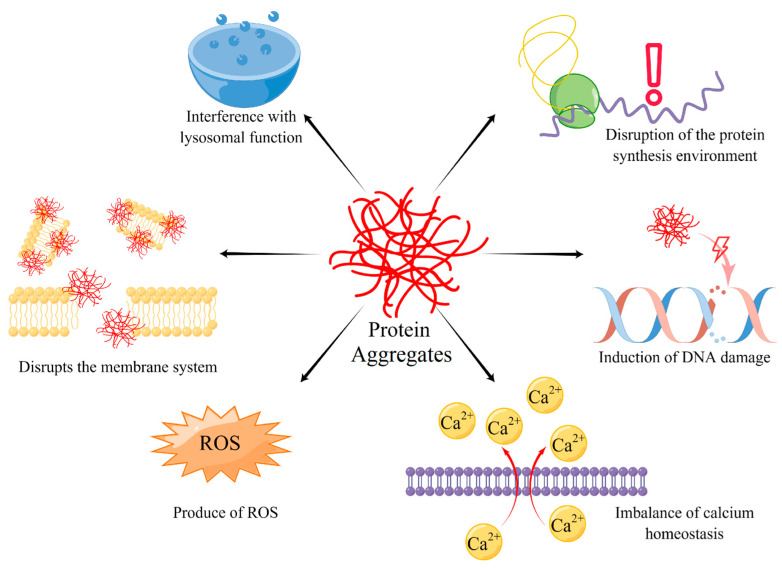
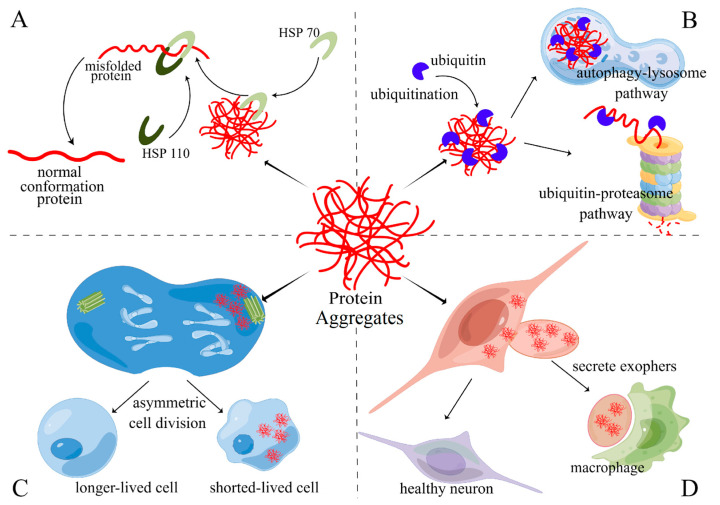
The accumulation of protein aggregates is the hallmark of many neurodegenerative diseases. The dysregulation of protein homeostasis (or proteostasis) caused by acute proteotoxic stresses or chronic expression of mutant proteins can lead to protein aggregation. Protein aggregates can interfere with a variety of cellular biological processes and consume factors essential for maintaining proteostasis, leading to a further imbalance of proteostasis and further accumulation of protein aggregates, creating a vicious cycle that ultimately leads to aging and the progression of age-related neurodegenerative diseases. Over the long course of evolution, eukaryotic cells have evolved a variety of mechanisms to rescue or eliminate aggregated proteins. Here, we will briefly review the composition and causes of protein aggregation in mammalian cells, systematically summarize the role of protein aggregates in the organisms, and further highlight some of the clearance mechanisms of protein aggregates. Finally, we will discuss potential therapeutic strategies that target protein aggregates in the treatment of aging and age-related neurodegenerative diseases.
蛋白质聚集体的积累是许多神经退行性疾病的标志。急性蛋白毒性应激或慢性表达突变蛋白引起的蛋白质平衡(或蛋白质稳态)失调可导致蛋白质聚集。蛋白质聚集体可以干扰各种细胞生物学过程,并消耗维持蛋白质稳态所必需的因素,导致蛋白质稳态进一步失衡和蛋白质聚集体进一步积累,形成一个恶性循环,最终导致衰老和与年龄相关的神经退行性疾病的进展。在漫长的进化过程中,真核细胞已经进化出多种机制来拯救或消除聚集的蛋白质。在这里,我们将简要回顾哺乳动物细胞中蛋白质聚集的组成和原因,系统总结蛋白质聚集体在生物体中的作用,并进一步强调蛋白质聚集体的一些清除机制。最后,我们将讨论针对蛋白质聚集的潜在治疗策略,以治疗衰老和与年龄相关的神经退行性疾病。