González-Mingot Cristina, Miana-Mena Francisco Javier, Iñarrea Pedro José, Iñiguez Cristina, Capablo José Luis, Osta Rosario, Gil-Sánchez Anna, Brieva Luis, Larrodé Pilar
Neurology-Department, Hospital Arnau de Vilanova of Lleida, 25198 Lleida, Spain.
LAGENBIO-Centro de Investigación Biomédica en Red de Enfermedades Neurodegenerativas (CIBERNED), Aragon Institute for Health Research (IIS Aragon), Zaragoza University, 50013 Zaragoza, Spain.
J Clin Med. 2023 May 19;12(10):3560. doi: 10.3390/jcm12103560.
Amyotrophic lateral sclerosis (ALS) is a multisystemic, progressive, neurodegenerative disorder. Despite it being generally fatal within a period of 2-4 years, it is highly heterogeneous; as a result, survival periods may vary greatly among individual patients. Biomarkers can serve as tools for diagnosis, prognosis, indicators of therapeutic response, and future therapeutics. Free-radical-dependent mitochondrial damage is believed to play a crucial role in neurodegeneration in ALS. Mitochondrial aconitase, which is also known as aconitase 2 (Aco2), is a key Krebs cycle enzyme and is involved in the regulation of cellular metabolism and iron homeostasis. Aco2 is very sensitive to oxidative inactivation and can aggregate and accumulate in the mitochondrial matrix, causing mitochondrial dysfunction. Loss of Aco2 activity may therefore reflect increased levels of mitochondrial dysfunction due to oxidative damage and could be relevant to ALS pathogenesis. The aim of our study was to confirm changes in mitochondrial aconitase activity in peripheral blood and to determine whether such changes are dependent on, or independent of, the patient's condition and to propose the feasibility of using them as possible valid biomarkers to quantify the progression of the disease and as a predictor of individual prognosis in ALS.
We measured the Aco2 enzymatic activity in the platelets of blood samples taken from 22 controls and 26 ALS patients at different stages of disease development. We then correlated antioxidant activity with clinical and prognostic variables.
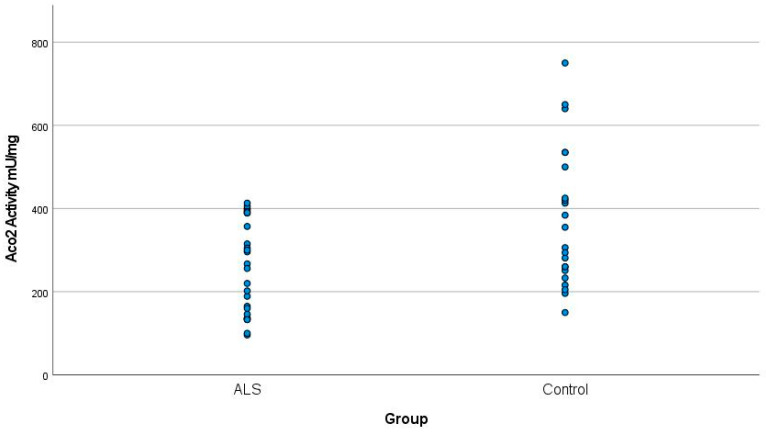
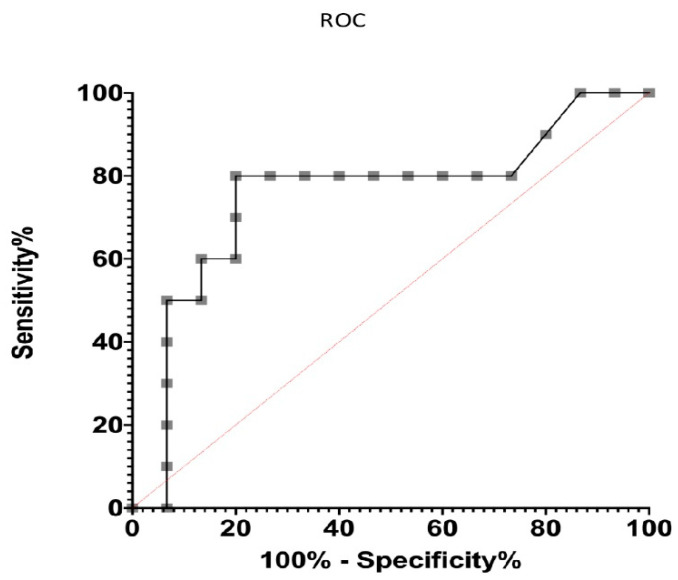
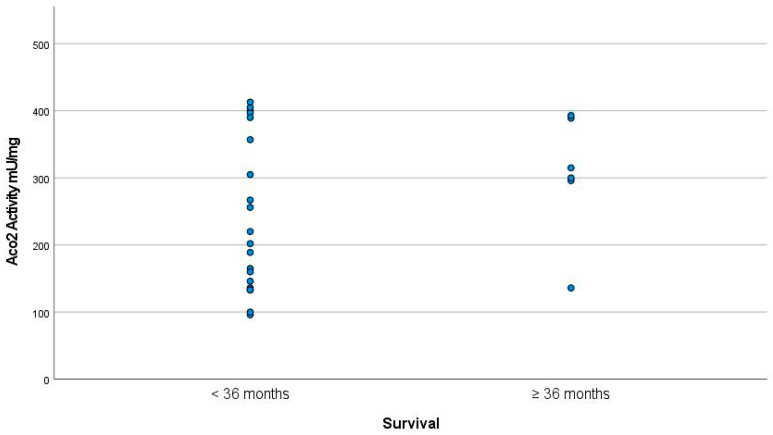
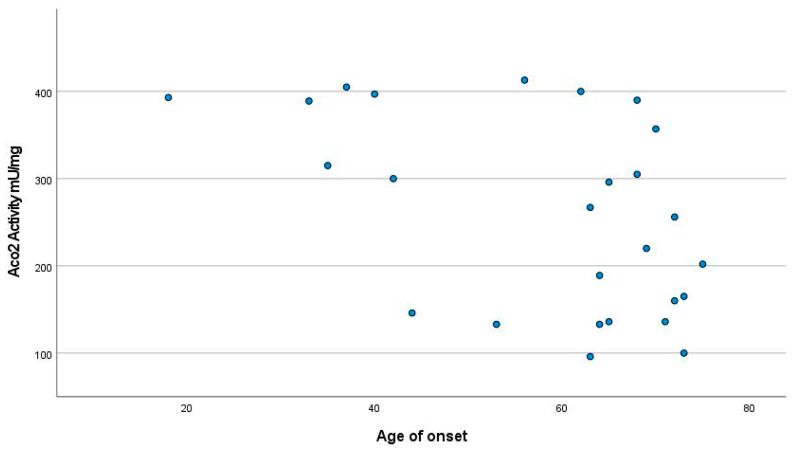
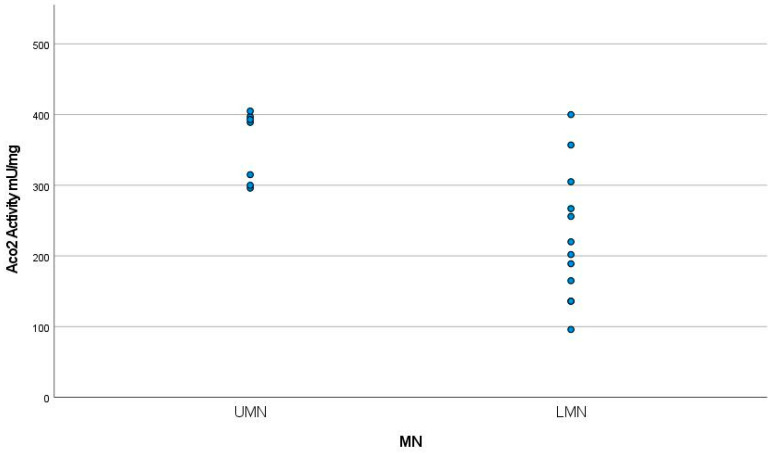
Aco2 activity was significantly lower in the 26 ALS patients than in the 22 controls ( < 0.05). Patients with higher levels of Aco2 activity survived longer than those with lower levels ( < 0.05). Aco2 activity was also higher in patients with earlier onset ( < 0.05) and in those with predominantly upper motor neuron signs.
Aco2 activity seems to be an independent factor that could be used in the long-term survival prognosis of ALS. Our findings suggest that blood Aco2 could be a leading candidate for use as a biomarker to improve prognosis. More studies are needed to confirm these results.
肌萎缩侧索硬化症(ALS)是一种多系统、进行性神经退行性疾病。尽管通常在2至4年内致命,但它具有高度异质性;因此,个体患者的生存期可能有很大差异。生物标志物可作为诊断、预后、治疗反应指标及未来治疗手段的工具。自由基依赖性线粒体损伤被认为在ALS的神经退行性变中起关键作用。线粒体乌头酸酶,也称为乌头酸酶2(Aco2),是三羧酸循环的关键酶,参与细胞代谢和铁稳态的调节。Aco2对氧化失活非常敏感,可在线粒体基质中聚集和积累,导致线粒体功能障碍。因此,Aco2活性的丧失可能反映由于氧化损伤导致的线粒体功能障碍水平升高,并且可能与ALS发病机制相关。我们研究的目的是确认外周血中线粒体乌头酸酶活性的变化,并确定这些变化是否取决于患者病情或与之无关,并提出将其用作可能有效的生物标志物以量化疾病进展及作为ALS个体预后预测指标的可行性。
我们测量了从22名对照者和26名处于疾病发展不同阶段的ALS患者采集的血样中血小板的Aco2酶活性。然后我们将抗氧化活性与临床和预后变量进行关联。
26名ALS患者的Aco2活性显著低于22名对照者(<0.05)。Aco2活性较高的患者比活性较低的患者生存期更长(<0.05)。发病较早的患者以及以上运动神经元体征为主的患者Aco2活性也较高(<0.05)。
Aco2活性似乎是一个可用于ALS长期生存预后的独立因素。我们的研究结果表明,血液中的Aco2可能是用作改善预后生物标志物的主要候选物。需要更多研究来证实这些结果。