Mokaleng Baitshepi, Choga Wonderful Tatenda, Bareng Ontlametse Thato, Maruapula Dorcas, Ditshwanelo Doreen, Kelentse Nametso, Mokgethi Patrick, Moraka Natasha Onalenna, Motswaledi Modisa Sekhamo, Tawe Leabaneng, Koofhethile Catherine Kegakilwe, Moyo Sikhulile, Zachariah Matshediso, Gaseitsiwe Simani
Botswana Harvard AIDS Institute Partnership for HIV Research and Education, Gaborone 999106, Botswana.
School of Allied Health Professions, Faculty of Health Sciences, University of Botswana, Gaborone 999106, Botswana.
Vaccines (Basel). 2023 May 19;11(5):1000. doi: 10.3390/vaccines11051000.
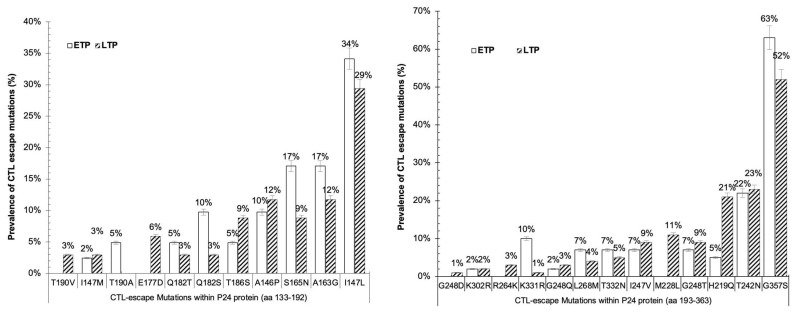
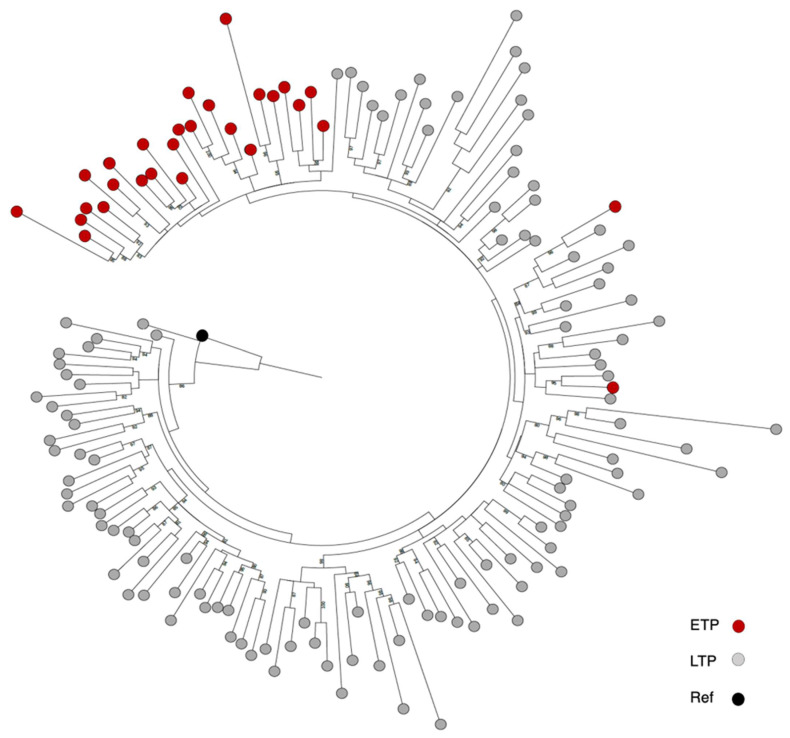
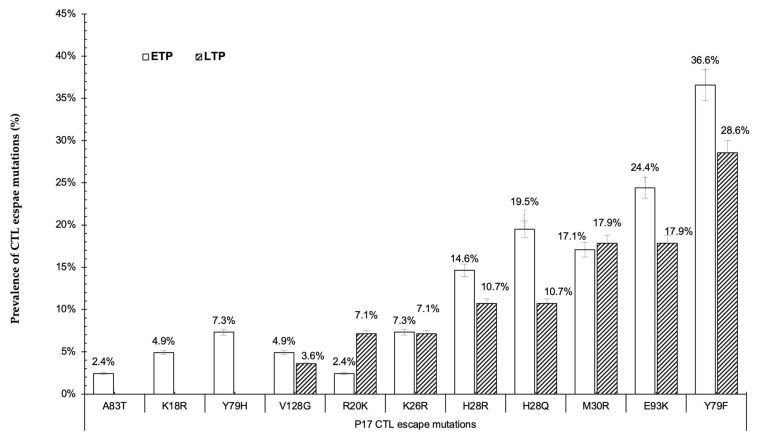
HIV is known to accumulate escape mutations in the gene in response to the immune response from cytotoxic T lymphocytes (CTLs). These mutations can occur within an individual as well as at a population level. The population of Botswana exhibits a high prevalence of HLAB57 and HLAB58, which are associated with effective immune control of HIV. In this retrospective cross-sectional investigation, HIV-1 gene sequences were analyzed from recently infected participants across two time periods which were 10 years apart: the early time point (ETP) and late time point (LTP). The prevalence of CTL escape mutations was relatively similar between the two time points-ETP (10.6%) and LTP (9.7%). The P17 protein had the most mutations (9.4%) out of the 36 mutations that were identified. Three mutations (A83T, K18R, Y79H) in P17 and T190A in P24 were unique to the ETP sequences at a prevalence of 2.4%, 4.9%, 7.3%, and 5%, respectively. Mutations unique to the LTP sequences were all in the P24 protein, including T190V (3%), E177D (6%), R264K (3%), G248D (1%), and M228L (11%). Mutation K331R was statistically higher in the ETP (10%) compared to the LTP (1%) sequences ( < 0.01), while H219Q was higher in the LTP (21%) compared to the ETP (5%) ( < 0.01). Phylogenetically, the sequences clustered dependently on the time points. We observed a slower adaptation of HIV-1C to CTL immune pressure at a population level in Botswana. These insights into the genetic diversity and sequence clustering of HIV-1C can aid in the design of future vaccine strategies.
众所周知,人类免疫缺陷病毒(HIV)会针对细胞毒性T淋巴细胞(CTL)的免疫反应在基因中积累逃逸突变。这些突变既可能在个体内部发生,也可能在群体层面出现。博茨瓦纳人群中HLAB57和HLAB58的流行率很高,这两种基因与对HIV的有效免疫控制相关。在这项回顾性横断面调查中,对相隔10年的两个时间段内近期感染参与者的HIV-1基因序列进行了分析:早期时间点(ETP)和晚期时间点(LTP)。两个时间点——ETP(10.6%)和LTP(9.7%)——之间CTL逃逸突变的流行率相对相似。在已识别的36个突变中,P17蛋白的突变最多(9.4%)。P17中的三个突变(A83T、K18R、Y79H)和P24中的T190A是ETP序列特有的,流行率分别为2.4%、4.9%、7.3%和5%。LTP序列特有的突变都在P24蛋白中,包括T190V(3%)、E177D(6%)、R264K(3%)、G248D(1%)和M228L(11%)。突变K331R在ETP序列中的发生率(10%)在统计学上高于LTP序列(1%)(P<0.01),而H219Q在LTP序列中的发生率(21%)高于ETP序列(5%)(P<0.01)。从系统发育角度看,基因序列根据时间点聚类。我们观察到在博茨瓦纳的群体层面,HIV-1C对CTL免疫压力的适应性较慢。这些对HIV-1C基因多样性和序列聚类的见解有助于未来疫苗策略的设计。