Laboratoire de Virologie, Institut des Agents Infectieux, Laboratoire Associé Au Centre National de Référence des Virus des Infections Respiratoires, Hospices Civils de Lyon, F-69317 Lyon, France.
CIRI, Centre International de Recherche en Infectiologie, Team VirPath, Univ Lyon, Inserm, U1111, Université Claude Bernard Lyon 1, CNRS, UMR5308, ENS de Lyon, F-69007 Lyon, France.
Viruses. 2023 Apr 24;15(5):1041. doi: 10.3390/v15051041.
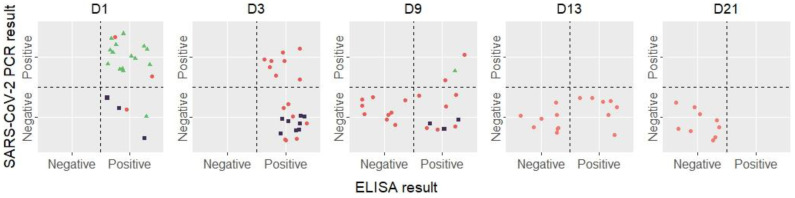
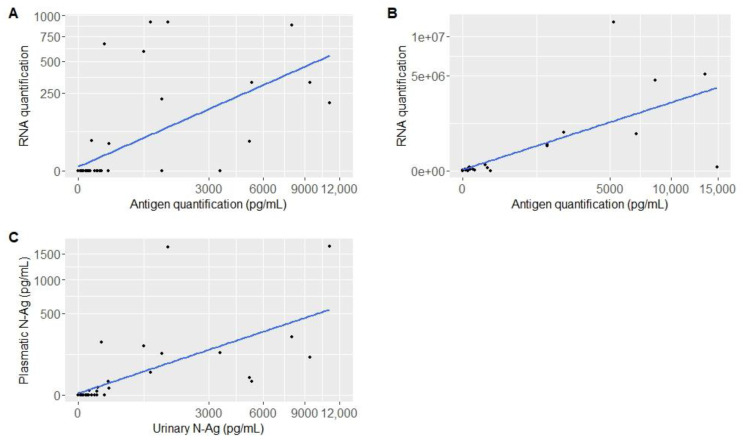
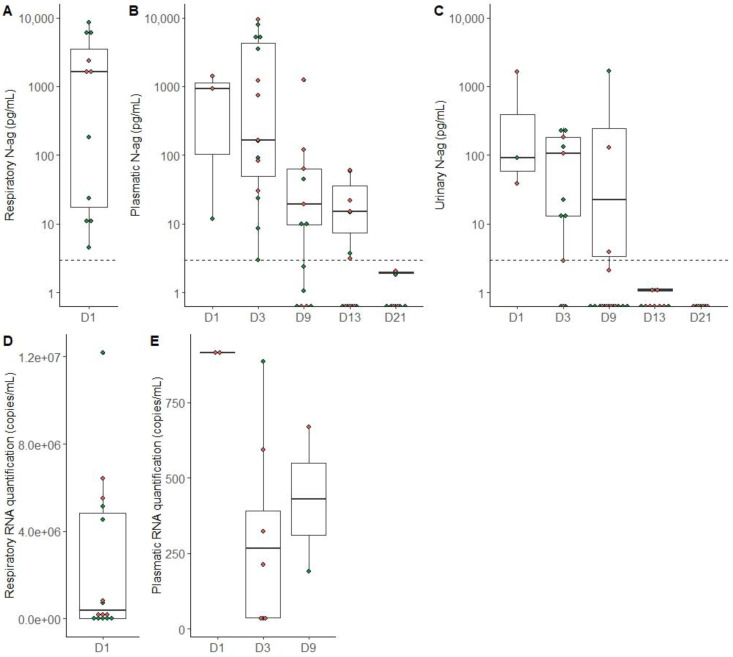
Qualitative SARS-CoV-2 antigen assays based on immunochromatography are useful for mass diagnosis of COVID-19, even though their sensitivity is poor in comparison with RT-PCR assays. In addition, quantitative assays could improve antigenic test performance and allow testing with different specimens. Using quantitative assays, we tested 26 patients for viral RNA and N-antigen in respiratory samples, plasma and urine. This allowed us to compare the kinetics between the three compartments and to compare RNA and antigen concentrations in each. Our results showed the presence of N-antigen in respiratory (15/15, 100%), plasma (26/59, 44%) and urine (14/54, 28.9%) samples, whereas RNA was only detected in respiratory (15/15, 100%) and plasma (12/60, 20%) samples. We detected N-antigen in urine and plasma samples until the day 9 and day 13 post-inclusion, respectively. The antigen concentration was found to correlate with RNA levels in respiratory ( < 0.001) and plasma samples ( < 0.001). Finally, urinary antigen levels correlated with plasma levels ( < 0.001). Urine N-antigen detection could be part of the strategy for the late diagnosis and prognostic evaluation of COVID-19, given the ease and painlessness of sampling and the duration of antigen excretion in this biological compartment.
基于免疫层析的定性 SARS-CoV-2 抗原检测对于 COVID-19 的大规模诊断很有用,尽管其灵敏度与 RT-PCR 检测相比较差。此外,定量检测可以提高抗原检测性能,并允许使用不同的样本进行检测。使用定量检测,我们在呼吸道样本、血浆和尿液中检测了 26 名患者的病毒 RNA 和 N 抗原。这使我们能够比较三个隔室之间的动力学,并比较每个隔室中的 RNA 和抗原浓度。我们的结果表明,N 抗原存在于呼吸道(15/15,100%)、血浆(26/59,44%)和尿液(14/54,28.9%)样本中,而 RNA 仅存在于呼吸道(15/15,100%)和血浆(12/60,20%)样本中。我们分别在感染后第 9 天和第 13 天检测到尿和血浆样本中的 N 抗原。发现抗原浓度与呼吸道( < 0.001)和血浆样本( < 0.001)中的 RNA 水平相关。最后,尿抗原水平与血浆水平相关( < 0.001)。鉴于采样的简便性和无痛性以及该生物隔室中抗原排泄的持续时间,尿液 N 抗原检测可作为 COVID-19 晚期诊断和预后评估策略的一部分。