Hingrat Quentin LE, Visseaux Benoit, Laouenan Cédric, Tubiana Sarah, Bouadma Lila, Yazdanpanah Yazdan, Duval Xavier, Burdet Charles, Ichou Houria, Damond Florence, Bertine Mélanie, Benmalek Nabil, Choquet Christophe, Timsit Jean-François, Ghosn Jade, Charpentier Charlotte, Descamps Diane, Houhou-Fidouh Nadhira
Université de Paris, IAME, INSERM, Paris, France; Virology, Assistance Publique-Hôpitaux de Paris, Bichat-Claude Bernard University Hospital, Paris, France.
Université de Paris, IAME, INSERM, Paris, France; Virology, Assistance Publique-Hôpitaux de Paris, Bichat-Claude Bernard University Hospital, Paris, France.
Clin Microbiol Infect. 2020 Dec 8;27(5):789.e1-5. doi: 10.1016/j.cmi.2020.11.025.
Molecular assays on nasopharyngeal swabs remain the cornerstone of COVID-19 diagnostic. The high technicalities of nasopharyngeal sampling and molecular assays, as well as scarce resources of reagents, limit our testing capabilities. Several strategies failed, to date, to fully alleviate this testing process (e.g. saliva sampling or antigen testing on nasopharyngeal samples). We assessed the clinical performances of SARS-CoV-2 nucleocapsid antigen (N-antigen) ELISA detection in serum or plasma using the COVID-19 Quantigene® (AAZ, France) assay.
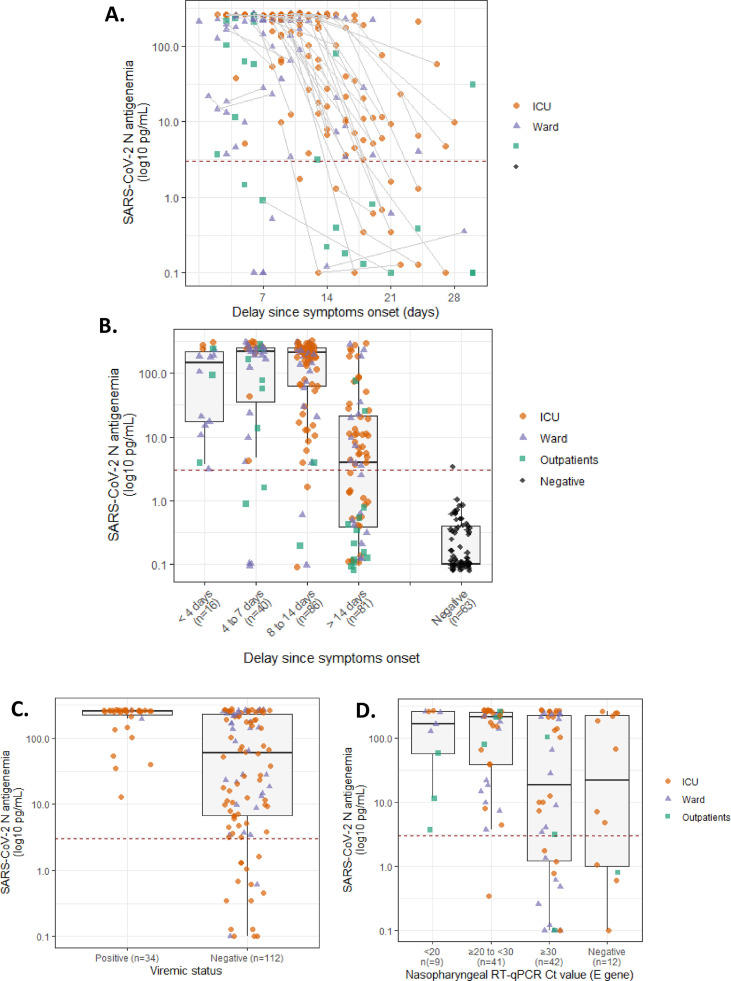
Performances were determined on 63 sera from 63 non-COVID patients and 227 serum samples (165 patients) from the French COVID and CoV-CONTACT cohorts with RT-PCR confirmed SARS-CoV-2 infection, including 142 serum (114 patients) obtained within 14 days after symptoms' onset.
Specificity was 98.4% (95% confidence interval [CI], 95.3 to 100). Sensitivity was 79.3% overall (180/227, 95% CI, 74.0 to 84.6) and 93.0% (132/142, 95% CI, 88.7 to 97.2) within 14 days after symptoms onset. 91 included patients had a sera and nasopharyngeal swabs collected in the same 24 hours. Among those with high nasopharyngeal viral loads, i.e. Ct value below 30 and 33, only 1/50 and 4/67 tested negative for N-antigenemia, respectively. Among those with a negative nasopharyngeal RT-PCR, 8/12 presented positive N-antigenemia; the lower respiratory tract was explored for 6 of these 8 patients, showing positive RT-PCR in 5 cases.
This is the first evaluation of a commercially available serum N-antigen detection assay. It presents a robust specificity and sensitivity within the first 14 days after symptoms onset. This approach provides a valuable new option for COVID-19 diagnosis, only requiring a blood draw and easily scalable in all clinical laboratories.
鼻咽拭子的分子检测仍是新冠病毒诊断的基石。鼻咽采样和分子检测的高技术要求,以及试剂资源的稀缺,限制了我们的检测能力。迄今为止,几种策略都未能完全缓解这一检测过程(例如唾液采样或鼻咽样本的抗原检测)。我们使用新冠病毒定量基因检测法(法国AAZ公司)评估了血清或血浆中新冠病毒核衣壳抗原(N抗原)酶联免疫吸附测定(ELISA)检测的临床性能。
对63名非新冠患者的63份血清以及来自法国新冠和新冠接触者队列的227份血清样本(165名患者)进行检测,这些样本经逆转录聚合酶链反应(RT-PCR)确诊为新冠病毒感染,其中包括症状出现后14天内采集的142份血清(114名患者)。
特异性为98.4%(95%置信区间[CI],95.3至100)。总体敏感性为79.3%(180/227,95%CI,74.0至84.6),症状出现后第14天内的敏感性为93.0%(132/142,95%CI,88.7至97.2)。91名纳入研究的患者在同一24小时内采集了血清和鼻咽拭子。在鼻咽病毒载量较高(即Ct值低于30和33)的患者中,分别只有1/50和4/67的N抗原血症检测呈阴性。在鼻咽RT-PCR检测呈阴性的患者中,8/12的N抗原血症呈阳性;对这8名患者中的6名进行了下呼吸道检查,其中5例RT-PCR检测呈阳性。
这是对一种市售血清N抗原检测方法的首次评估。该方法在症状出现后的前14天内具有较高的特异性和敏感性。这种检测方法为新冠病毒诊断提供了一种有价值的新选择,只需要采集血液,并且在所有临床实验室都易于扩展。