Centro de Biología Molecular "Severo Ochoa", Universidad Autónoma de Madrid, Cantoblanco, 28049 Madrid, Spain.
Viruses. 2023 Apr 25;15(5):1054. doi: 10.3390/v15051054.
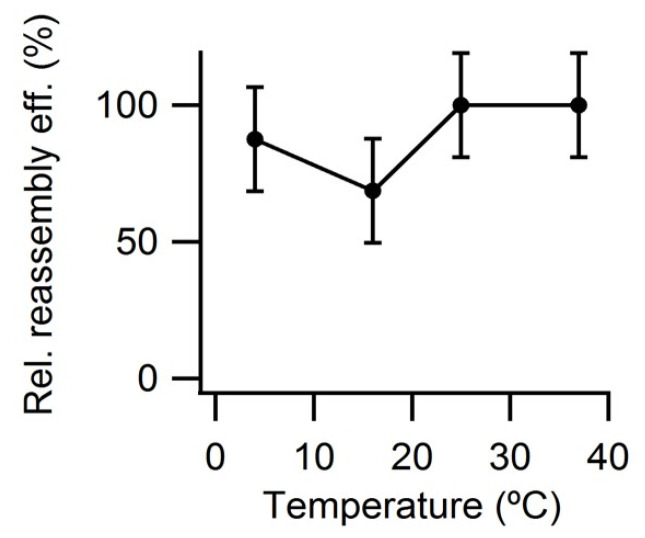
The hollow protein capsids from a number of different viruses are being considered for multiple biomedical or nanotechnological applications. In order to improve the applied potential of a given viral capsid as a nanocarrier or nanocontainer, specific conditions must be found for achieving its faithful and efficient assembly in vitro. The small size, adequate physical properties and specialized biological functions of the capsids of parvoviruses such as the minute virus of mice (MVM) make them excellent choices as nanocarriers and nanocontainers. In this study we analyzed the effects of protein concentration, macromolecular crowding, temperature, pH, ionic strength, or a combination of some of those variables on the fidelity and efficiency of self-assembly of the MVM capsid in vitro. The results revealed that the in vitro reassembly of the MVM capsid is an efficient and faithful process. Under some conditions, up to ~40% of the starting virus capsids were reassembled in vitro as free, non aggregated, correctly assembled particles. These results open up the possibility of encapsidating different compounds in VP2-only capsids of MVM during its reassembly in vitro, and encourage the use of virus-like particles of MVM as nanocontainers.
许多不同病毒的中空蛋白衣壳正被考虑用于多种生物医学或纳米技术应用。为了提高给定病毒衣壳作为纳米载体或纳米容器的应用潜力,必须找到实现其在体外忠实和高效组装的特定条件。微小病毒(MVM)等细小病毒的衣壳体积小、物理性质适当且具有特殊的生物学功能,使其成为纳米载体和纳米容器的绝佳选择。在这项研究中,我们分析了蛋白质浓度、大分子拥挤、温度、pH 值、离子强度或这些变量的组合对 MVM 衣壳体外自组装的保真度和效率的影响。结果表明,MVM 衣壳的体外重装配是一个高效且忠实的过程。在某些条件下,多达~40%的起始病毒衣壳在体外重新组装成游离、无聚集、正确组装的颗粒。这些结果为在 MVM 的 VP2 仅衣壳体外重装配期间包封不同化合物开辟了可能性,并鼓励使用 MVM 的病毒样颗粒作为纳米容器。