Lee Jae Gon, Park Yong Eun, Chang Ji Young, Song Hyun Joo, Kim Duk Hwan, Yang Young Joo, Kim Byung Chang, Lee Shin Hee, You Myung-Won, Kim Seong-Eun
Division of Gastroenterology, Department of Internal Medicine, Hallym University Dongtan Sacred Heart Hospital, Hallym University College of Medicine, Hwaseong, Korea.
Division of Gastroenterology, Department of Internal Medicine, Inje University Haeundae Paik Hospital, Inje University College of Medicine, Busan, Korea.
Intest Res. 2023 Oct;21(4):481-492. doi: 10.5217/ir.2023.00005. Epub 2023 May 31.
BACKGROUND/AIMS: Immunocompromised patients with acute colonic diverticulitis are at high risk for complications and failure of non-surgical treatment. However, evidence on the comparative outcomes of immunocompromised and immunocompetent patients with diverticulitis is lacking. This systematic review and meta-analysis investigated the outcomes of medical treatment in immunocompromised and immunocompetent patients with diverticulitis.
A comprehensive literature search was conducted in PubMed, Embase, and the Cochrane Library. Studies comparing the clinical outcomes of immunocompromised and immunocompetent patients with diverticulitis were included.
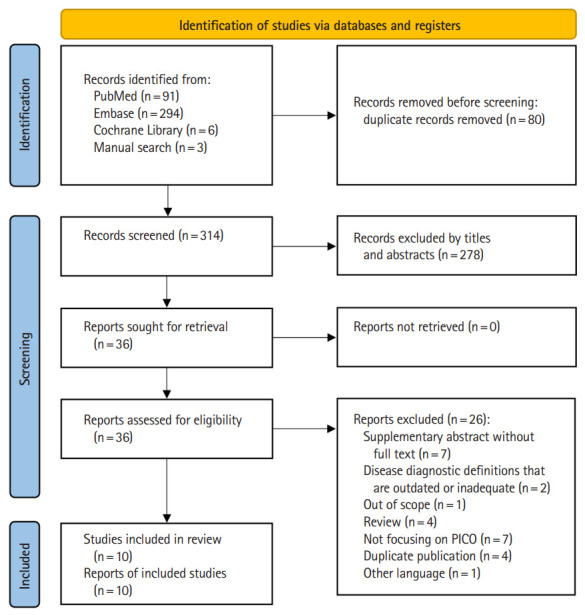
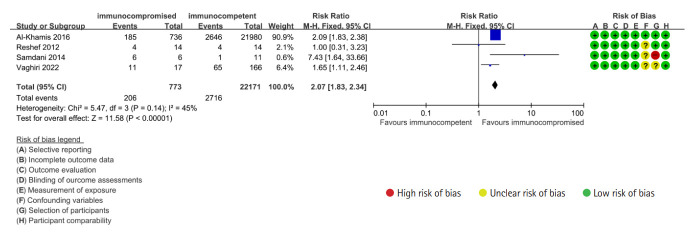
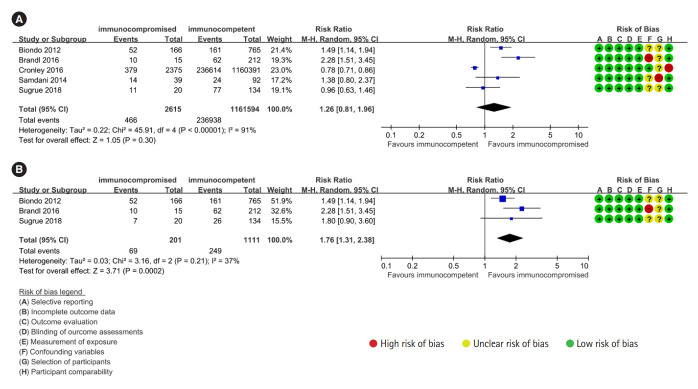
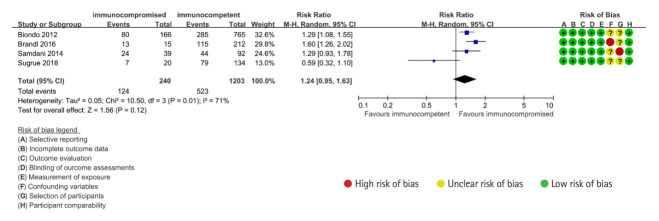
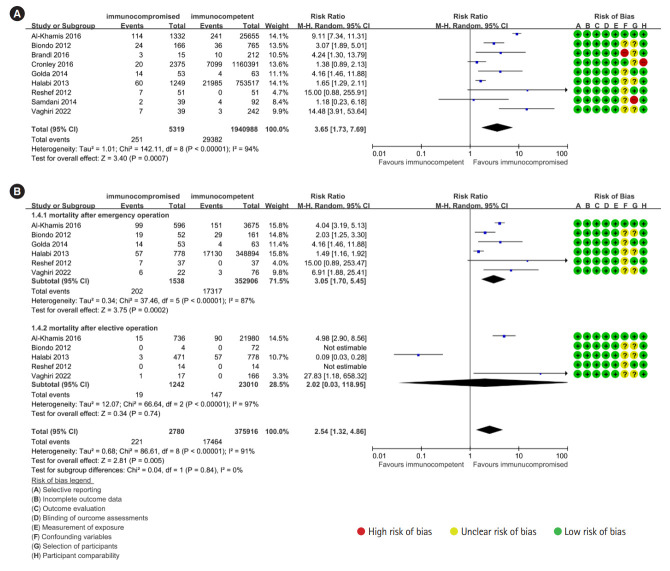
A total of 10 studies with 1,946,461 subjects were included in the quantitative synthesis. The risk of emergency surgery and postoperative mortality after emergency surgery was significantly higher in immunocompromised patients than in immunocompetent patients with diverticulitis (risk ratio [RR], 1.76; 95% confidence interval [CI], 1.31-2.38 and RR, 3.05; 95% CI, 1.70-5.45, respectively). Overall risk of complications associated with diverticulitis was non-significantly higher in immunocompromised than in immunocompetent patients (RR, 1.24; 95% CI, 0.95-1.63). Overall mortality irrespective of surgery was significantly higher in immunocompromised than in immunocompetent patients with diverticulitis (RR, 3.65; 95% CI, 1.73-7.69). By contrast, postoperative mortality after elective surgery was not significantly different between immunocompromised and immunocompetent patients with diverticulitis. In subgroup analysis, the risk of emergency surgery and recurrence was significantly higher in immunocompromised patients with complicated diverticulitis, whereas no significant difference was shown in mild disease.
Immunocompromised patients with diverticulitis should be given the best medical treatment with multidisciplinary approach because they had increased risks of surgery, postoperative morbidity, and mortality than immunocompetent patients.
背景/目的:免疫功能低下的急性结肠憩室炎患者发生并发症及非手术治疗失败的风险较高。然而,关于免疫功能低下和免疫功能正常的憩室炎患者比较结局的证据尚缺乏。本系统评价和荟萃分析调查了免疫功能低下和免疫功能正常的憩室炎患者的内科治疗结局。
在PubMed、Embase和Cochrane图书馆进行了全面的文献检索。纳入比较免疫功能低下和免疫功能正常的憩室炎患者临床结局的研究。
定量综合分析共纳入10项研究,涉及1,946,461名受试者。免疫功能低下的憩室炎患者急诊手术风险及急诊手术后的术后死亡率显著高于免疫功能正常的患者(风险比[RR]分别为1.76;95%置信区间[CI]为1.31 - 2.38和RR为3.零5;95% CI为1.70 - 5.45)。免疫功能低下的患者与憩室炎相关的总体并发症风险略高于免疫功能正常的患者,但差异无统计学意义(RR为1.24;95% CI为0.95 - 1.63)。无论是否手术,免疫功能低下的憩室炎患者的总体死亡率显著高于免疫功能正常的患者(RR为3.65;95% CI为1.73 - 7.69)。相比之下,免疫功能低下和免疫功能正常的憩室炎患者择期手术后的术后死亡率无显著差异。在亚组分析中,复杂性憩室炎的免疫功能低下患者急诊手术和复发风险显著更高,而轻症患者无显著差异。
免疫功能低下的憩室炎患者应采用多学科方法给予最佳内科治疗,因为他们比免疫功能正常的患者手术、术后发病率和死亡率风险更高。