Department of Health Management, College of Public Health, Zhengzhou University, Henan, China.
Henan Province Enginering, Research Center of Health Economy and Health Technology Assessment, Zhengzhou, Henan, China.
Front Public Health. 2023 May 12;11:1124548. doi: 10.3389/fpubh.2023.1124548. eCollection 2023.
Vaccination rates for the COVID-19 vaccine have recently been stagnant worldwide. We aim to analyze the potential patterns of vaccination development from the first three doses to reveal the possible trends of the next round of vaccination and further explore the factors influencing vaccination in the selected populations.
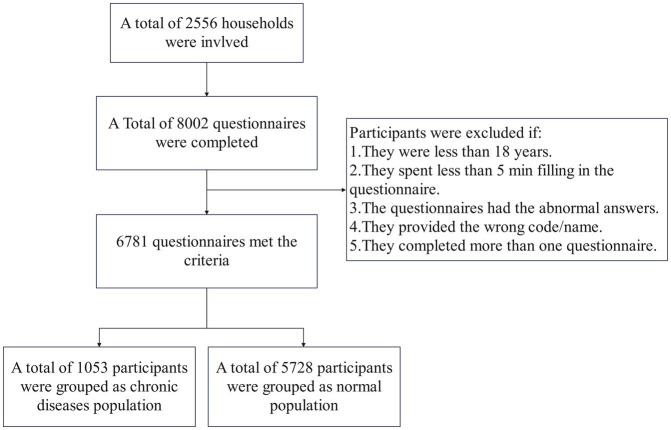
On July 2022, a stratified multistage random sampling method in the survey was conducted to select 6,781 people from 4 provinces China, who were above the age of 18 years. Participants were divided into two groups based on whether they had a chronic disease. The data were run through Cochran-Armitage trend test and multivariable regression analyses.
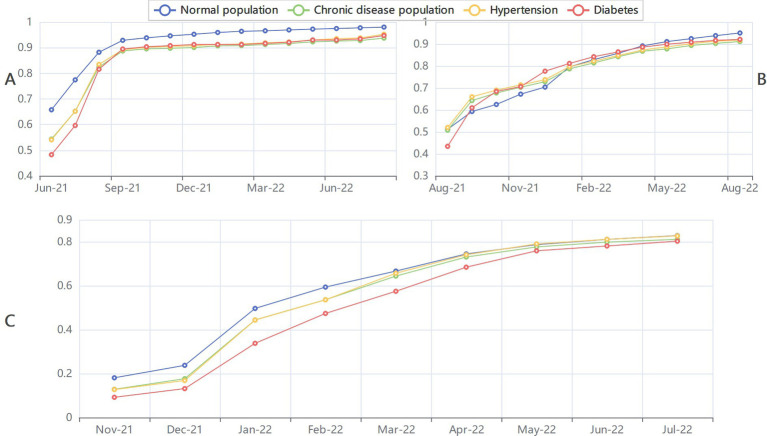
A total of 957 participants with chronic disease and 5,454 participants without chronic disease were included in this survey. Vaccination rates for the first, second and booster doses in chronic disease population were93.70% (95% CI: 92.19-95.27%), 91.12% (95%CI: 94.43-95.59%), and 83.18% (95%CI: 80.80-85.55%) respectively. By contrast, the first, second and booster vaccination rates for the general population were 98.02% (95% CI: 97.65-98.39%), 95.01% (95% CI: 94.43-95.59%) and 85.06% (95% CI: 84.11-86.00%) respectively. The widening gap in vaccination rates was observed as the number of vaccinations increases. Higher self-efficacy was a significant factor in promoting vaccination, which has been observed in all doses of vaccines. Higher education level, middle level physical activity and higher public prevention measures play a positive role in vaccination among the general population, while alcohol consumption acts as a significant positive factor in the chronic disease population ( < 0.05).
As the number of vaccinations increases, the trend of decreasing vaccination rate is becoming more pronounced. In future regular vaccinations, we may face low vaccination rates as the increasing number of infections and the fatigue associated with the prolonged outbreak hamper vaccination. Measures need to be found to counter this downward trend such as improving the self-efficacy of the population.
最近,全球范围内 COVID-19 疫苗的接种率一直停滞不前。我们旨在分析从前三剂疫苗接种情况中发现疫苗接种发展的潜在模式,以揭示下一轮疫苗接种的可能趋势,并进一步探讨选定人群中影响疫苗接种的因素。
2022 年 7 月,采用分层多阶段随机抽样方法在 4 个省份进行了调查,共选取了 6781 名年龄在 18 岁以上的人群。根据是否患有慢性病,将参与者分为两组。通过 Cochran-Armitage 趋势检验和多变量回归分析对数据进行分析。
本研究共纳入了 957 名患有慢性病的参与者和 5454 名没有慢性病的参与者。慢性病人群的第一、第二和加强针接种率分别为 93.70%(95%CI:92.19-95.27%)、91.12%(95%CI:94.43-95.59%)和 83.18%(95%CI:80.80-85.55%);相比之下,普通人群的第一、第二和加强针接种率分别为 98.02%(95%CI:97.65-98.39%)、95.01%(95%CI:94.43-95.59%)和 85.06%(95%CI:84.11-86.00%)。随着接种次数的增加,接种率的差距不断扩大。较高的自我效能感是促进接种的一个重要因素,这在所有疫苗剂量中都得到了观察。较高的教育水平、中等水平的身体活动和较高的公众预防措施对普通人群的接种起到了积极的作用,而在慢性病人群中,饮酒则是一个显著的积极因素(<0.05)。
随着接种次数的增加,接种率呈下降趋势,且越来越明显。在未来的常规疫苗接种中,由于感染人数的增加和持续爆发带来的疲劳,疫苗接种率可能会降低。需要找到应对这种下降趋势的措施,如提高人群的自我效能感。