Key Laboratory of Geospatial Technology for the Middle and Lower Yellow River Regions, Ministry of Education, Henan University, Kaifeng, 475004, Henan, China.
Institute of Urban Big Data, College of Geography and Environmental Science, Henan University, Kaifeng, 475004, Henan, China.
Sci Rep. 2023 May 30;13(1):8771. doi: 10.1038/s41598-023-35399-8.
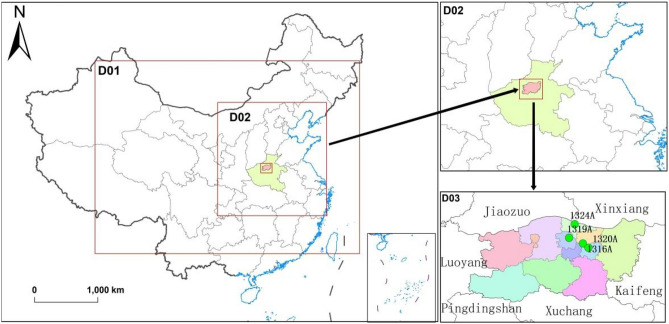
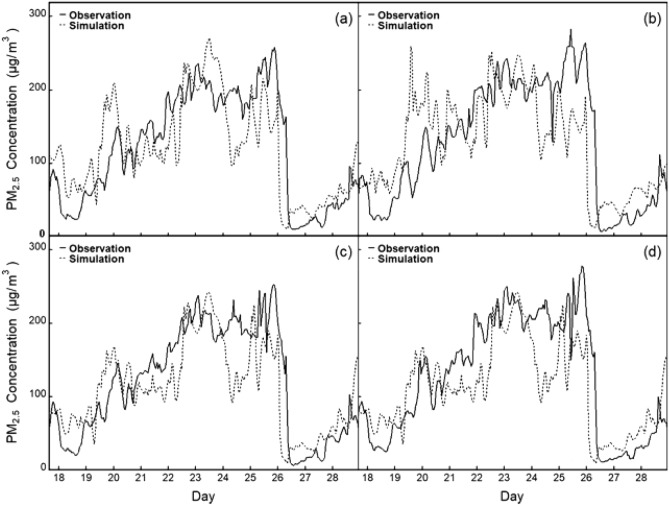
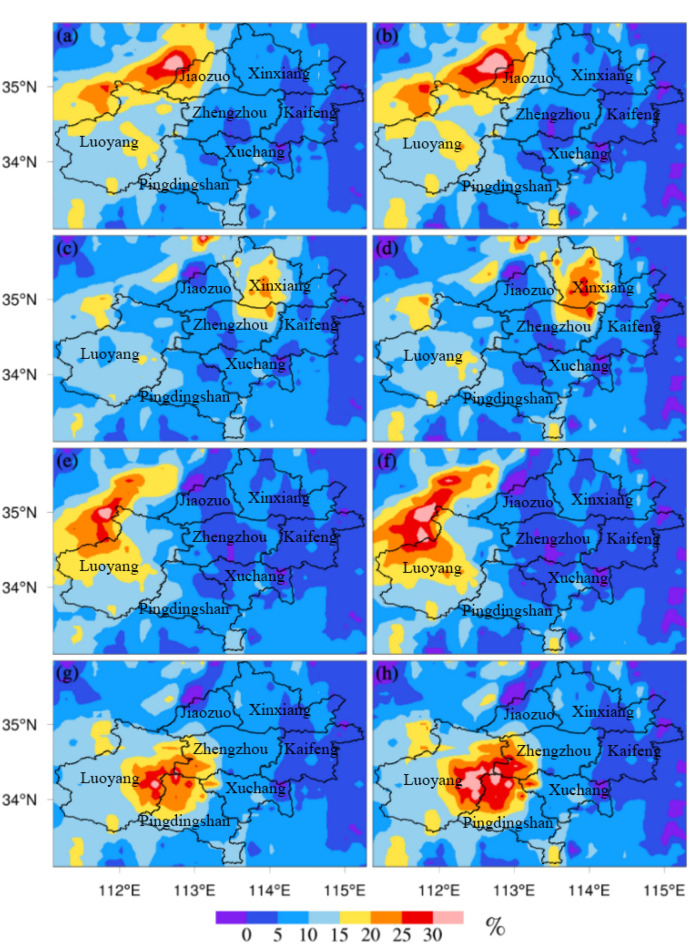
In this study, we simulated the spatial and temporal processes of a particulate matter (PM) pollution episode from December 10-29, 2019, in Zhengzhou, the provincial capital of Henan, China, which has a large population and severe PM pollution. As winter is the high incidence period of particulate pollution, winter statistical data were selected from the pollutant observation stations in the study area. During this period, the highest concentrations of PM (atmospheric PM with a diameter of less than 2.5 µm) and PM (atmospheric PM with a diameter of less than 10 µm) peaked at 283 μg m and 316 μg m, respectively. The contribution rates of local and surrounding regional emissions within Henan (emissions from the regions to the south, northwest, and northeast of Zhengzhou) to PM concentrations in Zhengzhou were quantitatively analyzed based on the regional Weather Research and Forecasting model coupled with Chemistry (WRF/Chem). Model evaluation showed that the WRF/Chem can accurately simulate the spatial and temporal variations in the PM concentrations in Zhengzhou. We found that the anthropogenic emissions south of Zhengzhou were the main causes of high PM concentrations during the studied episode, with contribution rates of 14.39% and 16.34% to PM and PM, respectively. The contributions of anthropogenic emissions from Zhengzhou to the PM and PM concentrations in Zhengzhou were 7.94% and 7.29%, respectively. The contributions of anthropogenic emissions from the area northeast of Zhengzhou to the PM and PM concentrations in Zhengzhou were 7.42% and 7.18%, respectively. These two areas had similar contributions to PM pollution in Zhengzhou. The area northeast of Zhengzhou had the lowest contributions to the PM and PM concentrations in Zhengzhou (5.96% and 5.40%, respectively).
在这项研究中,我们模拟了 2019 年 12 月 10 日至 29 日中国河南省省会郑州的一次颗粒物(PM)污染事件的时空过程,郑州人口众多,PM 污染严重。由于冬季是颗粒物污染高发期,因此选择了研究区域内污染物观测站的冬季统计数据。在此期间,PM(直径小于 2.5 µm 的大气颗粒物)和 PM(直径小于 10 µm 的大气颗粒物)的浓度最高值分别为 283 μg/m 和 316 μg/m。基于区域气象研究和预报模型与化学(WRF/Chem),定量分析了河南省内(郑州以南、西北和东北方向的区域排放)局地和周边区域排放对郑州 PM 浓度的贡献。模型评估表明,WRF/Chem 能够准确模拟郑州 PM 浓度的时空变化。我们发现,郑州南部的人为排放是该时段高 PM 浓度的主要原因,对 PM 和 PM 的贡献率分别为 14.39%和 16.34%。郑州人为排放对郑州 PM 和 PM 浓度的贡献率分别为 7.94%和 7.29%。郑州东北方向的人为排放对郑州 PM 和 PM 浓度的贡献率分别为 7.42%和 7.18%。这两个地区对郑州的 PM 污染有相似的贡献。郑州东北方向对郑州 PM 和 PM 浓度的贡献最低(分别为 5.96%和 5.40%)。