Faculty of Medicine, University of Ottawa, Ottawa, ON, Canada.
Division of Oral and Maxillofacial Surgery, University of Toronto, Mount Sinai, Princess Margaret and Humber River Hospitals, Toronto, ON, Canada.
BMC Oral Health. 2023 May 31;23(1):343. doi: 10.1186/s12903-023-03062-3.
Opportunistic oral cancer screening during visits to the dentist is a non-invasive and accessible option for detection of pre-malignant lesions and early-stage malignancies. The objective of this study was to investigate the knowledge, practices, and attitudes towards oral cancer screening among dentists.
A 42-item survey was sent to 650 dental professionals affiliated with the University of Toronto. Data regarding training/practice characteristics, knowledge of oral cavity cancer, current screening practices, attitudes towards screening, and remuneration were collected.
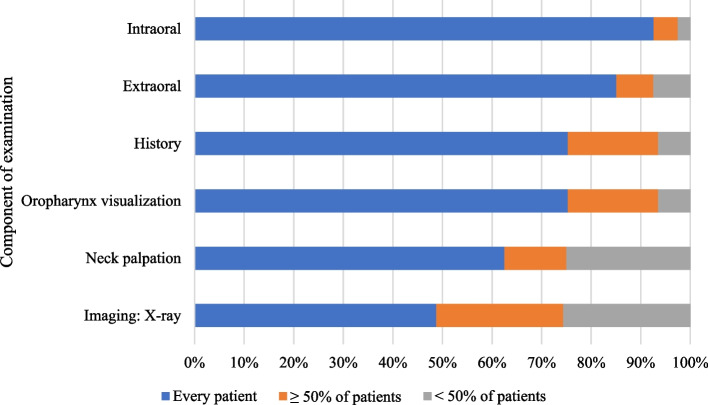
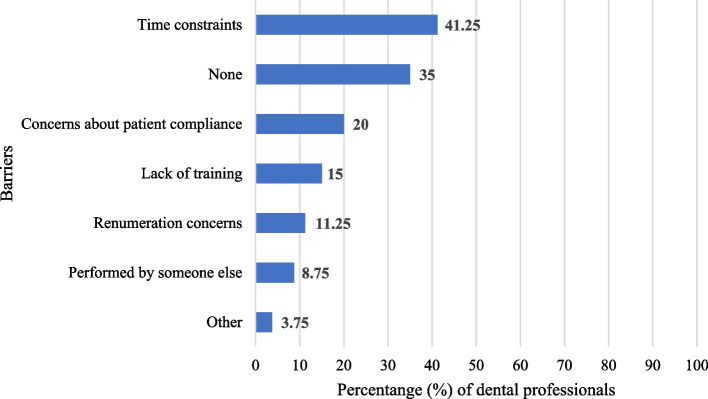
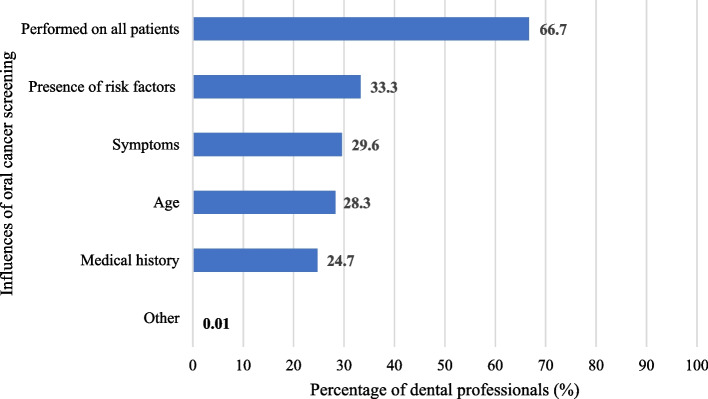
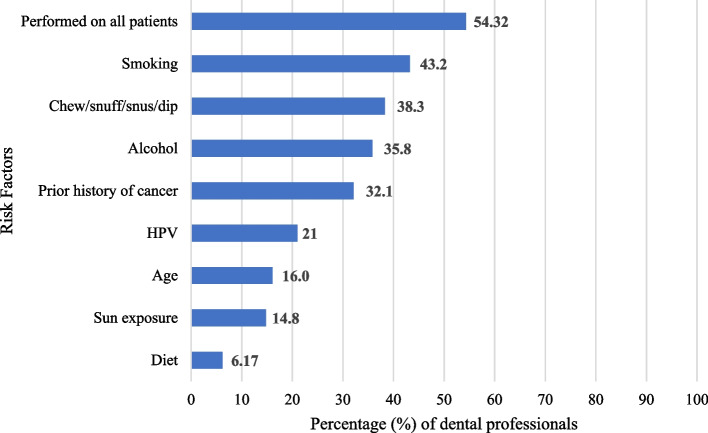
Ninety-one dentists responded. Most obtained their dental degree from Canada (71.4%) and were practicing in large urban centers (87.9%). Most dentists correctly identified the oral tongue (87.8%) and floor of mouth (80%) as the two of most common sites of oral cavity cancer but only 56% correctly identified the most common presentation. 91% performed intra/extra oral examinations at every patient visit. Only 9.9% of dentists discussed the risk factors of oral cancer and 33% were not familiar with resources for smoking cessation and alcohol abuse. International medical graduates were more likely to discuss risk factor management than Canadian medical graduates (p < 0.01). Over 80% of dentists referred to a specialist when a suspected lesion was found. The greatest barrier for oral cancer screening was lack of time. Almost all dentists (98.8%) reported that their screening practices do not differ depending on the patient's insurance status and 63.8% reported compensation would not influence their decision to perform oral examinations.
Most dentists have a good knowledge of the presentation and risk factors associated with oral cavity cancer. Most dentists perform screening with every patient, with no influence from compensation and insurance status. Dentists are therefore an excellent first contact for oral cavity cancer screening for the general public and for high-risk populations.
在看牙医时进行机会性口腔癌筛查是一种非侵入性、易于操作的方法,可以发现癌前病变和早期恶性肿瘤。本研究旨在调查牙医对口腔癌筛查的知识、实践和态度。
我们向 650 名多伦多大学附属牙医专业人员发送了一份 42 项的调查问卷。收集了有关培训/实践特征、口腔癌知识、当前筛查实践、对筛查的态度和报酬的数据。
91 名牙医做出了回应。他们中的大多数(71.4%)从加拿大获得了牙医学位,并在大城市中心(87.9%)行医。大多数牙医正确识别了口腔舌(87.8%)和口腔底部(80%)是口腔癌最常见的两个部位,但只有 56%正确识别了最常见的表现。91%的牙医在每次就诊时都进行口腔内外检查。只有 9.9%的牙医讨论了口腔癌的危险因素,33%的牙医不熟悉戒烟和酗酒的资源。国际医学毕业生比加拿大医学毕业生更有可能讨论危险因素管理(p<0.01)。超过 80%的牙医在发现可疑病变时会转介给专家。口腔癌筛查的最大障碍是缺乏时间。几乎所有牙医(98.8%)报告说,他们的筛查实践不因患者的保险状况而有所不同,63.8%的牙医报告说报酬不会影响他们进行口腔检查的决定。
大多数牙医对口腔癌的表现和相关风险因素有很好的了解。大多数牙医对每位患者进行筛查,不受补偿和保险状况的影响。因此,牙医是普通大众和高危人群进行口腔癌筛查的首选。