EcoHealth Alliance, 520 Eighth Avenue Ste 1200, New York, NY, 10018, USA.
Global Health Program, Smithsonian's National Zoological Park and Conservation Biology Institute, 3001 Connecticut Ave NW, Washington DC, 20008, USA.
Ecohealth. 2023 Mar;20(1):31-42. doi: 10.1007/s10393-023-01636-9. Epub 2023 May 31.
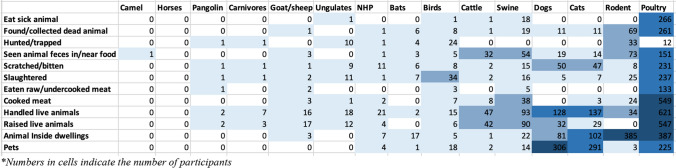
The increasing global emergence of zoonoses warrants improved awareness of activities that predispose vulnerable communities to greater risk of disease. Zoonotic disease outbreaks regularly occur within Myanmar and at its borders partly due to insufficient knowledge of behavioral risks, hindering participatory surveillance and reporting. This study employed a behavioral surveillance strategy among high-risk populations to understand the behavioral risks for zoonotic disease transmission in an effort to identify risk factors for pathogen spillover. To explore behavioral mechanisms of spillover in Myanmar, we aimed to: (1) evaluate the details around animal contact and types of interaction, (2) assess the association between self-reported unusual symptoms (i.e., any illness or sickness that is not known or recognized in the community or diagnosed by medical providers) and animal contact activities and (3) identify the potential risk factors including behavioral practices of self-reported illness. Participants were enrolled at two community sites: Hpa-An and Hmawbi in Southern Myanmar. A behavioral questionnaire was administered to understand participants' animal exposures, behaviors and self-reported illnesses. From these responses, associations between (1) animal contact activities and self-reported unusual illnesses, and (2) potential risk factors and self-reported unusual illness were tested. Contact with poultry seemed to be very frequent (91.1%) and many participants reported raising, handling and having poultry in their houses as well as slaughtering or being scratched/bitten by them, followed by contact with rodents (57.8%) and swine (17.9%). Compared to participants who did not have any unusual symptoms, participants who had unusual symptoms in the past year were more likely to have sold dead animals (OR = 13.6, 95% CI 6.8-27.2), slaughtered (OR = 2.4, 95% CI 1.7-3.3), raised (OR = 3.4, 95% CI 2.3-5.0) or handled animals (OR = 2.1, 95% CI 1.2-3.6), and had eaten sick (OR = 4.4, 95% CI 3.0-6.4) and/or dead animals (OR = 6.0, 95% CI 4.1-8.8) in the same year. Odds of having reported unusual symptoms was higher among those involved in animal production business (OR = 3.4, 95% CI 1.9-6.2) and animal-involved livelihoods (OR = 3.3, 95% CI 1.5-7.2) compared to other livelihoods. The results suggest that there is a high level of interaction between humans, livestock and wild animals in communities we investigated in Myanmar. The study highlights the specific high-risk behaviors as they relate to animal contact and demographic risk factors for zoonotic spillover. Our findings contribute to human behavioral data needed to develop targeted interventions to prevent zoonotic disease transmission at human-animal interfaces.
人畜共患病在全球范围内的不断出现,需要提高人们对使弱势社区面临更大疾病风险的活动的认识。人畜共患病疫情在缅甸及其边境地区经常发生,部分原因是对行为风险的了解不足,阻碍了参与式监测和报告。本研究在高危人群中采用行为监测策略,了解人畜共患病传播的行为风险,以确定病原体溢出的风险因素。为了探索缅甸溢出的行为机制,我们旨在:(1)评估动物接触和互动类型的详细信息,(2)评估自我报告的异常症状(即,在社区中未知或未被识别或由医疗服务提供者诊断的任何疾病或疾病)与动物接触活动之间的关联,以及(3)确定潜在风险因素,包括自我报告疾病的行为做法。参与者在缅甸南部的 Hpa-An 和 Hmawbi 两个社区地点招募。进行了行为问卷调查,以了解参与者的动物接触、行为和自我报告的疾病情况。根据这些反应,测试了(1)动物接触活动与自我报告的异常疾病之间,以及(2)潜在风险因素与自我报告的异常疾病之间的关联。接触家禽似乎非常频繁(91.1%),许多参与者报告说饲养、处理和在家中饲养家禽,以及屠宰或被它们抓伤/咬伤,其次是接触啮齿动物(57.8%)和猪(17.9%)。与过去一年没有任何异常症状的参与者相比,过去一年有异常症状的参与者更有可能出售过死亡动物(OR=13.6,95%CI 6.8-27.2)、屠宰(OR=2.4,95%CI 1.7-3.3)、饲养(OR=3.4,95%CI 2.3-5.0)或处理动物(OR=2.1,95%CI 1.2-3.6),并食用过患病(OR=4.4,95%CI 3.0-6.4)和/或死亡动物(OR=6.0,95%CI 4.1-8.8)在同一年。与从事其他生计的人相比,从事动物生产业务(OR=3.4,95%CI 1.9-6.2)和从事动物生计的人(OR=3.3,95%CI 1.5-7.2)报告异常症状的几率更高。研究结果表明,在我们调查的缅甸社区中,人与牲畜和野生动物之间存在高度的相互作用。该研究强调了与动物接触和与人口统计学相关的人畜共患病溢出风险有关的特定高危行为。我们的研究结果有助于提供人类行为数据,以制定有针对性的干预措施,防止人类-动物界面的人畜共患病传播。