Patel Krupali, Saxena Deepak
Center for Development Research (ZEF), University of Bonn, Germany.
Department of Epidemiology, Indian Institute of Public Health Gandhinagar, Gujarat, India.
Vet World. 2019 Jan;12(1):176-182. doi: 10.14202/vetworld.2019.176-182. Epub 2019 Jan 31.
Out of all global microbial pathogens, 61% are zoonoses. Zoonotic diseases (Z/D/S) are responsible for a large burden on the public health, livestock economies, and wildlife of India. Data on burden and knowledge about Z/D/S among animal handlers are limited for urban and peri-urban areas of India. The present study aimed to estimate the prevalence of self-reported selected Z/D/S and knowledge about those diseases among animal handlers in the urban area of Ahmedabad city, India.
This cross-sectional study was conducted among 170 animal handlers from three zones of Ahmedabad city, India, from February to May 2017. Data were collected on sociodemographic, different exposure, knowledge, practices about animal handling, and self-reported Z/D/S condition.
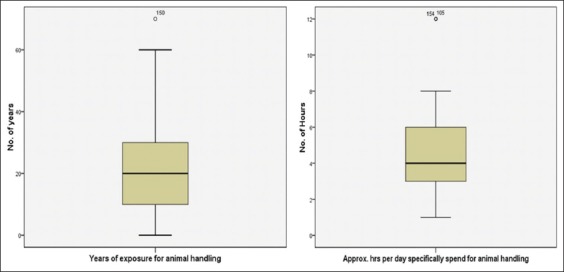
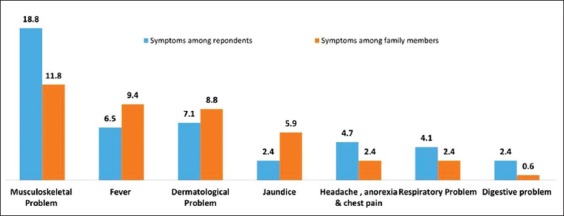
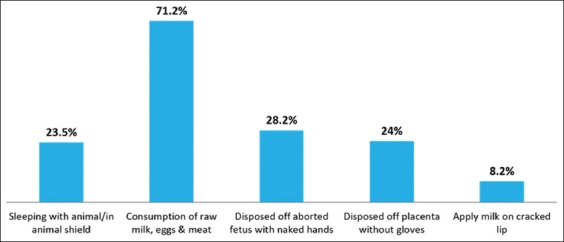
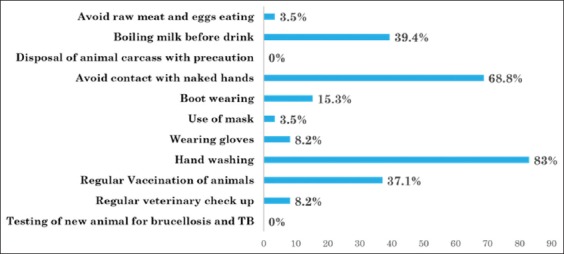
Majority of study participants were females. Participants had numbers of animals, and it ranged from 1 to 70. However, the majority of them were cattle. Average experience and hours/day spent for handling animal were reported 22±15 years and 5±2 h, respectively. From all participants, about one-third perceived that handling animal could be a cause of disease. Average knowledge on the mode of transmission of Z/D/S was found 4.1%. Most common high risk and preventive practices found consumption of raw milk (72%) and handwashing (83%). The proportion of self-reported Z/D/S in the past 5 years was found to be 23% among respondents and 17% among family members. However, the proportion of existing self-reported Z/D/S or symptomatic Z/D/S was 17% among respondents and 18% among family members. Most common self-reported Z/D/S were vector-borne, animal bite, and respiratory disorders.
The knowledge and prevalence of Z/D/S were found low as compared to other studies from India. Further awareness and screening of animal handlers can be useful to increase the reporting and prevention and control of Z/D/S among them.
在全球所有微生物病原体中,61%是人畜共患病原体。人畜共患疾病给印度的公共卫生、畜牧业经济和野生动物带来了沉重负担。在印度城市和城郊地区,关于动物饲养者所承担的负担以及他们对人畜共患疾病的了解的数据有限。本研究旨在估计印度艾哈迈达巴德市市区动物饲养者自我报告的特定人畜共患疾病的患病率以及对这些疾病的了解情况。
2017年2月至5月,在印度艾哈迈达巴德市三个区域的170名动物饲养者中开展了这项横断面研究。收集了社会人口统计学、不同接触情况、知识、动物处理做法以及自我报告的人畜共患疾病状况等方面的数据。
研究参与者多数为女性。参与者饲养的动物数量从1只到70只不等,不过其中大多数是牛。据报告,参与者处理动物的平均经验和每天花费的时间分别为22±15年和5±2小时。所有参与者中,约三分之一的人认为处理动物可能是患病原因。发现参与者对人畜共患疾病传播方式的平均知晓率为4.1%。最常见的高风险行为和预防措施分别是饮用生牛奶(72%)和洗手(83%)。在过去5年中,自我报告曾患人畜共患疾病的受访者比例为23%,家庭成员比例为17%。然而,当前自我报告患有或有症状的人畜共患疾病的受访者比例为17%,家庭成员比例为18%。最常见的自我报告的人畜共患疾病是媒介传播疾病、动物咬伤和呼吸道疾病。
与印度其他研究相比,发现人畜共患疾病的知晓率和患病率较低。进一步提高动物饲养者的认识并对其进行筛查,可能有助于增加对他们当中人畜共患疾病的报告以及预防和控制。