Centre for Marine Science and Innovation, School of Biological, Earth and Environmental Sciences, Faculty of Science, The University of New South Wales, Kensington, NSW, 2052, Australia.
King Abdullah University of Science and Technology, Biological and Environmental Science and Engineering Division, Thuwal, Saudi Arabia.
ISME J. 2023 Sep;17(9):1517-1519. doi: 10.1038/s41396-023-01439-4. Epub 2023 May 31.
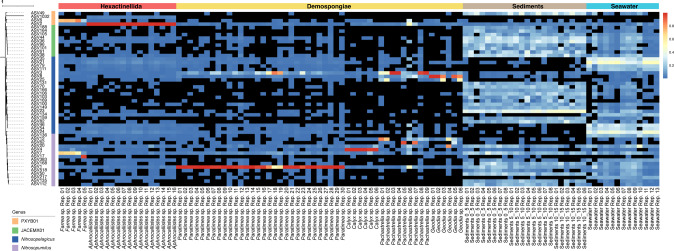
Sponges thrive in the deep, dark and nutrient-depleted ocean and may rely on microbial symbionts for carbon acquisition and energy generation. However, these symbiotic relationships remain largely unexplored. In this study, we analyze the microbiome of deep-sea sponges and show that ammonia-oxidizing archaea (AOA) of the family Nitrosopumilaceae make up at least 75% of the microbial communities of the sponges Aphrocallistes sp., Farrea sp. and Paratimea sp.. Given the known autotrophic metabolism of AOAs, this implies that these sponge holobionts can have the capacity for primary production in the deep-sea. We also show that specific AOA lineages are highly specific towards their hosts, hinting towards an unprecedent vertical transmission of these symbionts in deep-sea sponges. Our results show that the ecology and evolution of symbiotic relationships in deep-sea sponge is distinct from that of their shallow-water counterparts.
海绵在深海、黑暗和营养匮乏的海洋中茁壮成长,可能依赖于微生物共生体来获取碳和产生能量。然而,这些共生关系在很大程度上仍未得到探索。在这项研究中,我们分析了深海海绵的微生物组,结果表明氨氧化古菌(AOA)家族中的硝化螺旋菌科至少构成了海绵 Aphrocallistes sp.、Farrea sp. 和 Paratimea sp. 微生物群落的 75%。鉴于已知的 AOA 自养代谢,这意味着这些海绵后生动物体在深海中具有进行初级生产的能力。我们还表明,特定的 AOA 谱系对其宿主具有高度特异性,暗示这些共生体在深海海绵中存在前所未有的垂直传播。我们的研究结果表明,深海海绵共生关系的生态和进化与浅海海绵不同。