VillageReach USA, 210 S Hudson St Suite 307, Seattle, WA, 98134, USA.
VillageReach Malawi, PO Box 31348, Lilongwe 3, Malawi.
Hum Resour Health. 2023 May 31;21(1):42. doi: 10.1186/s12960-023-00827-3.
Global chronic health worker shortages and stagnating routine immunization rates require new strategies to increase vaccination coverage and equity. As trained, trusted members of their local communities, community health workers (CHWs) are in a prime position to expand the immunization workforce and increase vaccination coverage in under-reached communities. Malawi is one of only a few countries that relies on CHWs-called Health Surveillance Assistants (HSAs) in Malawi-to administer routine immunizations, and as such offers a unique example of how this can be done.
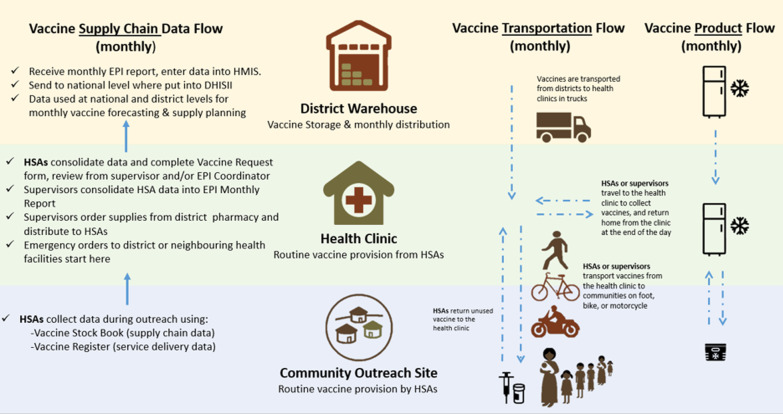
We sought to describe the operational and programmatic characteristics of a functional CHW-led routine immunization program by conducting interviews with HSAs, HSA supervisors, ministry of health officials, and community members in Malawi. This case study describes how and where HSAs provide vaccinations, their vaccination-related responsibilities, training and supervision processes, vaccine safety considerations, and the community-level vaccine supply chain. Interview participants consistently described HSAs as a high-functioning vaccination cadre, skilled and dedicated to increasing vaccine access for children. They also noted a need to strengthen some aspects of professional support for HSAs, particularly related to training, supervision, and supply chain processes. Interviewees agreed that other countries should consider following Malawi's example and use CHWs to administer vaccines, provided they can be sufficiently trained and supported.
This account from Malawi provides an example of how a CHW-led vaccination program operates. Leveraging CHWs as vaccinators is a promising yet under-explored task-shifting approach that shows potential to help countries maximize their health workforce, increase vaccination coverage and reach more zero-dose children. However, more research is needed to produce evidence on the impact of leveraging CHWs as vaccinators on patient safety, immunization coverage/vaccine equity, and cost-effectiveness as compared to use of other cadres for routine immunization.
全球慢性卫生工作者短缺和常规免疫接种率停滞不前,这要求我们采取新的策略来提高疫苗接种覆盖率和公平性。社区卫生工作者(CHW)作为经过培训、值得信赖的社区成员,处于扩大免疫工作人员队伍和提高服务欠缺社区疫苗接种覆盖率的最佳位置。马拉维是少数几个依靠 CHW(马拉维称为健康监督助理(HSA))来管理常规免疫接种的国家之一,因此为我们提供了一个独特的范例,说明了这是如何做到的。
我们通过采访马拉维的 HSA、HSA 主管、卫生部官员和社区成员,试图描述一个由 CHW 主导的常规免疫规划的运作和规划特点。本案例研究描述了 HSA 如何以及在哪里提供疫苗接种、他们与疫苗接种相关的责任、培训和监督流程、疫苗安全考虑因素以及社区级疫苗供应链。访谈参与者一致认为,HSA 是一支高效的疫苗接种队伍,他们熟练且致力于增加儿童获得疫苗的机会。他们还指出,需要加强对 HSA 的某些专业支持,特别是与培训、监督和供应链流程有关的支持。受访者一致认为,其他国家应该考虑效仿马拉维的做法,利用 CHW 来接种疫苗,但前提是他们能够得到充分的培训和支持。
本报告来自马拉维,提供了一个 CHW 主导的疫苗接种计划运作的范例。利用 CHW 作为接种者是一种有前途但尚未充分探索的任务转移方法,它有可能帮助各国最大限度地利用其卫生人力,提高疫苗接种覆盖率,并覆盖更多零剂量儿童。然而,需要更多的研究来提供关于利用 CHW 作为接种者对患者安全、免疫覆盖率/疫苗公平性以及与常规免疫接种相比使用其他人员作为接种者的成本效益的证据。