Qu Jinghao, Qin Xiaoran, Peng Rongmei, Xiao Gege, Gu Shaofeng, Wang Haikun, Hong Jing
Department of Ophthalmology, Peking University Third Hospital, No.49 Garden North Road, Haidian, Beijing, 100191, China.
Beijing Key Laboratory of Restoration of Damaged Ocular Nerve, Peking University Third Hospital, Beijing, China.
Eye Vis (Lond). 2023 Jun 1;10(1):20. doi: 10.1186/s40662-023-00340-7.
The goal of this study is to develop a fully automated segmentation and morphometric parameter estimation system for assessing abnormal corneal endothelial cells (CECs) from LASER in vivo confocal microscopy (IVCM) images.
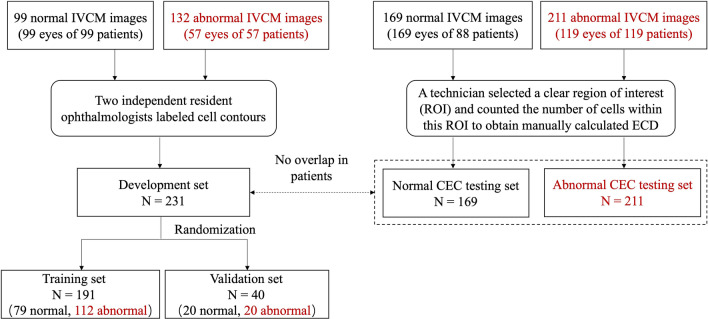
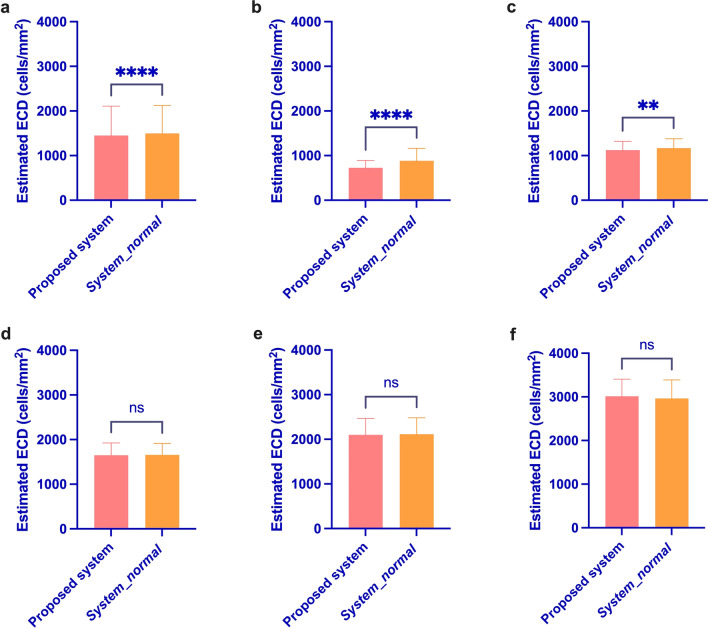
First, we developed a fully automated deep learning system for assessing abnormal CECs using a previous development set composed of normal images and a newly constructed development set composed of abnormal images. Second, two testing sets, one with 169 normal images and the other with 211 abnormal images, were used to evaluate the clinical validity and effectiveness of the proposed system on LASER IVCM images with different corneal endothelial conditions, particularly on abnormal images. Third, the automatically calculated endothelial cell density (ECD) and the manually calculated ECD were compared using both the previous and proposed systems.
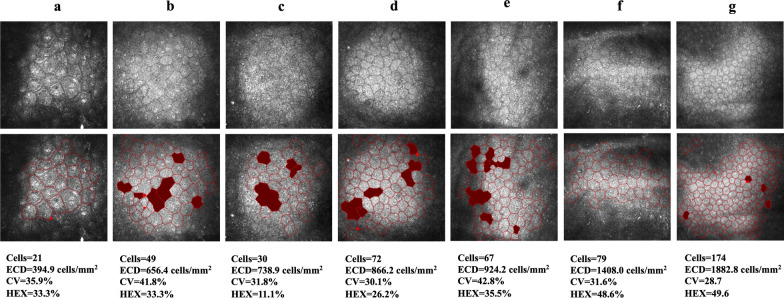
The automated morphometric parameter estimations of the average number of cells, ECD, coefficient of variation in cell area and percentage of hexagonal cells were 257 cells, 2648 ± 511 cells/mm, 32.18 ± 6.70% and 56.23 ± 8.69% for the normal CEC testing set and 83 cells, 1450 ± 656 cells/mm, 34.87 ± 10.53% and 42.55 ± 20.64% for the abnormal CEC testing set. Furthermore, for the abnormal CEC testing set, Pearson's correlation coefficient between the automatically and manually calculated ECDs was 0.9447; the 95% limits of agreement between the manually and automatically calculated ECDs were between 329.0 and - 579.5 (concordance correlation coefficient = 0.93).
This is the first report to count and analyze the morphology of abnormal CECs in LASER IVCM images using deep learning. Deep learning produces highly objective evaluation indicators for LASER IVCM corneal endothelium images and greatly expands the range of applications for LASER IVCM.
本研究的目的是开发一种全自动分割和形态计量参数估计系统,用于从激光活体共聚焦显微镜(IVCM)图像中评估异常角膜内皮细胞(CEC)。
首先,我们使用由正常图像组成的先前开发集和由异常图像组成的新构建开发集,开发了一种用于评估异常CEC的全自动深度学习系统。其次,使用两个测试集,一个包含169张正常图像,另一个包含211张异常图像,来评估所提出系统在具有不同角膜内皮状况的激光IVCM图像上的临床有效性和有效性,特别是在异常图像上。第三,使用先前和所提出的系统比较自动计算的内皮细胞密度(ECD)和手动计算的ECD。
正常CEC测试集的细胞平均数、ECD、细胞面积变异系数和六边形细胞百分比的自动形态计量参数估计分别为257个细胞、2648±511个细胞/mm、32.18±6.70%和56.23±8.69%,异常CEC测试集分别为83个细胞、1450±656个细胞/mm、34.87±10.53%和42.55±20.64%。此外,对于异常CEC测试集,自动计算和手动计算的ECD之间的Pearson相关系数为0.9447;手动计算和自动计算的ECD之间的95%一致性界限在329.0和-579.5之间(一致性相关系数=0.93)。
这是第一篇使用深度学习对激光IVCM图像中的异常CEC进行计数和形态分析的报告。深度学习为激光IVCM角膜内皮图像产生了高度客观的评估指标,并极大地扩展了激光IVCM的应用范围。