Fu Bojie, Liu Yanxu, Meadows Michael E
State Key Laboratory of Urban and Regional Ecology, Research Center for Eco-Environmental Sciences, Chinese Academy of Sciences, Beijing 100085, China.
State Key Laboratory of Earth Surface Processes and Resource Ecology, Faculty of Geographical Science, Beijing Normal University, Beijing 100875, China.
Natl Sci Rev. 2023 Feb 21;10(7):nwad033. doi: 10.1093/nsr/nwad033. eCollection 2023 Jul.
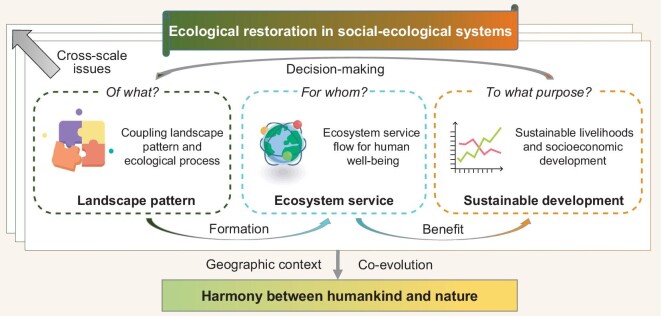
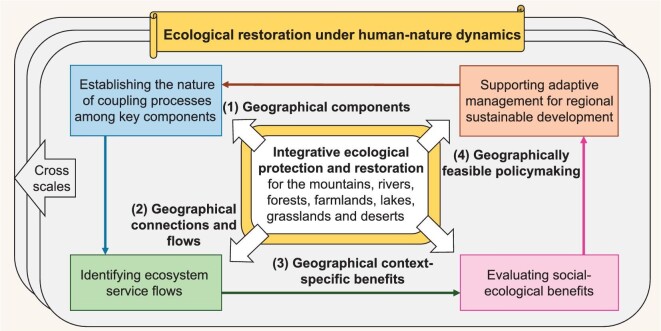
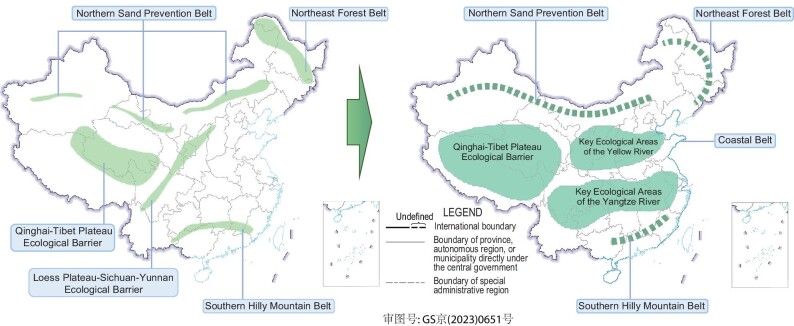
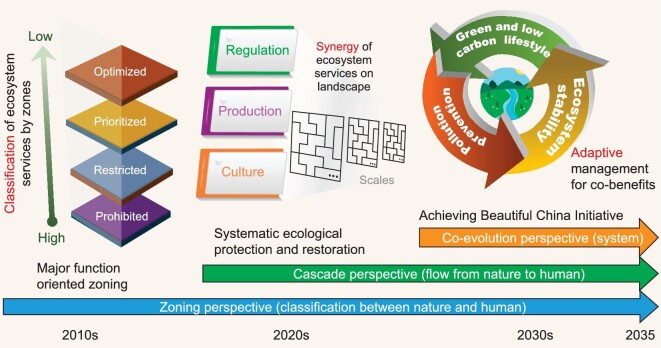
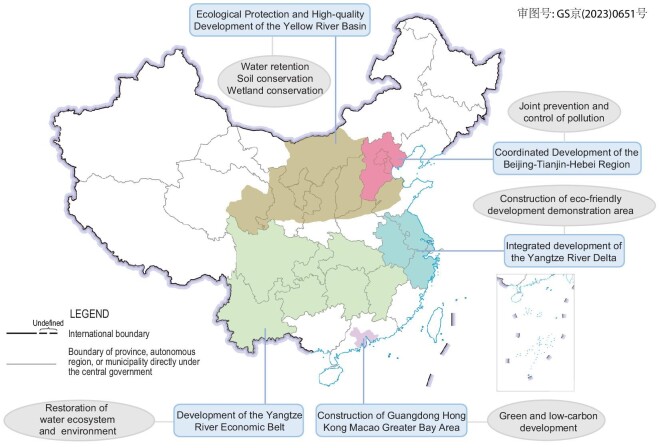
Facing the need for transdisciplinary research to promote ecological restoration that achieves both social and ecological benefits, research on past restoration efforts that have directly or indirectly contributed to regional or national sustainable development warrants reassessment. Using China as an example, in this review, we address three basic research questions that can be summarized as follows: ecological restoration-of what, for whom and to what purpose? Accordingly, a 'landscape pattern-ecosystem service-sustainable development' co-evolutionary framework is proposed here to describe landscape-scale ecological restoration and its impact on landscape patterns and ecological processes, ecosystem services for human well-being, sustainable livelihoods and socioeconomic development. From the strategic pattern of national ecological security to the pattern of major projects to protect and restore major national ecosystems, the spatial pattern of China's ecological restoration is more geographically integrative. From major function-oriented zoning to systematic ecological protection and restoration, and for the purpose of achieving the Beautiful China Initiative, there are three stages of ecosystem services management: classification, synergy and integration, respectively. The difference in geographic processes should be considered in the key requirements of ecological restoration for China's five national strategies for regional sustainable-development strategies. Deepening understanding of the relationship between humans and nature in different geographical contexts is a scientific prerequisite to support policymaking related to ecological restoration. To promote greater harmony between humans and nature, we propose four important research directions: (i) understanding coupling processes among key components, (ii) identifying ecosystem service flows, (iii) evaluating social-ecological benefits and (iv) supporting adaptive management for regional sustainable development.
面对跨学科研究的需求,以促进实现社会和生态效益的生态恢复,对过去直接或间接促进区域或国家可持续发展的恢复工作进行研究值得重新评估。以中国为例,在本综述中,我们探讨了三个基本研究问题,可概括如下:生态恢复——恢复什么、为谁恢复以及为何恢复?因此,本文提出了一个“景观格局-生态系统服务-可持续发展”共同进化框架,以描述景观尺度的生态恢复及其对景观格局和生态过程、人类福祉的生态系统服务、可持续生计和社会经济发展的影响。从国家生态安全战略格局到重大项目格局,以保护和恢复国家主要生态系统,中国生态恢复的空间格局在地理上更具整体性。从主体功能区到系统生态保护和恢复,为实现美丽中国倡议,生态系统服务管理有三个阶段:分类、协同和整合。在中国区域可持续发展战略的五项国家战略的生态恢复关键要求中,应考虑地理过程的差异。深入理解不同地理背景下人与自然的关系是支持生态恢复相关政策制定的科学前提。为促进人与自然的更大和谐,我们提出四个重要研究方向:(i)理解关键组成部分之间的耦合过程,(ii)识别生态系统服务流,(iii)评估社会生态效益,(iv)支持区域可持续发展的适应性管理。