Department of Biological Sciences, California State University Long Beach, Long Beach, California, United States of America.
PLoS One. 2023 Jun 2;18(6):e0286575. doi: 10.1371/journal.pone.0286575. eCollection 2023.
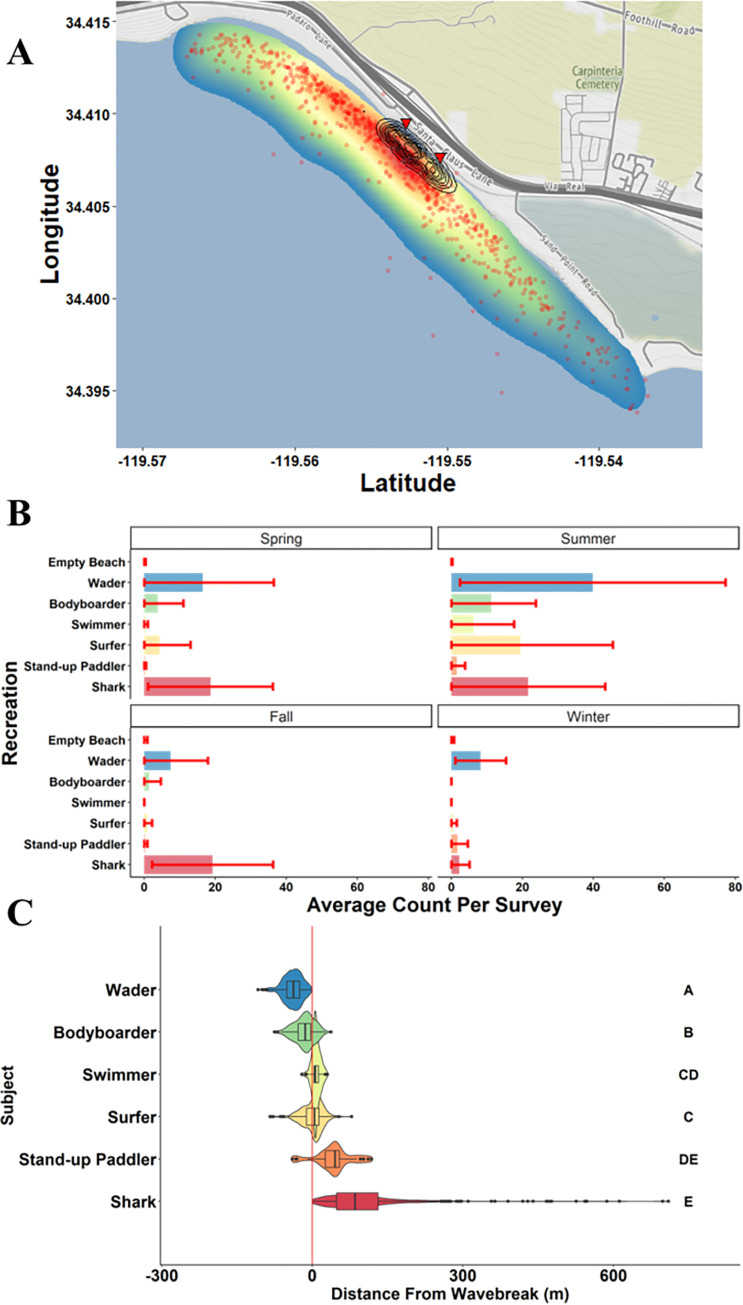
Juvenile white sharks (JWS) of the Northeastern Pacific population are present in nearshore southern California waters and form mixed size class (~1.5-3 m) aggregations for weeks to months, often within 500 m of shore. These nearshore beach habitats are heavily used for human recreation (e.g., surfing, swimming, body boarding, wading, and standup paddleboarding) and the amount of spatio-temporal overlap between JWS and humans is currently unknown. Increases in human population and the Northeastern Pacific population of white sharks have raised concern over human beach safety. To determine spatio-temporal JWS-human overlap at various spatial scales (e.g., across the entire southern California coastline, across different distances from shore, and within specific beach locations), 26 beach locations across southern California were surveyed monthly resulting in 1644 aerial drone surveys between January 2019 to March 2021. Thirteen environmental variables were assessed to predict when spatio-temporal overlap between JWS and water users was highest. Coast-wide distribution of JWS was clumped, limiting human-shark co-occurrence to specific locations, with 1096 of 1204 JWS observations occurring at Carpinteria and Del Mar Beach locations. Nearshore distribution indicated JWS are often close enough to the wave break to interact with some water users (median = 101 m, range = 2-702 m), although JWS had the most spatial overlap with stand-up paddlers. Daily human-shark co-occurrence was 97% at beaches where JWS aggregations had formed, and human activity showed high spatial overlap at shark aggregation sites. Although there is higher seasonal human-shark spatio-temporal overlap where aggregations form in southern California, the number of unprovoked shark bites across southern California is extremely low. This study provides evidence that high human-shark spatio-temporal overlap does not lead to an increased bite frequency in southern California, and there are a number of possible explanations as to why JWS are not biting water users despite daily encounters.
幼年白鲨(JWS)生活在东北太平洋的近岸南加州水域,并形成大小混合的群体,持续数周至数月,通常在离海岸 500 米以内。这些近岸海滩是人类娱乐活动的热门场所(如冲浪、游泳、趴板冲浪、涉水和站立式桨板运动),目前还不清楚 JWS 和人类之间的时空重叠量。人口增长和东北太平洋白鲨数量的增加引起了人们对人类海滩安全的担忧。为了确定在不同空间尺度(如整个南加州海岸线、离海岸不同距离以及特定海滩位置)上 JWS 与人类的时空重叠程度,2019 年 1 月至 2021 年 3 月期间,每月在南加州的 26 个海滩进行了调查,共进行了 1644 次无人机空中调查。评估了 13 个环境变量,以预测 JWS 和水使用者之间时空重叠度最高的时间。JWS 的沿海岸线分布呈聚集状,限制了人与鲨鱼的共同出现仅限于特定地点,1204 次 JWS 观测中有 1096 次发生在卡平特里亚和德尔马海滩。近岸分布表明,JWS 通常离破浪区足够近,可以与一些水使用者互动(中位数=101 米,范围=2-702 米),尽管 JWS 与站立式桨板冲浪者的空间重叠度最高。在形成 JWS 聚集区的海滩上,人与鲨鱼的每日共同出现率为 97%,而人类活动在鲨鱼聚集点显示出高度的空间重叠。尽管在南加州形成聚集区时,人类与鲨鱼的季节性时空重叠度更高,但南加州的无端鲨鱼咬伤事件数量极低。本研究提供的证据表明,在南加州,高时空重叠度并不会导致咬伤频率增加,而且尽管每天都有接触,但 JWS 不咬水使用者的原因有很多。