Li Chengxiang, Chen Xiang, Zhang Xu, Chen Xun, Wu De
School of Information Science and Technology, University of Science and Technology of China, Hefei, Anhui, China.
Department of Pediatrics, The First Affiliated Hospital of Anhui Medical University, Hefei, China.
Front Neurosci. 2023 May 19;17:1135646. doi: 10.3389/fnins.2023.1135646. eCollection 2023.
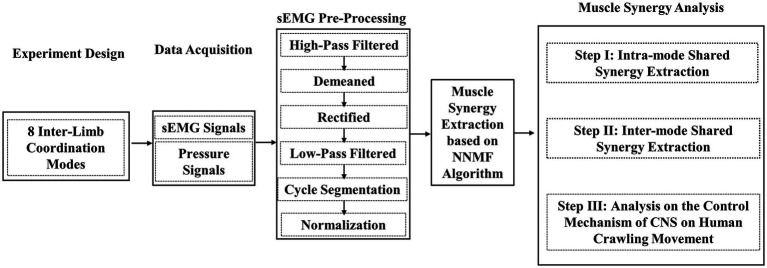
In order to reveal in-depth the neuromuscular control mechanism of human crawling, this study carries out muscle synergy extraction and analysis on human hands-knees crawling under eight specific inter-limb coordination modes, which are defined according to the swing sequence of limbs and includes two-limb swing crawling modes and six single-limb swing crawling modes. Ten healthy adults participate in crawling data collection, and surface electromyography (sEMG) signals are recorded from 30 muscles of limbs and trunk. Non-negative matrix factorization (NNMF) algorithm is adopted for muscle synergy extraction, and a three-step muscle synergy analysis scheme is implemented by using the hierarchical clustering method. Based on results of muscle synergy extraction, 4 to 7 synergies are extracted from each participant in each inter-limb coordination mode, which supports the muscle synergy hypothesis to some extent, namely, central nervous system (CNS) controls the inter-limb coordination modes during crawling movement by recruiting a certain amount of muscle synergies, rather than a single muscle. In addition, when different participants crawl in the same inter-limb coordination mode, they share more temporal features in recruiting muscle synergies. Further, by extracting and analyzing intra-mode shared synergies among participants and inter-mode shared synergies among the eight inter-limb coordination modes, the CNS is found to realize single-limb swing crawling modes by recruiting the four inter-mode shared synergy structures related to the swing function of each limb in different orders, and realize the two-limb swing crawling modes by recruiting synchronously two intra-mode shared synergy structures. The research results of the muscle synergy analysis on the eight specific inter-limb coordination modes, on the one hand, provide a basis for muscle synergy hypothesis from the perspective of crawling motion, on the other hand, also provide a possible explanation for the choice of the inter-limb coordination mode in human crawling.
为深入揭示人类爬行的神经肌肉控制机制,本研究对人类手膝爬行在八种特定肢体间协调模式下进行肌肉协同作用提取与分析,这八种模式根据肢体摆动顺序定义,包括双肢摆动爬行模式和六种单肢摆动爬行模式。十名健康成年人参与爬行数据采集,并记录了来自四肢和躯干30块肌肉的表面肌电图(sEMG)信号。采用非负矩阵分解(NNMF)算法进行肌肉协同作用提取,并使用层次聚类方法实施了三步肌肉协同作用分析方案。基于肌肉协同作用提取结果,在每种肢体间协调模式下,从每个参与者中提取出4至7种协同作用,这在一定程度上支持了肌肉协同作用假说,即中枢神经系统(CNS)在爬行运动过程中通过募集一定数量的肌肉协同作用而非单一肌肉来控制肢体间协调模式。此外,当不同参与者以相同的肢体间协调模式爬行时,他们在募集肌肉协同作用方面共享更多的时间特征。进一步地,通过提取和分析参与者之间的模式内共享协同作用以及八种肢体间协调模式之间的模式间共享协同作用,发现中枢神经系统通过以不同顺序募集与每个肢体摆动功能相关的四种模式间共享协同作用结构来实现单肢摆动爬行模式,并通过同步募集两种模式内共享协同作用结构来实现双肢摆动爬行模式。对八种特定肢体间协调模式的肌肉协同作用分析研究结果,一方面从爬行运动角度为肌肉协同作用假说提供了依据,另一方面也为人类爬行中肢体间协调模式的选择提供了一种可能的解释。