Wang Jiasheng, Metheny Leland
Department of Hematology/Oncology, University Hospitals Seidman Cancer Center, Cleveland, OH, United States.
Front Oncol. 2023 May 18;13:1167266. doi: 10.3389/fonc.2023.1167266. eCollection 2023.
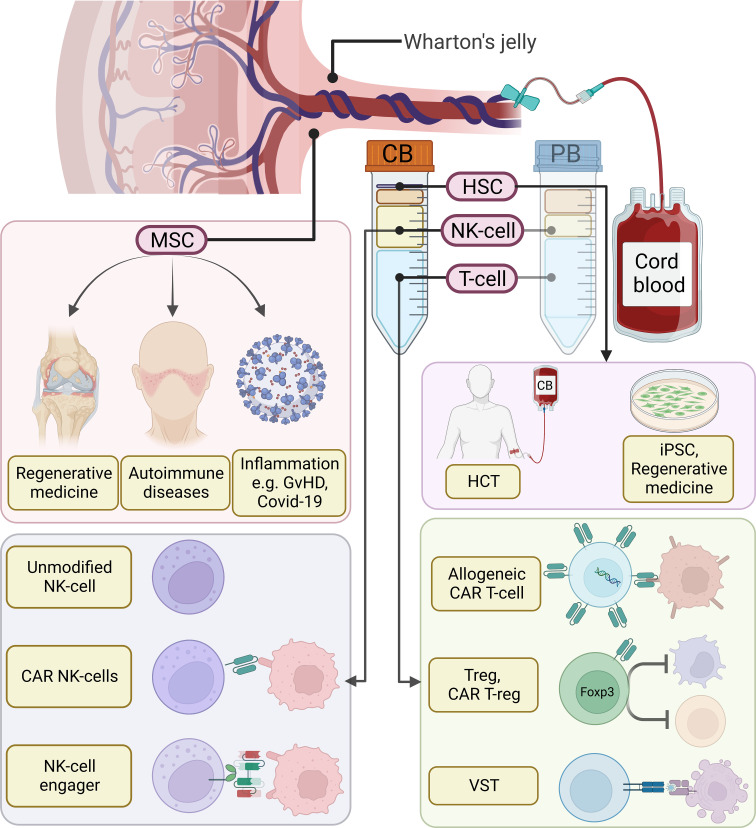
While cord blood (CB) is primarily utilized in allogeneic hematopoietic cell transplantation (HCT), the development of novel cell therapy products from CB is a growing and developing field. Compared to adult blood, CB is characterized by a higher percentage of hematopoietic stem cells (HSCs) and progenitor cells, less mature immune cells that retain a high capacity of proliferation, and stronger immune tolerance that requires less stringent HLA-matching when used in the allogenic setting. Given that CB is an FDA regulated product and along with its unique cellular composition, CB lends itself as a readily available and safe starting material for the development of off-the-shelf cell therapies. Moreover, non-hematologic cells such as mesenchymal stem cell (MSCs) residing in CB or CB tissue also have potential in regenerative medicine and inflammatory and autoimmune conditions. In this review, we will focus on recent clinical development on CB-derived cellular therapies in the field of oncology, including T-cell therapies such as chimeric antigen receptor (CAR) T-cells, regulatory T-cells, and virus-specific T-cells; NK-cell therapies, such as NK cell engagers and CAR NK-cells; CB-HCT and various modifications; as well as applications of MSCs in HCT.
虽然脐带血(CB)主要用于异基因造血细胞移植(HCT),但从脐带血开发新型细胞治疗产品是一个不断发展的领域。与成人血液相比,脐带血的特点是造血干细胞(HSC)和祖细胞的百分比更高,免疫细胞不太成熟但增殖能力强,并且免疫耐受性更强,在同种异体环境中使用时对HLA匹配的要求较低。鉴于脐带血是一种受美国食品药品监督管理局(FDA)监管的产品,并且其细胞组成独特,脐带血适合作为现成的安全起始材料用于开发即用型细胞疗法。此外,存在于脐带血或脐带血组织中的非血液学细胞,如间充质干细胞(MSC),在再生医学以及炎症和自身免疫性疾病方面也具有潜力。在本综述中,我们将重点关注肿瘤学领域中脐带血来源的细胞疗法的最新临床进展,包括嵌合抗原受体(CAR)T细胞、调节性T细胞和病毒特异性T细胞等T细胞疗法;NK细胞疗法,如NK细胞衔接器和CAR NK细胞;脐带血造血细胞移植(CB-HCT)及其各种改良;以及间充质干细胞在造血细胞移植中的应用。