Bai Mei, Wang Zhiyao, Lloyd James, Seneviratne Dilini, Flesch Thomas, Yuan Zhiguo, Chen Deli
School of Agriculture and Food Science, Faculty of Science, The University of Melbourne, Parkville, Victoria 3010, Australia.
Australian Centre for Water and Environmental Biotechnology (ACWEB, formerly AWMC), The University of Queensland, Brisbane, Queensland 4067, Australia.
Water Res X. 2023 May 26;19:100184. doi: 10.1016/j.wroa.2023.100184. eCollection 2023 May 1.
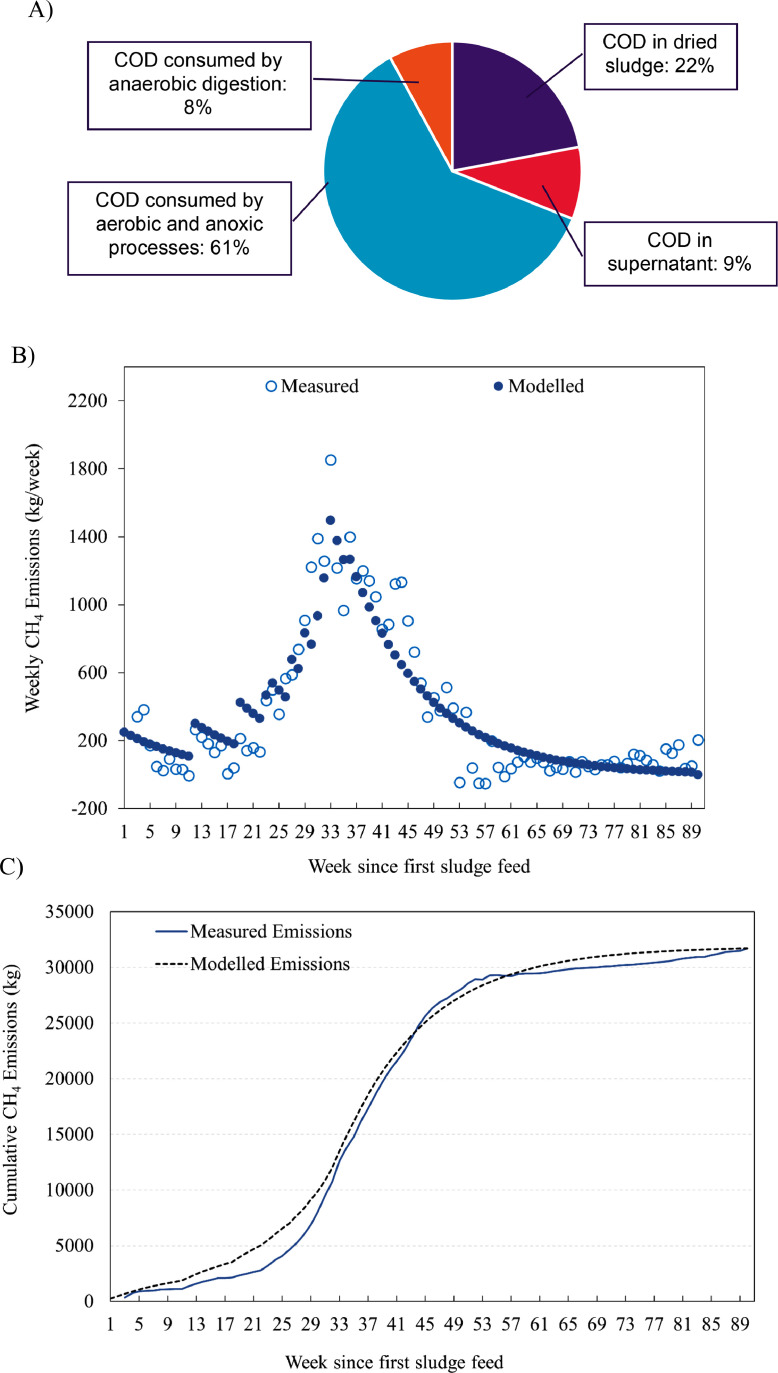
As the wastewater sector moves towards achieving net zero greenhouse gas (GHG) emissions, quantifying and understanding fugitive emissions from various sewage treatment steps is crucial for developing effective GHG abatement strategies. Methane (CH) emissions from a sludge drying pan (SDP) were measured at a wastewater treatment plant in Australia for more than a year, using a micrometeorological technique paired with open-path lasers. The emission rate was tightly associated with sludge additions, climatology, and operational processes. The mean emission rate during the 90 weeks after initial sludge addition was 2.3 (± 0.8) g m d, with cumulative emissions of approximately 32 t of CH. A dynamic temporal pattern of emissions was observed, highlighting the importance of continuous (or near-continuous) measurements for quantifying SDP emissions. A Methane Correction Factor (MCF) expressed as a fraction of the measured chemical oxygen demand of the sludge, was determined to be 0.17 after 63 weeks (the median operational cycle duration at the facility). This is broadly consistent with, albeit slightly less than, the IPCC default value of 0.2 for shallow anaerobic lagoons. These emission measurements will support wastewater utilities that employ open air sludge drying processes to develop effective GHG abatement strategies.
随着废水处理行业朝着实现温室气体(GHG)净零排放迈进,量化和了解各个污水处理步骤中的逸散排放对于制定有效的温室气体减排策略至关重要。在澳大利亚的一家污水处理厂,使用与开放路径激光相结合的微气象技术,对污泥干燥盘(SDP)的甲烷(CH)排放进行了为期一年多的测量。排放速率与污泥添加量、气候条件和运行过程密切相关。初次添加污泥后的90周内,平均排放速率为2.3(±0.8)g m² d,CH累积排放量约为32吨。观察到排放呈现动态时间模式,突出了连续(或近乎连续)测量对于量化SDP排放的重要性。在63周(该设施的中位运行周期时长)后,以污泥实测化学需氧量的分数表示的甲烷校正因子(MCF)确定为0.17。这与政府间气候变化专门委员会(IPCC)为浅厌氧泻湖设定的默认值0.2大致一致,尽管略低于该值。这些排放测量结果将有助于采用露天污泥干燥工艺的污水处理企业制定有效的温室气体减排策略。