Department of Anesthesiology and Perioperative Medicine, Xijing Hospital, The Fourth Military Medical University, Xi'an, 710032, China.
Sci Rep. 2023 Jun 5;13(1):9067. doi: 10.1038/s41598-023-36139-8.
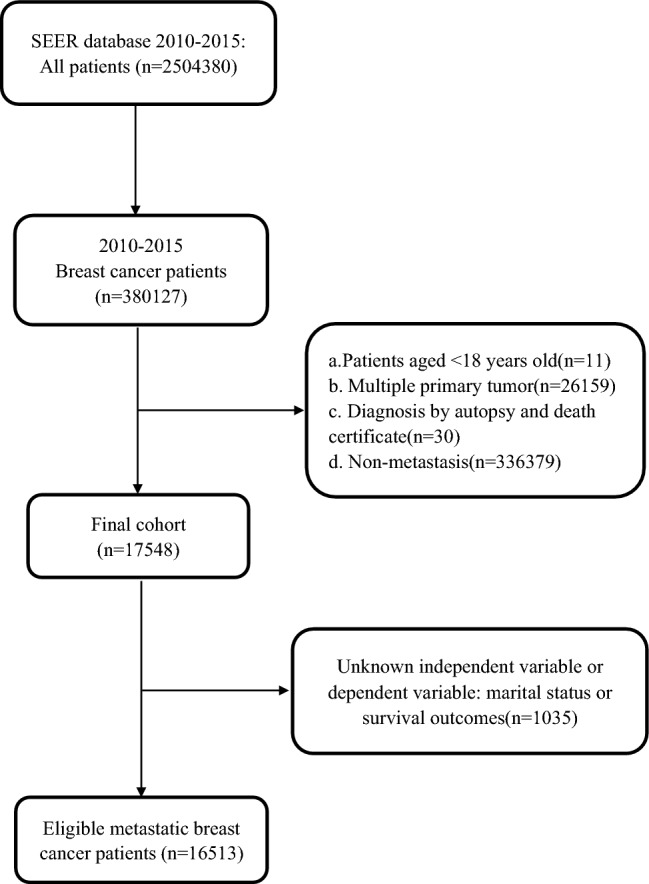
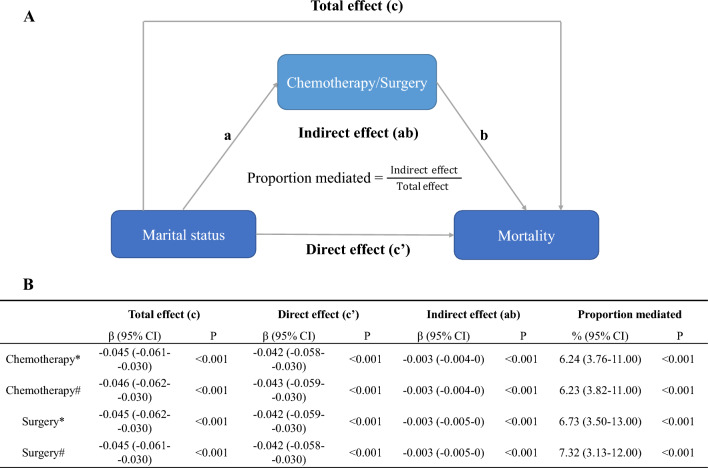
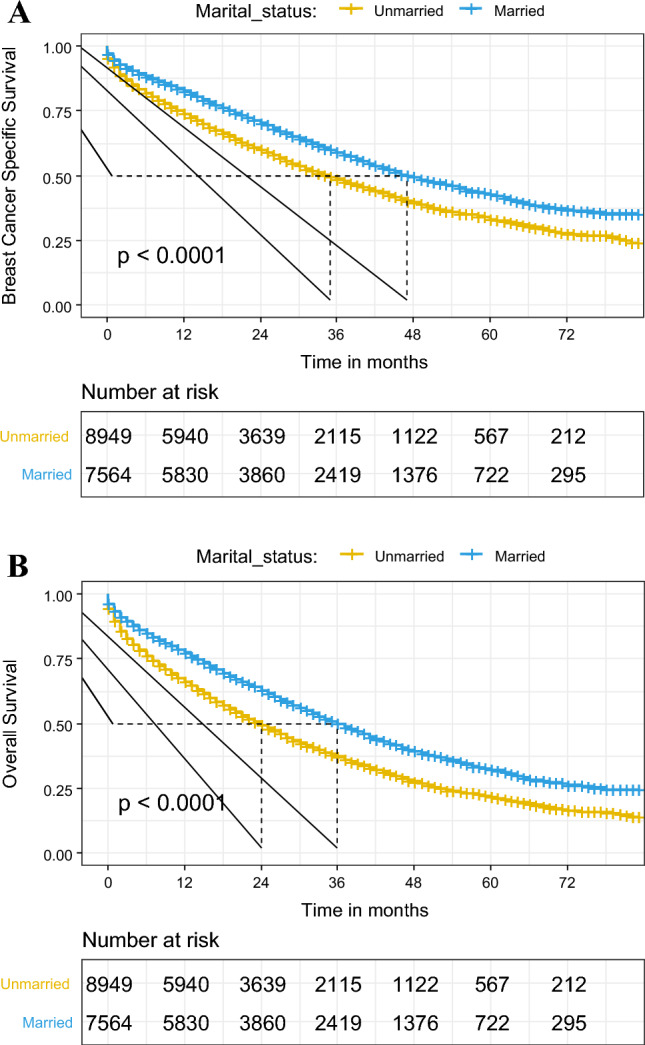
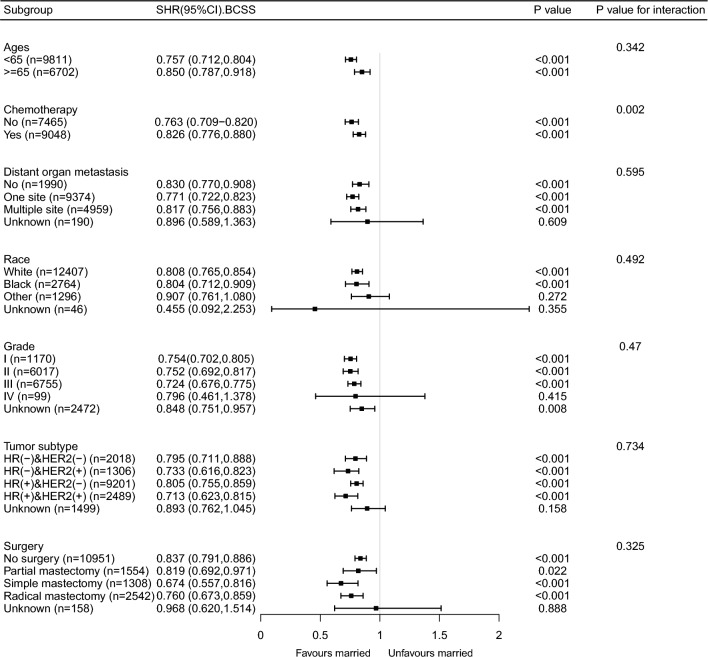
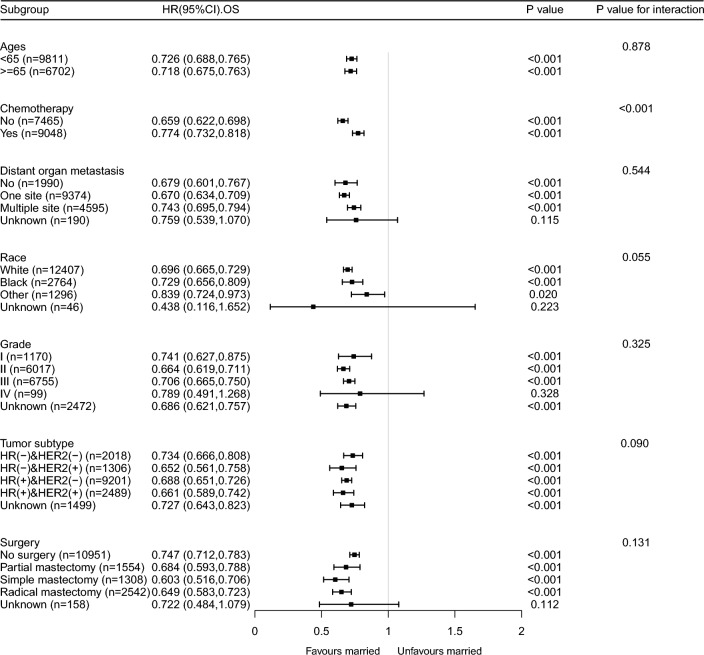
This study aimed to investigate the association between marital status and the prognosis of patients with metastatic breast cancer (MBC). Data of patients with MBC were obtained from the Surveillance, Epidemiology, and End Results (SEER) database. Patients were classified into married and unmarried groups. Kaplan-Meier analysis with the log-rank test was conducted to compare breast cancer-specific survival (BCSS) and overall survival (OS) between the groups. Univariable and multivariable Cox proportional models were used to determine whether marital status was independently associated with OS, and the Fine-Gray subdistribution hazard method was performed to determine whether marital status was independently associated with BCSS. In total, 16,513 patients with MBC were identified, including 8949 married (54.19%) and 7564 unmarried (45.81%) patients. The married patients were significantly younger [median age (interquartile range), 59.0 (50.0-68.0) vs. 63.0 (53.0-75.0); p < 0.001] and received more aggressive treatments, such as chemotherapy (p < 0.001) and surgery (p < 0.001), than the unmarried patients. Moreover, married patients had higher 5-year BCSS (42.64% vs. 33.17%, p < 0.0001) and OS (32.22% vs. 21.44%, p < 0.0001) rates. Multivariable analysis revealed that marital status was an independent prognostic factor, and married status was associated with a significant reduction in the risk of breast cancer-specific (sub-hazard ratio, 0.845; 95% confidence interval, 0.804-0.888; p < 0.001) and all-cause (hazard ratio, 0.810; 95% confidence interval, 0.777-0.844; p < 0.001) mortality. Unmarried patients had a 15.5% increased risk of breast cancer-specific mortality and a 19.0% increased risk of overall mortality compared with married patients with MBC. BCSS and OS were superior in married populations compared with unmarried populations in most subgroups. Marital status was an independent prognostic indicator for survival in patients with MBC and was associated with significant survival benefits.
这项研究旨在探讨婚姻状况与转移性乳腺癌(MBC)患者预后之间的关系。MBC 患者的数据来自监测、流行病学和最终结果(SEER)数据库。患者分为已婚和未婚组。采用 Kaplan-Meier 分析和对数秩检验比较两组间乳腺癌特异性生存(BCSS)和总生存(OS)。采用单变量和多变量 Cox 比例模型确定婚姻状况是否与 OS 独立相关,采用 Fine-Gray 亚分布风险方法确定婚姻状况是否与 BCSS 独立相关。共纳入 16513 例 MBC 患者,其中已婚 8949 例(54.19%),未婚 7564 例(45.81%)。与未婚患者相比,已婚患者明显更年轻[中位年龄(四分位数范围),59.0(50.0-68.0)比 63.0(53.0-75.0);p<0.001],接受的治疗更积极,如化疗(p<0.001)和手术(p<0.001)。此外,已婚患者的 5 年 BCSS(42.64%比 33.17%,p<0.0001)和 OS(32.22%比 21.44%,p<0.0001)率更高。多变量分析显示,婚姻状况是独立的预后因素,已婚状态与乳腺癌特异性(亚危险比,0.845;95%置信区间,0.804-0.888;p<0.001)和全因(风险比,0.810;95%置信区间,0.777-0.844;p<0.001)死亡率降低显著相关。与已婚 MBC 患者相比,未婚患者乳腺癌特异性死亡率增加 15.5%,总死亡率增加 19.0%。在大多数亚组中,已婚人群的 BCSS 和 OS 优于未婚人群。婚姻状况是 MBC 患者生存的独立预后指标,与显著的生存获益相关。