College of Grassland Science and Technology, China Agricultural University, Beijing, 100193, China.
BMC Plant Biol. 2023 Jun 6;23(1):301. doi: 10.1186/s12870-023-04318-4.
Medicago sativa is the most important forage world widely, and is characterized by high quality and large biomass. While abiotic factors such as salt stress can negatively impact the growth and productivity of alfalfa. Maintaining Na/K homeostasis in the cytoplasm helps reduce cell damage and nutritional deprivation, which increases a salt-tolerance of plant. Teosinte Branched1/ Cycloidea/ Proliferating cell factors (TCP) family genes, a group of plant-specific transcription factors (TFs), involved in regulating plant growth and development and abiotic stresses. Recent studies have shown TCPs control the Na/K concentration of plants during salt stress. In order to improve alfalfa salt tolerance, it is important to identify alfalfa TCP genes and investigate if and how they regulate alfalfa Na/K homeostasis.
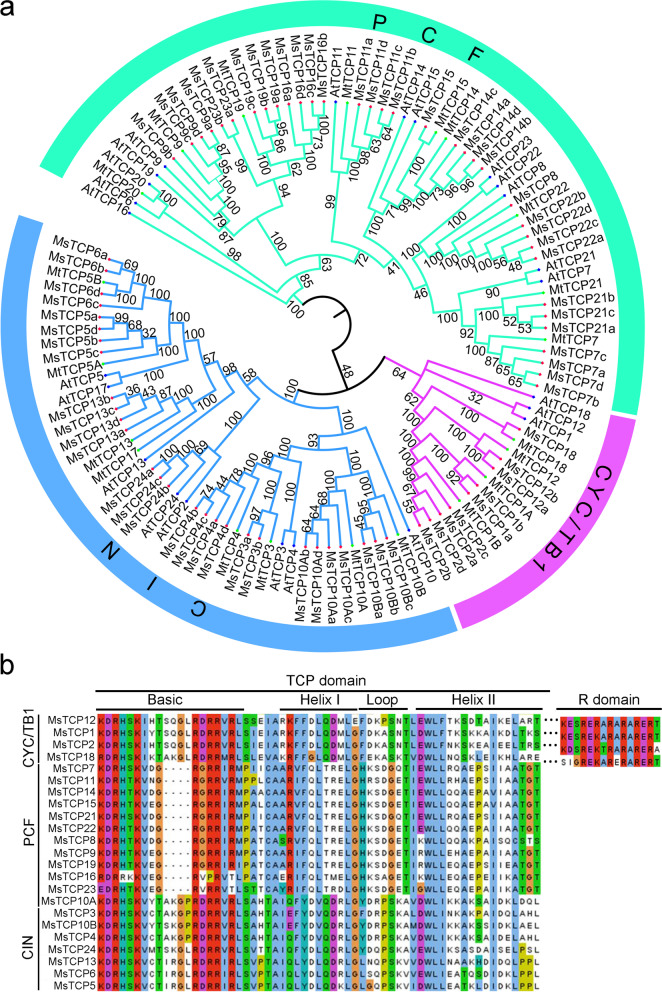
Seventy-one MsTCPs including 23 non-redundant TCP genes were identified in the database of alfalfa genome (C.V XinJiangDaYe), they were classified into class I PCF (37 members) and class II: CIN (28 members) and CYC/TB1 (9 members). Their distribution on chromosome were unequally. MsTCPs belonging to PCF were expressed specifically in different organs without regularity, which belonging to CIN class were mainly expressed in mature leaves. MsTCPs belongs to CYC/TB1 clade had the highest expression level at meristem. Cis-elements in the promoter of MsTCPs were also predicted, the results indicated that most of the MsTCPs will be induced by phytohormone and stress treatments, especially by ABA-related stimulus including salinity stress. We found 20 out of 23 MsTCPs were up-regulated in 200 mM NaCl treatment, and MsTCP3/14/15/18 were significantly induced by 10 μM KCl, a K deficiency treatment. Fourteen non-redundant MsTCPs contained miR319 target site, 11 of them were upregulated in MIM319 transgenic alfalfa, and among them four (MsTCP3/4/10A/B) genes were directly degraded by miR319. MIM319 transgene alfalfa plants showed a salt sensitive phenotype, which caused by a lower content of potassium in alfalfa at least partly. The expression of potassium transported related genes showed significantly higher expression in MIM319 plants.
We systematically analyzes the MsTCP gene family at a genome-wide level and reported that miR319-TCPs model played a function in K up-taking and/ or transportation especially in salt stress. The study provide valuable information for future study of TCP genes in alfalfa and supplies candidate genes for salt-tolerance alfalfa molecular-assisted breeding.
紫花苜蓿是世界上最重要的饲料作物,具有品质高、生物量大的特点。然而,盐胁迫等非生物因素会对苜蓿的生长和生产力产生负面影响。在细胞质中维持钠/钾平衡有助于减少细胞损伤和营养缺乏,从而提高植物的耐盐性。Teosinte Branched1/Cycloidea/Proliferating cell factors (TCP) 家族基因是一组植物特异性转录因子 (TFs),参与调节植物的生长发育和非生物胁迫。最近的研究表明,TCP 控制植物在盐胁迫下的钠/钾浓度。为了提高苜蓿的耐盐性,鉴定苜蓿 TCP 基因并研究它们如何调节苜蓿的钠/钾平衡非常重要。
从紫花苜蓿基因组数据库 (C.V XinJiangDaYe) 中鉴定出 71 个 MsTCPs,包括 23 个非冗余 TCP 基因,它们被分为 I 类 PCF(37 个成员)和 II 类:CIN(28 个成员)和 CYC/TB1(9 个成员)。它们在染色体上的分布不均匀。属于 PCF 的 MsTCP 基因在不同器官中的表达特异性,没有规律,属于 CIN 类的基因主要在成熟叶片中表达。属于 CYC/TB1 分支的 MsTCPs 在分生组织中具有最高的表达水平。还预测了 MsTCPs 启动子中的顺式元件,结果表明,大多数 MsTCPs 将被植物激素和应激处理诱导,特别是盐胁迫等与 ABA 相关的刺激。我们发现,在 200mM NaCl 处理下,23 个 MsTCPs 中有 20 个上调,在 10μM KCl 处理下,MsTCP3/14/15/18 明显上调,这是一种钾缺乏处理。14 个非冗余 MsTCPs 含有 miR319 靶位点,其中 11 个在 MIM319 转基因苜蓿中上调,其中 4 个(MsTCP3/4/10A/B)基因被 miR319 直接降解。MIM319 转基因苜蓿植物表现出盐敏感表型,这至少部分是由于苜蓿中钾含量较低所致。钾转运相关基因的表达在 MIM319 植物中表现出明显更高的表达。
我们系统地在全基因组水平上分析了 MsTCP 基因家族,并报告了 miR319-TCPs 模型在钾吸收和/或运输,特别是在盐胁迫中发挥了作用。该研究为苜蓿 TCP 基因的进一步研究提供了有价值的信息,并为耐盐苜蓿分子辅助育种提供了候选基因。