Song Zhibing, Li Xinyu, Lv Mengting, Guo Yuchen, Deng Shanshan, Zhang Yuefan, Li Tiejun
School of Medicine, Shanghai University; College of Biological and Medical Engineering, Donghua University, Shanghai, China.
School of Medicine, Shanghai University, Shanghai, China.
Neural Regen Res. 2023 Nov;18(11):2429-2435. doi: 10.4103/1673-5374.371367.
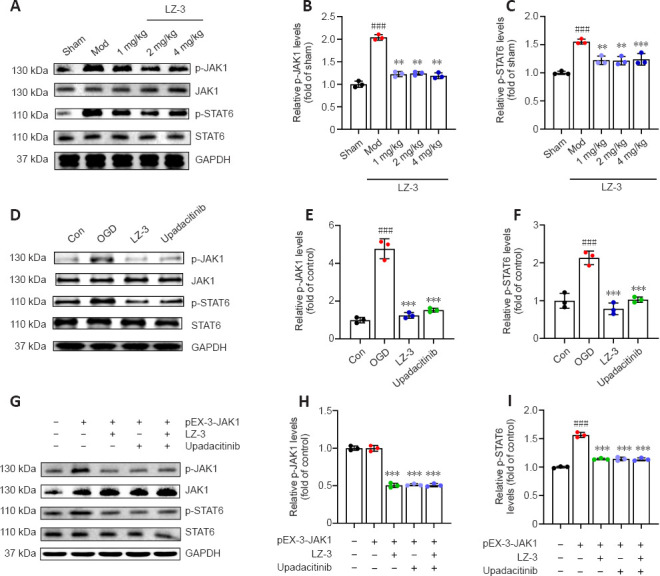
We previously found that monocyte locomotion inhibitory factor has a neuroprotective effect on ischemic brain injury during the acute phase of stroke. Therefore, we modified the structure of an anti-inflammatory monocyte locomotion inhibitory factor peptide to construct an active cyclic peptide-Cyclo (MQCNS) (LZ-3)-and investigated its effects on ischemic stroke. In this study, we established a rat model of ischemic stroke by occluding the middle cerebral artery and then administered LZ-3 (2 or 4 mg/kg) via the tail vein for 7 consecutive days. Our results showed that LZ-3 (2 or 4 mg/kg) substantially decreased infarct volume, reduced cortical nerve cell death, improved neurological function, reduced cortical and hippocampal injury, and decreased the levels of inflammatory factors in the blood and brain tissues. In a well-differentiated, oxygen-glucose deprivation/reoxygenation-induced BV2 cell model of post-stroke, LZ-3 (100 μM) inhibited the JAK1-STAT6 signaling pathway. LZ-3 regulated microglia/macrophage polarization from the M1 to the M2 type and inhibited microglia/macrophage phagocytosis and migration via the JAK1/STAT6 signaling pathway. To conclude, LZ-3 regulates microglial activation by inhibiting the JAK1/STAT6 signaling pathway and improves functional recovery post-stroke.
我们先前发现,单核细胞移动抑制因子对中风急性期的缺血性脑损伤具有神经保护作用。因此,我们对一种抗炎性单核细胞移动抑制因子肽的结构进行了修饰,构建了一种活性环肽——环(MQCNS)(LZ-3),并研究了其对缺血性中风的影响。在本研究中,我们通过阻断大脑中动脉建立了大鼠缺血性中风模型,然后经尾静脉连续7天给予LZ-3(2或4mg/kg)。我们的结果表明,LZ-3(2或4mg/kg)可显著减少梗死体积,减少皮质神经细胞死亡,改善神经功能,减轻皮质和海马损伤,并降低血液和脑组织中炎症因子的水平。在一个分化良好的、氧糖剥夺/复氧诱导的中风后BV2细胞模型中,LZ-3(100μM)抑制了JAK1-STAT6信号通路。LZ-3通过JAK1/STAT6信号通路调节小胶质细胞/巨噬细胞从M1型向M2型极化,并抑制小胶质细胞/巨噬细胞的吞噬作用和迁移。总之,LZ-3通过抑制JAK1/STAT6信号通路调节小胶质细胞活化,并改善中风后的功能恢复。