• 文献检索
  • 文档翻译
  • 深度研究
  • 学术资讯
  • Suppr Zotero 插件Zotero 插件
  • 邀请有礼
  • 套餐&价格
  • 历史记录
应用&插件
Suppr Zotero 插件Zotero 插件浏览器插件Mac 客户端Windows 客户端微信小程序
定价
高级版会员购买积分包购买API积分包
服务
文献检索文档翻译深度研究API 文档MCP 服务
关于我们
关于 Suppr公司介绍联系我们用户协议隐私条款
关注我们

Suppr 超能文献

核心技术专利:CN118964589B侵权必究
粤ICP备2023148730 号-1Suppr @ 2026

文献检索

告别复杂PubMed语法,用中文像聊天一样搜索,搜遍4000万医学文献。AI智能推荐,让科研检索更轻松。

立即免费搜索

文件翻译

保留排版,准确专业,支持PDF/Word/PPT等文件格式,支持 12+语言互译。

免费翻译文档

深度研究

AI帮你快速写综述,25分钟生成高质量综述,智能提取关键信息,辅助科研写作。

立即免费体验

与巴西东北部流行期间登革热和基孔肯雅热病毒感染死亡相关的因素:一项回顾性队列研究。

Factors associated with death from dengue and chikungunya virus infection during an epidemic period in Northeast Brazil: A retrospective cohort study.

机构信息

Universidade Federal de Pernambuco, Programa de Pós-Graduação em Medicina Tropical, Recife, PE, Brasil.

Universidade Federal de Pernambuco, Centro Acadêmico de Vitória, Centro de Saúde Coletiva, Vitória de Santo Antão, PE, Brasil.

出版信息

Rev Soc Bras Med Trop. 2023 Jun 2;56:e0030. doi: 10.1590/0037-8682-0030-2023. eCollection 2023.

DOI:10.1590/0037-8682-0030-2023
PMID:37283343
原文链接:https://pmc.ncbi.nlm.nih.gov/articles/PMC10238066/
Abstract

BACKGROUND

We investigated the time to death and factors associated with deaths from dengue and chikungunya during the first epidemic after the introduction of the chikungunya virus in Northeastern Brazil.

METHODS

This retrospective cohort study was conducted in Pernambuco between 2015 and 2018. Logistic regression was used to identify independent risk factors. The probability of survival among individuals with different arbovirus infections was estimated and the survival curves were compared using log-rank tests.

RESULTS

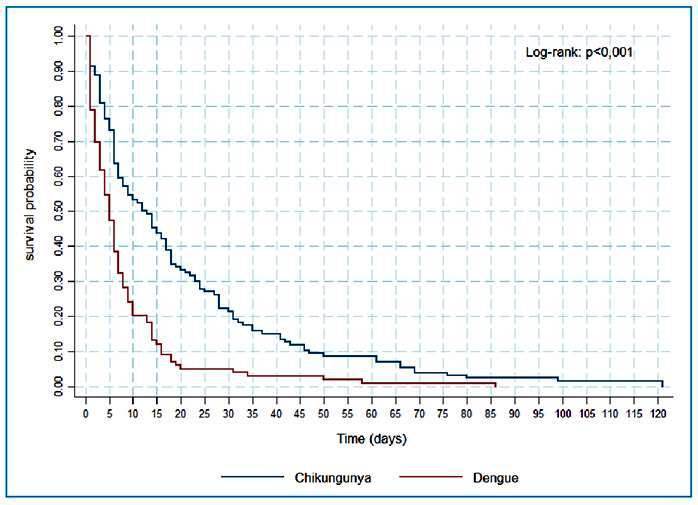
The lethality coefficients for dengue and chikungunya viruses were 0.08% and 0.35%, respectively. The chance of death due to chikungunya infection increased progressively from the age of 40 years. At 40-49 years, the odds ratio was 13.83 (95%CI, 1.80-106.41). At 50-59 years and 60 years or older, the odds ratio was 27.63 (95%CI, 3.70-206.48); and 78.72 (95%CI, 10.93-566.90), respectively. The probability of death associated with dengue virus infection increased from the age of 50 years. Among patients aged 50-59 years and 60 years or older, the odds ratio was 4.30 (95%CI, 1.80-10.30) and 8.97 (95%CI, 4.00-20.0), respectively. Independent factors associated death were headache and age of 50 years or older for dengue; and headache, nausea, back pain, intense arthralgia, age 0-9 years or 40 years and older, and male sex for chikungunya. The ratio between mortality rates revealed that the time to death from dengue was 2.1 times faster than that from chikungunya (95%CI, 1.57-2.72).

CONCLUSIONS

The time to death was shorter in patients with dengue than in those with chikungunya disease. This study reinforces the need for faster and more effective decision-making in public health services to enhance patient outcomes and minimize mortality.

摘要

背景

本研究旨在调查巴西东北部首次引入基孔肯雅热病毒后登革热和基孔肯雅热相关死亡的时间及相关因素。

方法

本回顾性队列研究于 2015 年至 2018 年在伯南布哥州进行。采用逻辑回归分析鉴定独立的危险因素。估计不同虫媒病毒感染者的生存概率,并采用对数秩检验比较生存曲线。

结果

登革热病毒和基孔肯雅热病毒的致死系数分别为 0.08%和 0.35%。基孔肯雅热病毒感染导致死亡的几率从 40 岁开始逐渐增加。40-49 岁时,比值比为 13.83(95%CI,1.80-106.41)。50-59 岁和 60 岁及以上时,比值比分别为 27.63(95%CI,3.70-206.48)和 78.72(95%CI,10.93-566.90)。登革热病毒感染相关死亡的几率从 50 岁开始增加。50-59 岁和 60 岁及以上的患者中,比值比分别为 4.30(95%CI,1.80-10.30)和 8.97(95%CI,4.00-20.0)。与死亡相关的独立因素为登革热患者的头痛和 50 岁及以上年龄,以及基孔肯雅热患者的头痛、恶心、背痛、剧烈关节痛、0-9 岁或 40 岁及以上年龄和男性。死亡率比值表明,登革热患者的死亡时间比基孔肯雅热患者快 2.1 倍(95%CI,1.57-2.72)。

结论

与基孔肯雅热相比,登革热患者的死亡时间更短。本研究强调公共卫生服务部门需要更快、更有效地做出决策,以改善患者预后并降低死亡率。
https://cdn.ncbi.nlm.nih.gov/pmc/blobs/3957/10238066/2f7e17762f1d/1678-9849-rsbmt-56-e0030-2023-gf1.jpg

相似文献

1
Factors associated with death from dengue and chikungunya virus infection during an epidemic period in Northeast Brazil: A retrospective cohort study.与巴西东北部流行期间登革热和基孔肯雅热病毒感染死亡相关的因素:一项回顾性队列研究。
Rev Soc Bras Med Trop. 2023 Jun 2;56:e0030. doi: 10.1590/0037-8682-0030-2023. eCollection 2023.
2
Seroprevalence, spatial dispersion and factors associated with flavivirus and chikungunha infection in a risk area: a population-based seroprevalence study in Brazil.在一个风险地区,与黄病毒和基孔肯雅热感染相关的血清流行率、空间分布和因素:巴西的一项基于人群的血清流行率研究。
BMC Infect Dis. 2020 Nov 24;20(1):881. doi: 10.1186/s12879-020-05611-5.
3
A spatial analysis of co-circulating dengue and chikungunya virus infections during an epidemic in a region of Northeastern Brazil.巴西东北部某地区登革热和基孔肯雅热病毒同时流行的空间分析。
Spat Spatiotemporal Epidemiol. 2023 Aug;46:100589. doi: 10.1016/j.sste.2023.100589. Epub 2023 Jun 1.
4
Survival analysis in non-congenital neurological disorders related to dengue, chikungunya and Zika virus infections in Northeast Brazil.巴西东北部登革热、基孔肯雅热和寨卡病毒感染相关非先天性神经系统疾病的生存分析
Rev Inst Med Trop Sao Paulo. 2020 Sep 30;62:e69. doi: 10.1590/S1678-9946202062069. eCollection 2020.
5
The Challenges Imposed by Dengue, Zika, and Chikungunya to Brazil.登革热、寨卡和基孔肯雅热对巴西构成的挑战。
Front Immunol. 2018 Aug 28;9:1964. doi: 10.3389/fimmu.2018.01964. eCollection 2018.
6
Epidemiological profile of Zika, Dengue and Chikungunya virus infections identified by medical and molecular evaluations in Rondonia, Brazil.通过医学和分子评估确定的巴西朗多尼亚州寨卡病毒、登革热病毒和基孔肯雅病毒感染的流行病学概况
Rev Inst Med Trop Sao Paulo. 2019 Aug 19;61:e40. doi: 10.1590/S1678-9946201961040.
7
The spectrum of neurological disease associated with Zika and chikungunya viruses in adults in Rio de Janeiro, Brazil: A case series.巴西里约热内卢成年人中与寨卡和基孔肯雅病毒相关的神经疾病谱:病例系列。
PLoS Negl Trop Dis. 2018 Feb 12;12(2):e0006212. doi: 10.1371/journal.pntd.0006212. eCollection 2018 Feb.
8
Concomitant Transmission of Dengue, Chikungunya, and Zika Viruses in Brazil: Clinical and Epidemiological Findings From Surveillance for Acute Febrile Illness.巴西登革热、基孔肯雅热和寨卡病毒的共同传播:急性发热性疾病监测的临床和流行病学发现
Clin Infect Dis. 2019 Sep 27;69(8):1353-1359. doi: 10.1093/cid/ciy1083.
9
Epidemiological profile of arboviruses in two different scenarios: dengue circulation vs. dengue, chikungunya and Zika co-circulation.虫媒病毒在两种不同情况下的流行病学特征:登革热传播与登革热、基孔肯雅热和寨卡病毒共同传播。
BMC Infect Dis. 2023 Mar 22;23(1):177. doi: 10.1186/s12879-023-08139-6.
10
Seroprevalence of Dengue, Chikungunya and Zika at the epicenter of the congenital microcephaly epidemic in Northeast Brazil: A population-based survey.巴西东北部先天性小头畸形流行中心登革热、基孔肯雅热和寨卡病毒血清流行率:一项基于人群的调查。
PLoS Negl Trop Dis. 2023 Jul 3;17(7):e0011270. doi: 10.1371/journal.pntd.0011270. eCollection 2023 Jul.

引用本文的文献

1
Risk factors for dengue mortality: a 7-year retrospective cohort in Honduras.登革热死亡的危险因素:洪都拉斯一项为期7年的回顾性队列研究
BMC Infect Dis. 2025 Jan 31;25(1):147. doi: 10.1186/s12879-025-10544-y.
2
The greatest Dengue epidemic in Brazil: Surveillance, Prevention, and Control.巴西历史上最严重的登革热疫情:监测、预防和控制。
Rev Soc Bras Med Trop. 2024 Sep 20;57:e002032024. doi: 10.1590/0037-8682-0113-2024. eCollection 2024.
3
Risk factors associated with dengue complications and death: A cohort study in Peru.与登革热并发症和死亡相关的风险因素:秘鲁的一项队列研究。

本文引用的文献

1
Leucocytosis and early organ involvement as risk factors of mortality in adults with dengue fever.白细胞增多和早期器官受累是登革热成人患者死亡的危险因素。
Drug Discov Ther. 2021 Jan 23;14(6):313-318. doi: 10.5582/ddt.2020.03089. Epub 2020 Dec 27.
2
Survival analysis in non-congenital neurological disorders related to dengue, chikungunya and Zika virus infections in Northeast Brazil.巴西东北部登革热、基孔肯雅热和寨卡病毒感染相关非先天性神经系统疾病的生存分析
Rev Inst Med Trop Sao Paulo. 2020 Sep 30;62:e69. doi: 10.1590/S1678-9946202062069. eCollection 2020.
3
Events preceding death among chikungunya virus infected patients: a systematic review.
PLoS One. 2024 Jun 25;19(6):e0305689. doi: 10.1371/journal.pone.0305689. eCollection 2024.
4
Immune Response to Chikungunya Virus: Sex as a Biological Variable and Implications for Natural Delivery via the Mosquito.基孔肯雅病毒的免疫反应:性别作为生物学变量及其对蚊子自然传播的影响。
Viruses. 2023 Sep 3;15(9):1869. doi: 10.3390/v15091869.
基孔肯雅热病毒感染患者死亡前的事件:系统评价。
Rev Soc Bras Med Trop. 2020;53:e04312019. doi: 10.1590/0037-8682-0431-2019. Epub 2020 May 11.
4
Dengue in Fiji: epidemiology of the 2014 DENV-3 outbreak.斐济的登革热:2014年登革热病毒3型疫情的流行病学
Western Pac Surveill Response J. 2019 May 15;10(2):31-38. doi: 10.5365/wpsar.2018.9.3.001. eCollection 2019 Apr-Jun.
5
Risk factors for death among patients with Chikungunya virus infection during the outbreak in northeast Brazil, 2016-2017.2016-2017 年巴西东北部基孔肯雅热病毒感染患者死亡的危险因素。
Trans R Soc Trop Med Hyg. 2019 Apr 1;113(4):221-226. doi: 10.1093/trstmh/try127.
6
Post Chikungunya Chronic Arthritis: Systemic Inflammatory Status Triggering Acute Coronary Syndrome.基孔肯雅热后慢性关节炎:引发急性冠状动脉综合征的全身炎症状态
Curr Rheumatol Rev. 2019;15(3):229-233. doi: 10.2174/1573397114666180816112948.
7
[Not Available].[无可用内容]
J Vasc Bras. 2017 Apr-Jun;16(2):88-91. doi: 10.1590/1677-5449.041117.
8
Prediction of mortality in severe dengue cases.严重登革热病例的死亡率预测。
BMC Infect Dis. 2018 May 21;18(1):232. doi: 10.1186/s12879-018-3141-6.
9
Is the recent increment in attributable deaths to type-2 diabetes (T2D) associated with the latest chikungunya outbreak in a major epidemic area in Brazil?巴西一个主要流行地区近期2型糖尿病(T2D)所致死亡人数的增加是否与最近的基孔肯雅热疫情有关?
Rev Soc Bras Med Trop. 2018 Jan-Feb;51(1):63-65. doi: 10.1590/0037-8682-0440-2017.
10
Excess Mortality Related to Chikungunya Epidemics in the Context of Co-circulation of Other Arboviruses in Brazil.在巴西其他虫媒病毒共同传播背景下,与基孔肯雅热疫情相关的超额死亡率
PLoS Curr. 2017 Nov 13;9:ecurrents.outbreaks.14608e586cd321d8d5088652d7a0d884. doi: 10.1371/currents.outbreaks.14608e586cd321d8d5088652d7a0d884.