Department of Epidemiology, Brown University School of Public Health, Providence, Rhode Island, USA.
Department of Epidemiology, Johns Hopkins Bloomberg School of Public Health, Baltimore, Maryland, USA.
Environ Health Perspect. 2023 Jun;131(6):67001. doi: 10.1289/EHP11545. Epub 2023 Jun 7.
Gestational per- and polyfluoroalkyl substances (PFAS) exposure may be associated with adiposity and increased risk of obesity among children and adolescents. However, results from epidemiological studies evaluating these associations are inconsistent.
We estimated the associations of pregnancy PFAS concentrations with child body mass index (BMI) -scores and risk of overweight/obesity in eight U.S. cohorts.
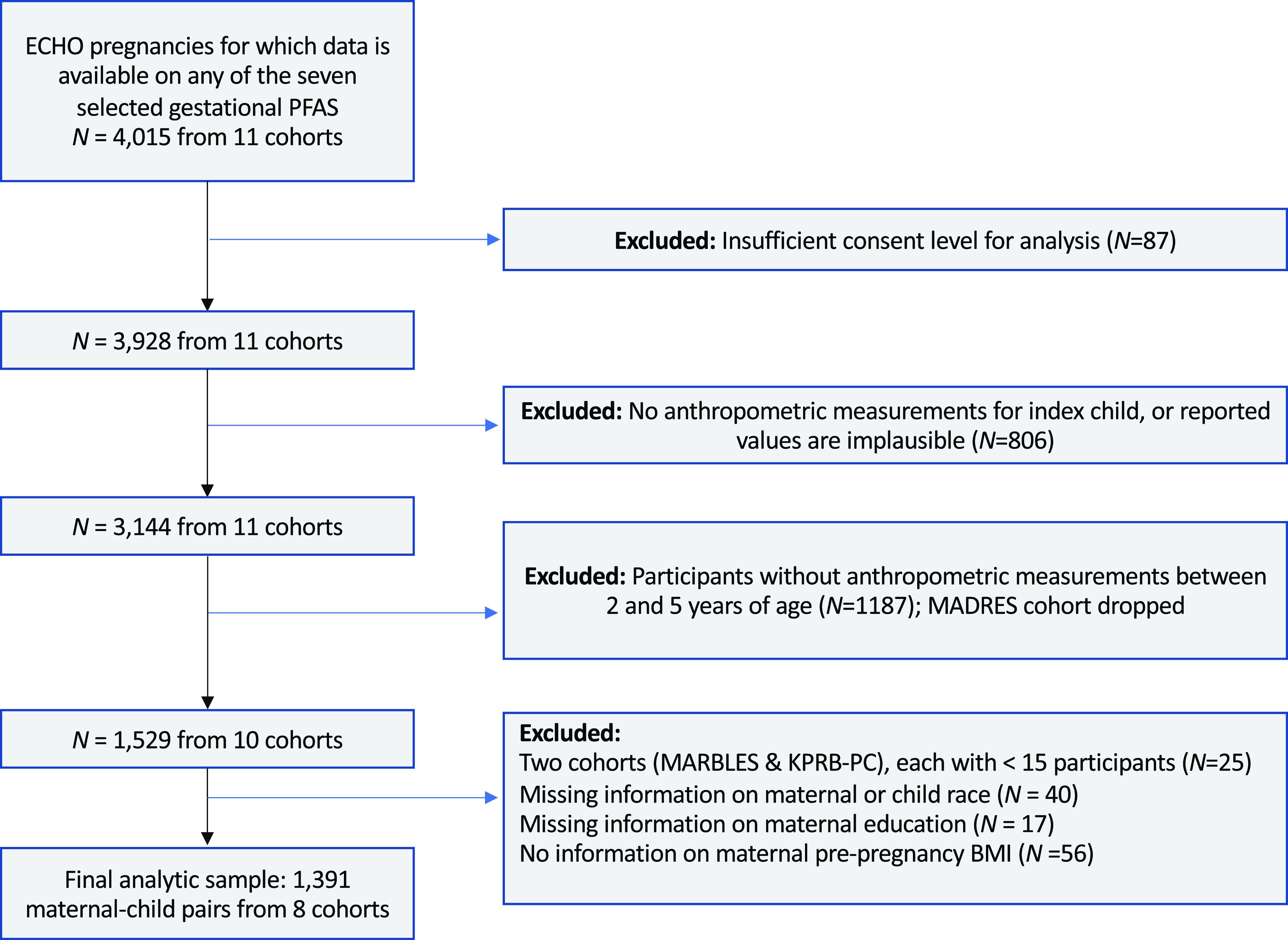
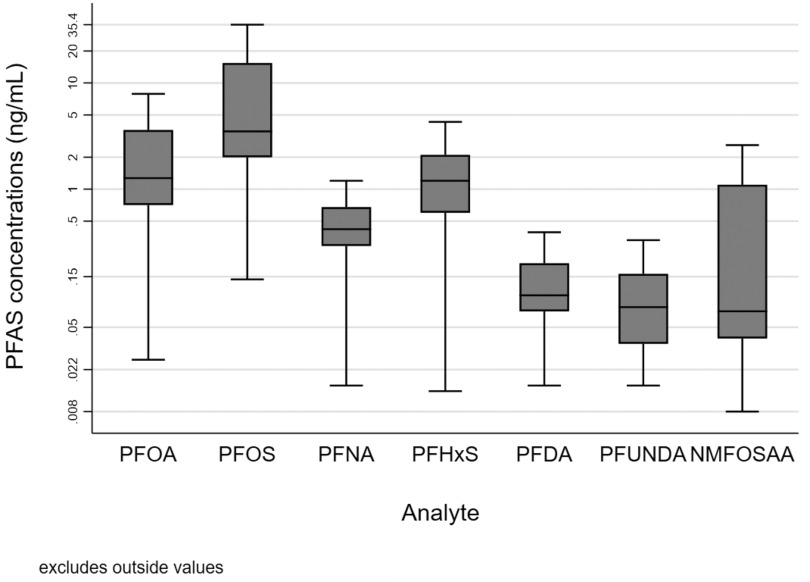
We used data from 1,391 mother-child pairs who enrolled in eight Environmental influences on Child Health Outcomes (ECHO) cohorts (enrolled: 1999-2019). We quantified concentrations of seven PFAS in maternal plasma or serum in pregnancy. We measured child weight and height between the ages of 2 and 5 y and calculated age- and sex-specific BMI -scores; 19.6% children had more than one BMI measurement. We estimated covariate-adjusted associations of individual PFAS and their mixture with child BMI -scores and risk of overweight/obesity using linear mixed models, modified Poisson regression models, and Bayesian approaches for mixtures. We explored whether child sex modified these associations.
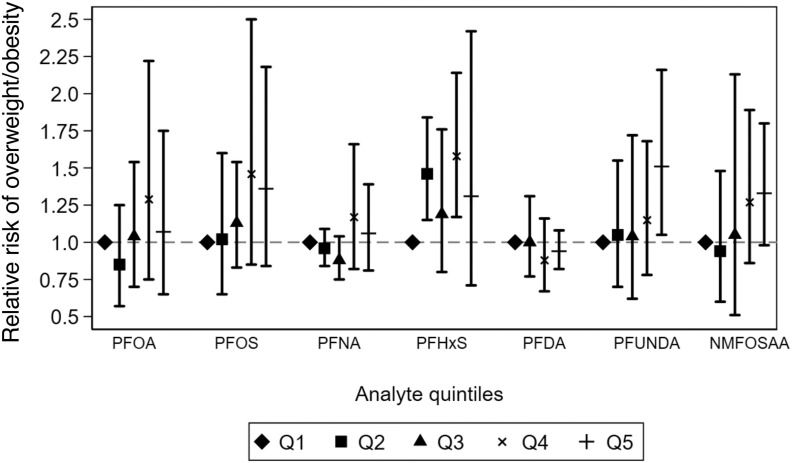
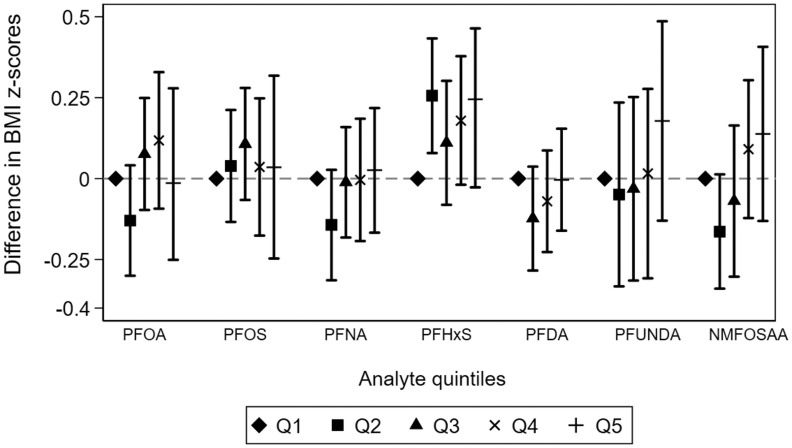
We observed a pattern of subtle positive associations of PFAS concentrations in pregnancy with BMI -scores and risk of overweight/obesity. For instance, each doubling in perfluorohexane sulfonic acid concentrations was associated with higher BMI -scores (; 95% CI: 0.01, 0.12). Each doubling in perfluroundecanoic acid [; 95% CI: 1.04, 1.16] and -methyl perfluorooctane sulfonamido acetic acid (; 95% CI: 1.00, 1.12) was associated with increased risk of overweight/obesity, with some evidence of a monotonic dose-response relation. We observed weaker and more imprecise associations of the PFAS mixture with BMI or risk of overweight/obesity. Associations did not differ by child sex.
In eight U.S.-based prospective cohorts, gestational exposure to higher levels of PFAS were associated with slightly higher childhood BMI -score and risk of overweight or obesity. Future studies should examine associations of gestational exposure to PFAS with adiposity and related cardiometabolic consequences in older children. https://doi.org/10.1289/EHP11545.
妊娠期间的全氟和多氟烷基物质(PFAS)暴露可能与儿童和青少年的肥胖症和肥胖风险增加有关。然而,评估这些关联的流行病学研究结果并不一致。
我们估计了 8 项美国队列中妊娠期间 PFAS 浓度与儿童体重指数(BMI)得分和超重/肥胖风险的关联。
我们使用了 1391 对母子参与 8 项环境对儿童健康结果的影响(ECHO)队列(入组时间:1999-2019 年)的数据。我们在妊娠期间定量测量了母亲血浆或血清中的 7 种 PFAS 浓度。我们在 2 至 5 岁之间测量了儿童的体重和身高,并计算了年龄和性别特异性 BMI 得分;19.6%的儿童有超过一次的 BMI 测量。我们使用线性混合模型、修正泊松回归模型和混合物的贝叶斯方法,估计了个体 PFAS 及其混合物与儿童 BMI 得分和超重/肥胖风险的协变量调整关联。我们探讨了儿童性别是否改变了这些关联。
我们观察到妊娠期间 PFAS 浓度与 BMI 得分和超重/肥胖风险呈轻微正相关的模式。例如,每增加一倍的全氟己烷磺酸浓度与更高的 BMI 得分相关(95%置信区间:0.01,0.12)。每增加一倍的全氟癸酸[95%置信区间:1.04,1.16]和-甲基全氟辛烷磺酰胺基乙酸(95%置信区间:1.00,1.12)与超重/肥胖风险增加相关,存在单调剂量反应关系的一些证据。我们观察到 PFAS 混合物与 BMI 或超重/肥胖风险的关联较弱且不精确。这些关联不因儿童性别而异。
在 8 项基于美国的前瞻性队列研究中,妊娠期间暴露于较高水平的 PFAS 与儿童 BMI 得分略高和超重或肥胖的风险增加有关。未来的研究应该研究妊娠期间 PFAS 暴露与肥胖和相关心血管代谢后果在年龄较大的儿童中的关联。