Department of Surgery, Amsterdam UMC Location University of Amsterdam, Meibergdreef 9, Amsterdam, The Netherlands.
Cancer Treatment and Quality of Life, Cancer Center Amsterdam, Amsterdam, The Netherlands.
Gastric Cancer. 2023 Sep;26(5):763-774. doi: 10.1007/s10120-023-01404-2. Epub 2023 Jun 7.
In trials evaluating perioperative chemotherapy for gastric cancer, which serve as the basis for treatment guidelines, patients are selected. The generalizability of these trial findings to older patients is uncertain.
This population-based retrospective cohort study compared the survival outcomes of patients ≥ 75 years with gastric adenocarcinoma treated with or without neoadjuvant chemotherapy between 2015 and 2019. Additionally, the percentage of patients < 75 years and ≥ 75 years who did not proceeded to surgery after receiving neoadjuvant chemotherapy were examined.
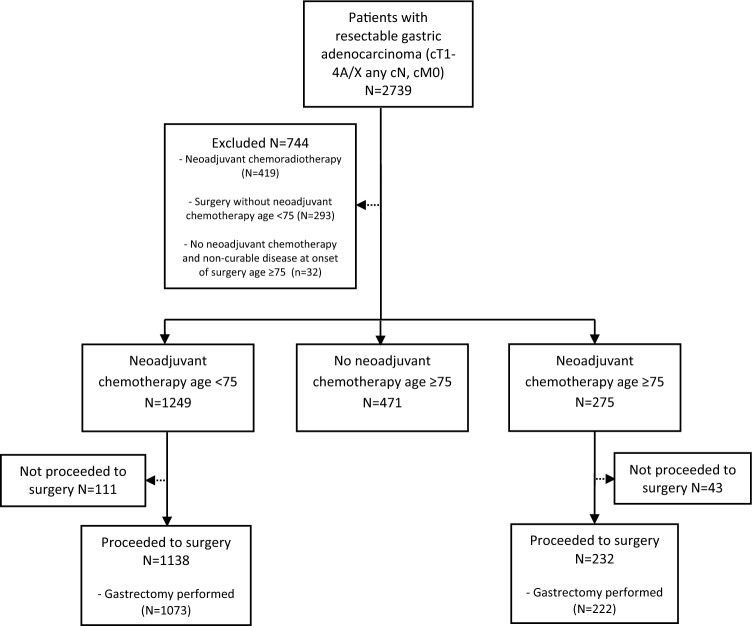
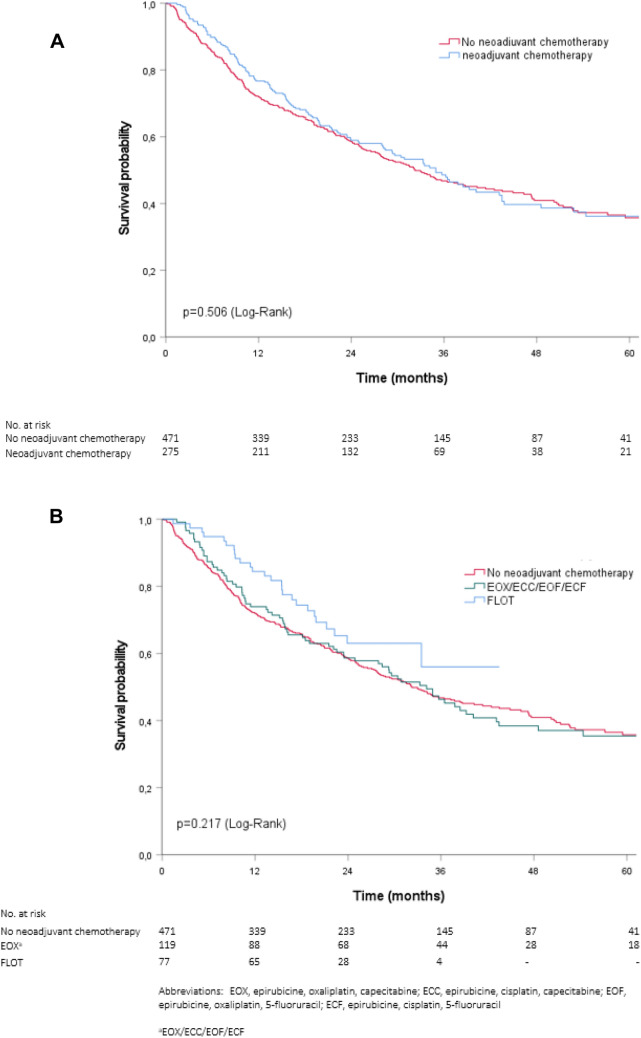
A total of 1995 patients, of whom 1249 aged < 75 years and 746 aged ≥ 75 years, were included. In the group of patients ≥ 75 years, 275 patients received neoadjuvant chemotherapy and 471 patients were directly scheduled for gastrectomy. Patients ≥ 75 years treated with or without neoadjuvant chemotherapy differed significantly from one and another in characteristics. Overall survival of patients ≥ 75 years treated with or without neoadjuvant chemotherapy was not significantly different (median 34.9 vs. 32.3 months; P = 0.506), also after adjusting for potential confounders (HR 0.87; P = 0.263). Of patients ≥ 75 years who received neoadjuvant chemotherapy, 43 (15.6%) did not proceed to surgery compared to 111 (8.9%) patients < 75 years (P < 0.001).
Patients ≥ 75 years treated with or without chemotherapy were highly selected, and overall survival was not significantly different between both groups. Nonetheless, the proportion of patients who did not proceed to surgery following neoadjuvant chemotherapy was higher in patients ≥ 75 years compared to patients < 75 years. Therefore, neoadjuvant chemotherapy should be considered with more caution in patients ≥ 75 years, while identifying those who may benefit.
在评估围手术期化疗治疗胃癌的临床试验中,患者被选择入组。这些试验结果对老年患者的普遍适用性尚不确定。
本基于人群的回顾性队列研究比较了 2015 年至 2019 年间接受或未接受新辅助化疗的 75 岁及以上胃腺癌患者的生存结局。此外,还检查了接受新辅助化疗后未行手术的患者中年龄<75 岁和≥75 岁的比例。
共纳入 1995 例患者,其中 1249 例年龄<75 岁,746 例年龄≥75 岁。在年龄≥75 岁的患者中,275 例接受新辅助化疗,471 例直接行胃切除术。接受或未接受新辅助化疗的年龄≥75 岁的患者在特征上存在显著差异。接受或未接受新辅助化疗的年龄≥75 岁的患者的总生存时间无显著差异(中位 34.9 与 32.3 个月;P=0.506),调整潜在混杂因素后亦如此(HR 0.87;P=0.263)。在接受新辅助化疗的年龄≥75 岁的患者中,有 43 例(15.6%)未行手术,而年龄<75 岁的患者中则有 111 例(8.9%)(P<0.001)。
接受或未接受化疗的年龄≥75 岁的患者均为高度选择的患者,两组的总体生存时间无显著差异。然而,与年龄<75 岁的患者相比,接受新辅助化疗后未行手术的年龄≥75 岁患者的比例更高。因此,在年龄≥75 岁的患者中应更谨慎地考虑新辅助化疗,并识别可能从中获益的患者。