van Deudekom Floor J, Postmus Iris, van der Ham Danielle J, Pothof Alexander B, Broekhuizen Karen, Blauw Gerard J, Mooijaart Simon P
Department of Gerontology and Geriatrics, Leiden University Medical Centre, Leiden, The Netherlands.
Institute for Evidence-Based Medicine in Old Age (IEMO), Leiden, The Netherlands.
PLoS One. 2017 Mar 27;12(3):e0174053. doi: 10.1371/journal.pone.0174053. eCollection 2017.
To critically assess the external validity of randomized controlled trials (RCTs) it is important to know what older adults have been enrolled in the trials. The aim of this systematic review is to study what proportion of trials specifically designed for older patients report on somatic status, physical and mental functioning, social environment and frailty in the patient characteristics.
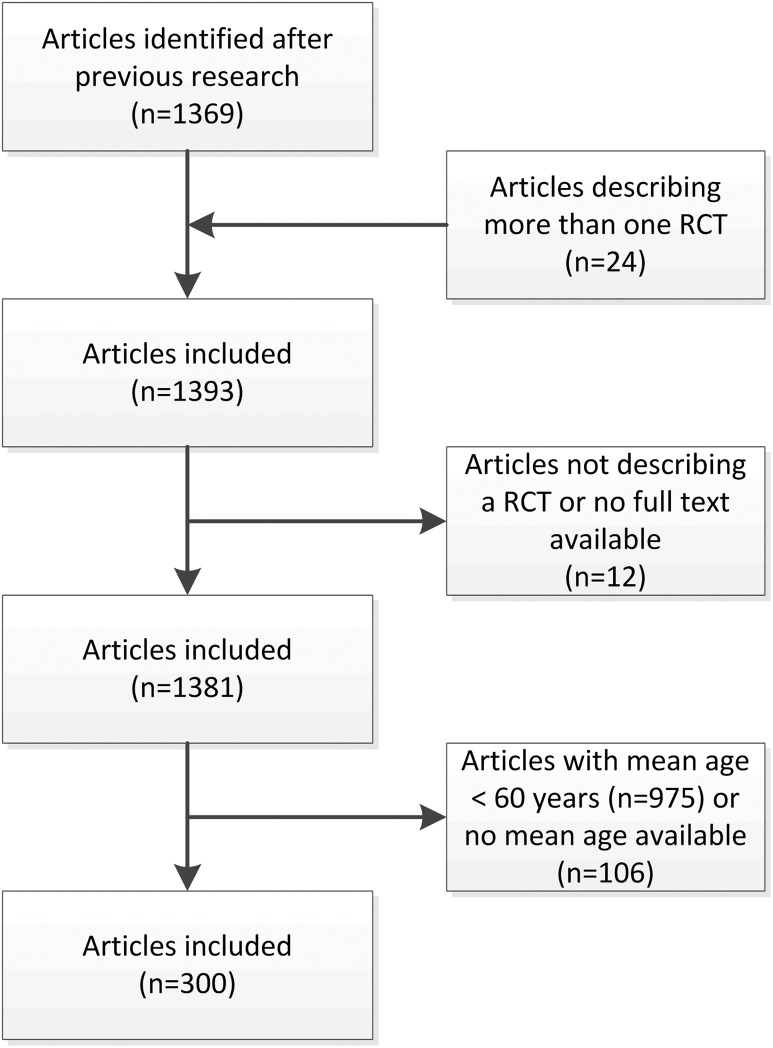
PubMed was searched for articles published in 2012 and only RCTs were included. Articles were further excluded if not conducted with humans or only secondary analyses were reported. A random sample of 10% was drawn. The current review analyzed this random sample and further selected trials when the reported mean age was ≥ 60 years. We extracted geriatric assessments from the population descriptives or the in- and exclusion criteria.
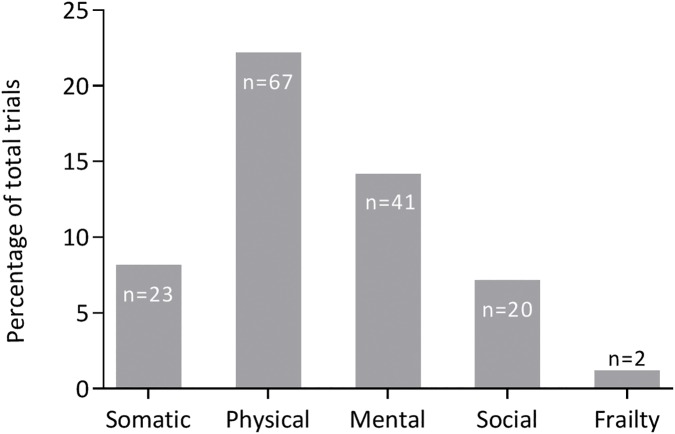
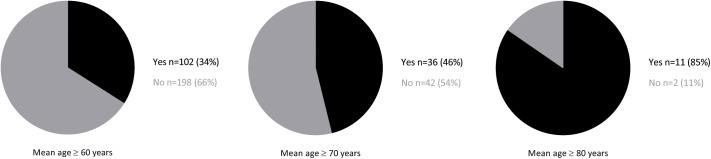
In total 1396 trials were analyzed and 300 trials included. The median of the reported mean age was 66 (IQR 63-70) and the median percentage of men in the trials was 60 (IQR 45-72). In 34% of the RCTs specifically designed for older patients somatic status, physical and mental functioning, social environment or frailty were reported in the population descriptives or the in- and exclusion criteria. Physical and mental functioning was reported most frequently (22% and 14%). When selecting RCTs on a mean age of 70 or 80 years the report of geriatric assessments in the patient characteristics was 46% and 85% respectively but represent only 5% and 1% of the trials.
Somatic status, physical and mental functioning, social environment and frailty are underreported even in RCTs specifically designed for older patients published in 2012. Therefore, it is unclear for clinicians to which older patients the results can be applied. We recommend systematic to transparently report these relevant characteristics of older participants included in RCTs.
为严格评估随机对照试验(RCT)的外部有效性,了解纳入试验的老年人情况很重要。本系统评价的目的是研究专门针对老年患者设计的试验中,有多大比例在患者特征方面报告了躯体状况、身体和心理功能、社会环境及衰弱情况。
在PubMed中检索2012年发表的文章,仅纳入随机对照试验。若研究未在人体中进行或仅报告了二次分析结果,则进一步排除。抽取10%的随机样本。本综述分析了该随机样本,并在报告的平均年龄≥60岁时进一步选择试验。我们从人群描述或纳入及排除标准中提取老年评估内容。
共分析了1396项试验,纳入300项试验。报告的平均年龄中位数为66岁(四分位间距63 - 70岁),试验中男性的中位数百分比为60%(四分位间距45 - 72%)。在专门针对老年患者设计的随机对照试验中,34%在人群描述或纳入及排除标准中报告了躯体状况、身体和心理功能、社会环境或衰弱情况。身体和心理功能报告最为频繁(分别为22%和14%)。当选择平均年龄为70岁或80岁的随机对照试验时,患者特征中老年评估的报告率分别为46%和85%,但仅占试验的5%和1%。
即使在2012年发表的专门针对老年患者的随机对照试验中,躯体状况、身体和心理功能、社会环境及衰弱情况的报告也不足。因此,临床医生不清楚这些结果可应用于哪些老年患者。我们建议系统且透明地报告随机对照试验中纳入的老年参与者的这些相关特征。