Instituto de Investigación en Recursos Cinegéticos IREC-CSIC-UCLM-JCCM, Ronda de Toledo s/n, Ciudad Real, 13005, Spain.
National Livestock Resources Research Institute (NaLIRRI/NARO), Wakiso District, P.O. Box 5704, Wakiso, Uganda.
Exp Appl Acarol. 2023 Jun;90(1-2):83-98. doi: 10.1007/s10493-023-00804-4. Epub 2023 Jun 7.
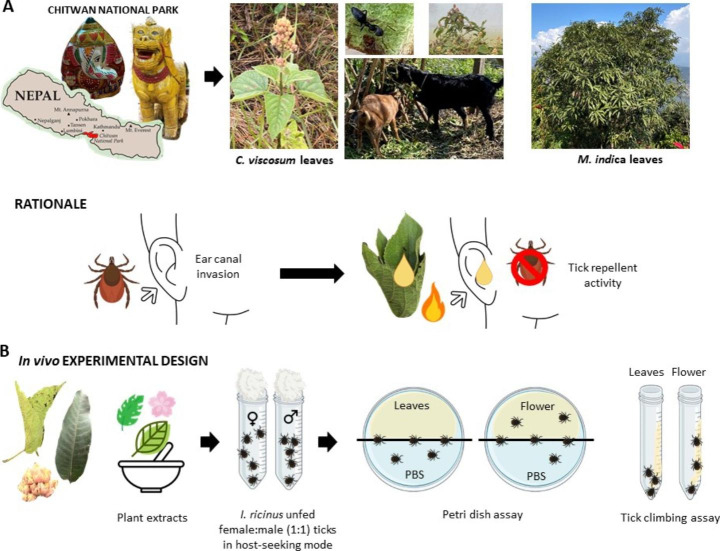
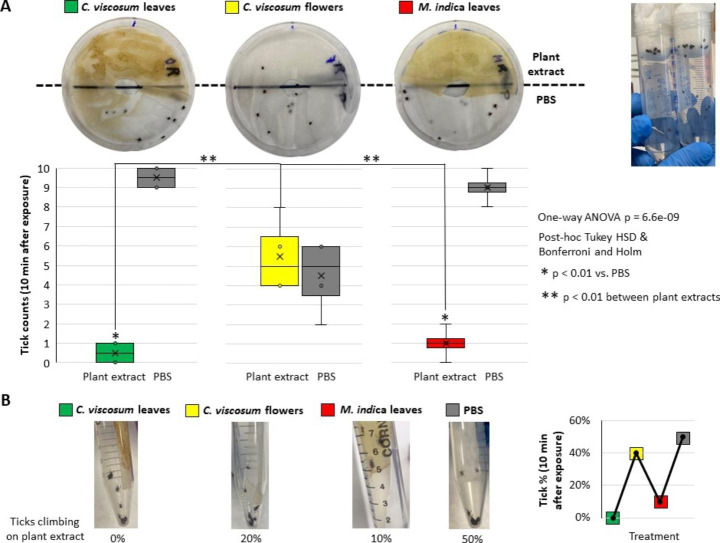
Ticks attaching to ear canals of humans and animals are the cause of otoacariasis, common in rural areas of Nepal. The plant Clerodendrum viscosum is used in multiple indigenous systems of medicine by ethnic communities in the Indo-Nepali-Malaysian region. Visiting the Chitwan National Park, we learned that in indigenous medicine, flower extract of C. viscosum is utilized to treat digestive disorders and extracts from leaves as tick repellent to prevent ticks from invading or to remove them from the ear canal. The objective of our study was to provide support to indigenous medicine by characterizing the in vivo effect of leave extracts on ticks under laboratory conditions and its phytochemical composition. We collected plant parts of C. viscosum (leaves and flowers) and mango (Mangifera indica) leaves at the Chitwan National Park, previously associated with repellent activity to characterize their effect on Ixodes ricinus ticks by in vivo bioassays. A Q-ToF high-resolution analysis (HPLC-ESI-QToF) was conducted to elucidate phenolic compounds with potential repellent activity. Clerodendrum viscosum and M. indica leaf extracts had the highest tick repellent efficacy (%E = 80-100%) with significant differences when compared to C. viscosum flowers extracts (%E = 20-60%) and phosphate-buffered saline. Phytochemicals with tick repellent function as caffeic acid, fumaric acid and p-coumaric acid glucoside were identified in C. viscosum leaf extracts by HPLC-ESI-QToF, but not in non-repellent flower extracts. These results support the Nepali indigenous medicine application of C. viscosum leaf extracts to repel ticks. Additional research is needed for the development of natural and green repellent formulations to reduce the risks associated with ticks resistant to acaricides.
附着在人和动物耳道上的蜱是耳虱病的病因,在尼泊尔农村地区很常见。在印度-尼泊尔-马来西亚地区,克利odendrum viscosum 这种植物被多个土着医学系统的民族社区使用。在参观奇特旺国家公园时,我们了解到,在土着医学中,克利odendrum viscosum 的花提取物被用于治疗消化紊乱,而从叶子中提取的物质则被用作蜱虫驱避剂,以防止蜱虫入侵或从耳道中取出蜱虫。我们的研究目的是通过在实验室条件下对叶子提取物对蜱虫的体内作用及其植物化学成分进行表征,为土着医学提供支持。我们在奇特旺国家公园收集了克利odendrum viscosum(叶子和花)和芒果(Mangifera indica)的植物部分,这些植物部分以前与驱避活性有关,用于通过体内生物测定来表征它们对蓖子硬蜱的作用。进行了 Q-ToF 高分辨率分析(HPLC-ESI-QToF)以阐明具有潜在驱避活性的酚类化合物。克利odendrum viscosum 和 M. indica 叶子提取物对蜱虫的驱避效果最高(%E = 80-100%),与克利odendrum viscosum 花提取物(%E = 20-60%)和磷酸盐缓冲盐水相比有显著差异。通过 HPLC-ESI-QToF 在克利odendrum viscosum 叶子提取物中鉴定出具有驱避功能的植物化学物质,如咖啡酸、富马酸和对香豆酸葡萄糖苷,但在无驱避作用的花提取物中没有。这些结果支持尼泊尔土着医学应用克利odendrum viscosum 叶子提取物来驱避蜱虫。需要进一步研究以开发天然和绿色驱避配方,以降低与对杀蜱剂有抗药性的蜱虫相关的风险。