Duke Clinical Research Institute, Durham, North Carolina.
Division of Cardiology, Department of Medicine, Duke University Medical Center, Durham, North Carolina.
JAMA Netw Open. 2023 Jun 1;6(6):e2317156. doi: 10.1001/jamanetworkopen.2023.17156.
Although reduced doses of direct oral anticoagulants (DOACs) are approved for patients with nonvalvular atrial fibrillation (NVAF) at high risk of bleeding, little is known about dosing accuracy, particularly in patients with renal dysfunction.
To determine whether underdosing of DOACs is associated with longitudinal adherence to anticoagulation.
DESIGN, SETTING, AND PARTICIPANTS: This retrospective cohort analysis used data from the Symphony Health claims data set. This national medical and prescription data set comprises 280 million patients and 1.8 million prescribers in the US. Patients included had at least 2 claims for NVAF between January 2015 and December 2017. The dates of analysis for this article were from February 2021 to July 2022.
This study included patients with CHA2DS2-VASc scores of 2 or higher who were treated with a dose of DOACs who did and did not meet label-specified criteria for dose reduction.
Logistic regression models examined factors associated with off-label dosing (ie, dosing not recommended by US Food and Drug Administration [FDA] labeling), the association of creatinine clearance with recommended DOAC dosing, and the association of DOAC underdosing and excess dosing with 1-year adherence.
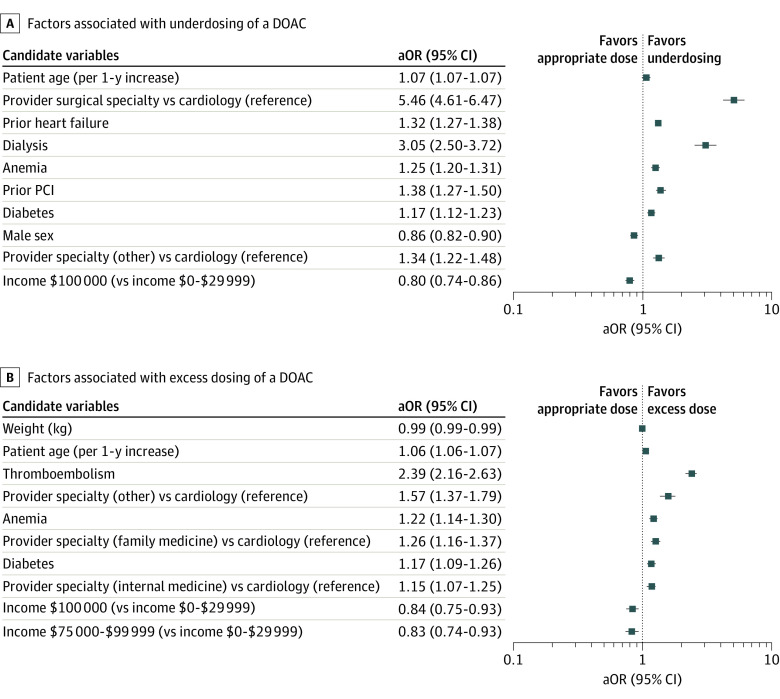
Among the 86 919 patients included (median [IQR] age, 74 [67-80] years; 43 724 men [50.3%]; 82 389 White patients [94.8%]), 7335 (8.4%) received an appropriately reduced dose, and 10 964 (12.6%) received an underdose not consistent with FDA recommendations, meaning that 59.9% (10 964 of 18 299) of those who received a reduced dose received an inappropriate dose. Patients who received off-label doses of DOACs were older (median [IQR] age, 79 [73-85] vs 73 [66-79] years) and had higher CHA2DS2-VASc scores (median [IQR], 5 [4-6] vs 4 [3-6]) compared with patients who received appropriate doses (as recommended by FDA labeling). Renal dysfunction, age, heart failure, and the prescribing clinician being in a surgical specialty were associated with dosing not recommended by FDA labeling. Almost one-third of patients (9792 patients [31.9%]) with creatinine clearance less than 60 mL per minute taking DOACs were either underdosed or excess-dosed not consistent with FDA recommendations. For every 10-unit decrease in creatinine clearance, the odds of the patient receiving an appropriately dosed DOAC was lower by 21%. Treatment with underdosed DOACs was associated with a lower likelihood of adherence (adjusted odds ratio, 0.88; 95% CI, 0.83-0.94) and higher risk of anticoagulation discontinuation (adjusted odds ratio, 1.20; 95% CI, 1.13-1.28) by 1 year.
In this study of oral anticoagulant dosing, DOAC dosing that did not follow FDA label recommendations was observed in a substantial number of patients with NVAF, occurred more frequently in patients with worse renal function, and was associated with less-consistent long-term anticoagulation. These results suggest a need for efforts to improve the quality of DOAC use and dosing.
尽管对于有发生非瓣膜性心房颤动(NVAF)高出血风险的患者,批准了降低剂量的直接口服抗凝剂(DOAC),但对于剂量准确性,特别是肾功能不全患者的剂量准确性知之甚少。
确定 DOAC 剂量不足是否与抗凝治疗的长期依从性相关。
设计、设置和参与者:本回顾性队列分析使用了 Symphony Health 索赔数据集的数据。这个全国性的医疗和处方数据集中包含了美国 2.8 亿患者和 180 万名医生。该研究纳入的患者在 2015 年 1 月至 2017 年 12 月期间至少有 2 次 NVAF 的索赔。本文的分析日期为 2021 年 2 月至 2022 年 7 月。
本研究纳入了 CHA2DS2-VASc 评分≥2 的患者,他们接受了 DOAC 剂量治疗,且剂量符合或不符合美国食品药品监督管理局(FDA)标签规定的剂量减少标准。
逻辑回归模型检查了与标签外剂量(即 FDA 标签不推荐的剂量)相关的因素、与推荐 DOAC 剂量的肌酐清除率的关系,以及 DOAC 剂量不足和过量与 1 年依从性的关系。
在纳入的 86919 名患者中(中位数[IQR]年龄,74[67-80]岁;43724 名男性[50.3%];82389 名白人患者[94.8%]),7335 名(8.4%)接受了适当的降低剂量,10964 名(12.6%)接受了不符合 FDA 建议的剂量不足,这意味着在接受降低剂量的 18299 名患者中,59.9%(10964 名)接受了不适当的剂量。接受 DOAC 标签外剂量的患者年龄较大(中位数[IQR]年龄,79[73-85] vs 73[66-79]岁)且 CHA2DS2-VASc 评分较高(中位数[IQR],5[4-6] vs 4[3-6]),与接受适当剂量(FDA 标签推荐)的患者相比。肾功能不全、年龄、心力衰竭和开处方的临床医生为外科医生与 FDA 标签不推荐的剂量有关。近三分之一(9792 名)接受 DOAC 治疗且肌酐清除率<60 mL/min 的患者,其剂量不足或过量,不符合 FDA 建议。肌酐清除率每降低 10 单位,患者接受适当剂量 DOAC 的可能性就会降低 21%。接受剂量不足的 DOAC 治疗与抗凝治疗的依从性降低(校正优势比,0.88;95%CI,0.83-0.94)和抗凝治疗中断风险增加(校正优势比,1.20;95%CI,1.13-1.28)相关,在 1 年内。
在这项关于口服抗凝剂剂量的研究中,观察到 NVAF 患者的 DOAC 剂量不符合 FDA 标签建议的情况相当普遍,在肾功能更差的患者中更为常见,且与长期抗凝治疗的一致性较差。这些结果表明,需要努力提高 DOAC 的使用和剂量的质量。
