School of Systems Biology, George Mason University, Manassas, VA 20110, USA.
Research Centre for Medical Genetics, Moscow 115478, Russia.
QJM. 2023 Oct 6;116(9):766-773. doi: 10.1093/qjmed/hcad122.
COVID-19 might cause neuroinflammation in the brain, which could decrease neurocognitive function. We aimed to evaluate the causal associations and genetic overlap between COVID-19 and intelligence.
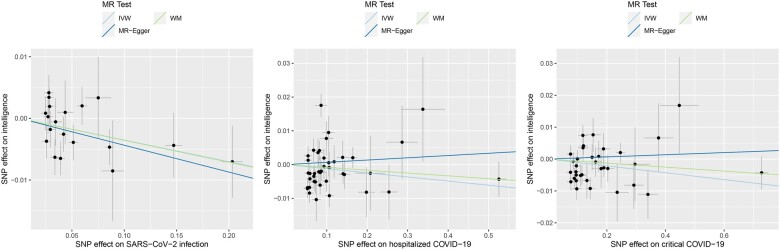
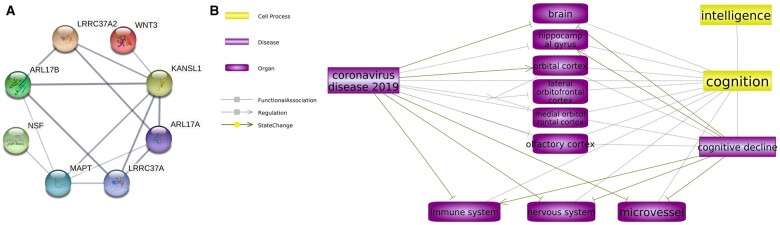
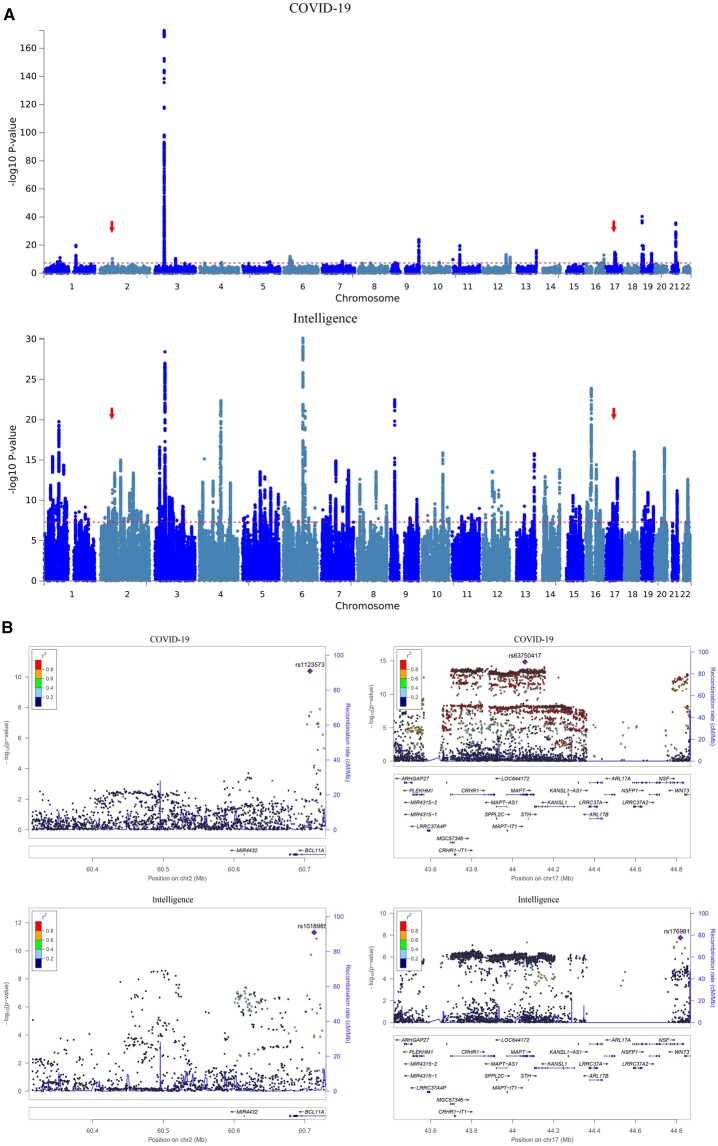
We performed Mendelian randomization (MR) analyses to assess potential associations between three COVID-19 outcomes and intelligence (N = 269 867). The COVID phenotypes included severe acute respiratory syndrome coronavirus 2 (SARS-CoV-2) infection (N = 2 501 486), hospitalized COVID-19 (N = 1 965 329) and critical COVID-19 (N = 743 167). Genome-wide risk genes were compared between the genome-wide association study (GWAS) datasets on hospitalized COVID-19 and intelligence. In addition, functional pathways were constructed to explore molecular connections between COVID-19 and intelligence.
The MR analyses indicated that genetic liabilities to SARS-CoV-2 infection (odds ratio [OR]: 0.965, 95% confidence interval [CI]: 0.939-0.993) and critical COVID-19 (OR: 0.989, 95% CI: 0.979-0.999) confer causal effects on intelligence. There was suggestive evidence supporting the causal effect of hospitalized COVID-19 on intelligence (OR: 0.988, 95% CI: 0.972-1.003). Hospitalized COVID-19 and intelligence share 10 risk genes within 2 genomic loci, including MAPT and WNT3. Enrichment analysis showed that these genes are functionally connected within distinct subnetworks of 30 phenotypes linked to cognitive decline. The functional pathway revealed that COVID-19-driven pathological changes within the brain and multiple peripheral systems may lead to cognitive impairment.
Our study suggests that COVID-19 may exert a detrimental effect on intelligence. The tau protein and Wnt signaling may mediate the influence of COVID-19 on intelligence.
COVID-19 可能在大脑中引起神经炎症,从而降低神经认知功能。我们旨在评估 COVID-19 与智力之间的因果关系和遗传重叠。
我们进行了孟德尔随机化(MR)分析,以评估三种 COVID-19 结局(严重急性呼吸综合征冠状病毒 2(SARS-CoV-2)感染(N=269867)、住院 COVID-19(N=1965329)和危重症 COVID-19(N=743167))与智力之间的潜在关联。比较了住院 COVID-19 与智力的全基因组关联研究(GWAS)数据集之间的全基因组风险基因。此外,构建了功能途径,以探索 COVID-19 与智力之间的分子联系。
MR 分析表明,SARS-CoV-2 感染(比值比[OR]:0.965,95%置信区间[CI]:0.939-0.993)和危重症 COVID-19(OR:0.989,95%CI:0.979-0.999)的遗传易感性对智力有因果影响。有证据表明,住院 COVID-19 对智力有因果影响(OR:0.988,95%CI:0.972-1.003)。住院 COVID-19 和智力在 2 个基因组座内共享 10 个风险基因,包括 MAPT 和 WNT3。富集分析表明,这些基因在与认知衰退相关的 30 种表型的不同子网络中具有功能连接。功能途径表明,COVID-19 在大脑和多个周围系统中引起的病理变化可能导致认知障碍。
我们的研究表明,COVID-19 可能对智力产生不利影响。tau 蛋白和 Wnt 信号可能介导 COVID-19 对智力的影响。