Baranova Ancha, Cao Hongbao, Zhang Fuquan
George Mason University, Fairfax, Virginia, USA.
Research Centre for Medical Genetics, Moscow, Russia.
Gen Psychiatr. 2024 Feb 28;37(1):e101080. doi: 10.1136/gpsych-2023-101080. eCollection 2024.
Previous studies have shown that educational attainment (EA), intelligence and income are key factors associated with mental disorders. However, the direct effects of each factor on major mental disorders are unclear.
We aimed to evaluate the overall and independent causal effects of the three psychosocial factors on common mental disorders.
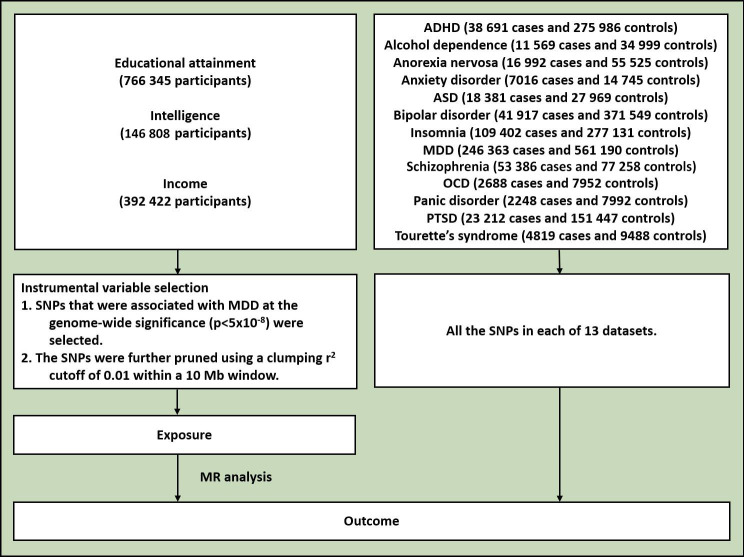
Using genome-wide association study summary datasets, we performed Mendelian randomisation (MR) and multivariable MR (MVMR) analyses to assess potential associations between the 3 factors (EA, N=766 345; household income, N=392 422; intelligence, N=146 808) and 13 common mental disorders, with sample sizes ranging from 9907 to 807 553. Inverse-variance weighting was employed as the main method in the MR analysis.
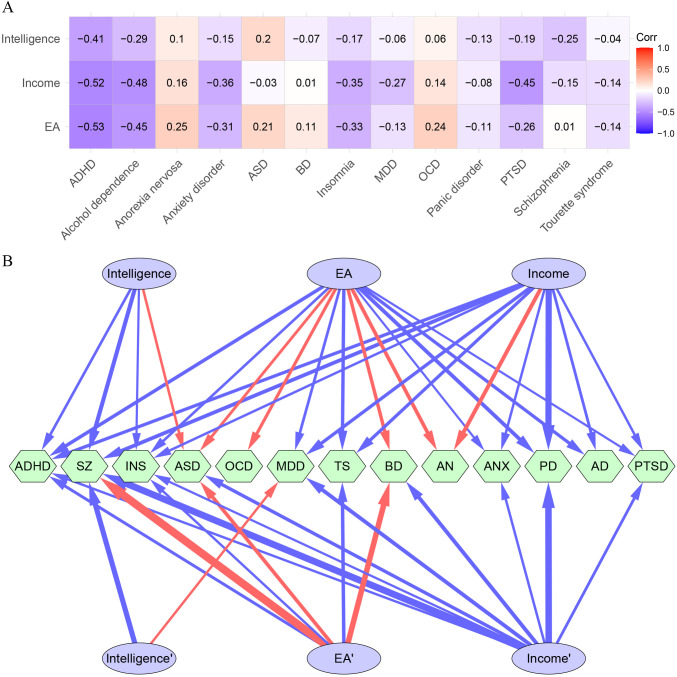
Our MR analysis showed that (1) higher EA was a protective factor for eight mental disorders but contributed to anorexia nervosa, obsessive-compulsive disorder (OCD), bipolar disorder (BD) and autism spectrum disorder (ASD); (2) higher intelligence was a protective factor for five mental disorders but a risk factor for OCD and ASD; (3) higher household income protected against 10 mental disorders but confers risk for anorexia nervosa. Our MVMR analysis showed that (1) higher EA was a direct protective factor for attention-deficit/hyperactivity disorder (ADHD) and insomnia but a direct risk factor for schizophrenia, BD and ASD; (2) higher intelligence was a direct protective factor for schizophrenia but a direct risk factor for major depressive disorder (MDD) and ASD; (3) higher income was a direct protective factor for seven mental disorders, including schizophrenia, BD, MDD, ASD, post-traumatic stress disorder, ADHD and anxiety disorder.
Our study reveals that education, intelligence and income intertwine with each other. For each factor, its independent effects on mental disorders present a more complex picture than its overall effects.
既往研究表明,教育程度、智力和收入是与精神障碍相关的关键因素。然而,各因素对主要精神障碍的直接影响尚不清楚。
我们旨在评估这三种社会心理因素对常见精神障碍的总体和独立因果效应。
使用全基因组关联研究汇总数据集,我们进行了孟德尔随机化(MR)和多变量MR(MVMR)分析,以评估这三个因素(教育程度,N = 766345;家庭收入,N = 392422;智力,N = 146808)与13种常见精神障碍之间的潜在关联,样本量从9907到807553不等。逆方差加权法被用作MR分析的主要方法。
我们的MR分析显示:(1)较高的教育程度是八种精神障碍的保护因素,但会导致神经性厌食症、强迫症(OCD)、双相情感障碍(BD)和自闭症谱系障碍(ASD);(2)较高的智力是五种精神障碍的保护因素,但却是OCD和ASD的危险因素;(3)较高的家庭收入可预防十种精神障碍,但会增加神经性厌食症的风险。我们的MVMR分析显示:(1)较高的教育程度是注意力缺陷多动障碍(ADHD)和失眠的直接保护因素,但却是精神分裂症(SZ)、BD和ASD的直接危险因素;(2)较高的智力是SZ的直接保护因素,但却是重度抑郁症(MDD)和ASD的直接危险因素;(3)较高的收入是七种精神障碍的直接保护因素,包括SZ、BD、MDD、ASD、创伤后应激障碍、ADHD和焦虑症。
我们的研究表明,教育、智力和收入相互交织。对于每个因素,其对精神障碍的独立影响比其总体影响呈现出更复杂的情况。