Saito Junko, Odawara Miyuki, Fujimori Maiko, Kuchiba Aya, Oyamada Shunsuke, Swe Khin Thet, Saito Eiko, Fukai Kota, Tatemichi Masayuki, Nakamura Masakazu, Uchitomi Yosuke, Shimazu Taichi
Division of Behavioral Sciences, National Cancer Center Institute for Cancer Control, Tokyo, Japan.
Division of Survivorship Research, National Cancer Center Institute for Cancer Control, Tokyo, Japan.
Implement Sci Commun. 2023 Jun 7;4(1):61. doi: 10.1186/s43058-023-00444-0.
Tobacco control should be a higher public health priority in Japan. Some workplaces provide smoking cessation support and connect employees to effective smoking cessation treatments such as outpatient clinics. However, tobacco control measures have not been sufficiently implemented in Japan, especially in small- and medium-sized enterprises (SMEs), where resources are limited. Organizational commitment and consistent leadership are crucial to facilitate implementation, but research on whether supporting organizational leaders leads to health behavior changes among employees is limited.
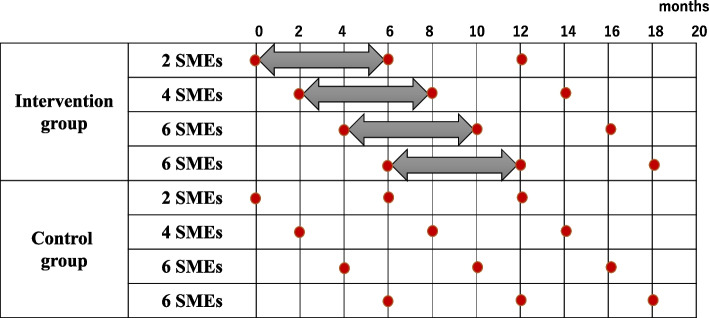
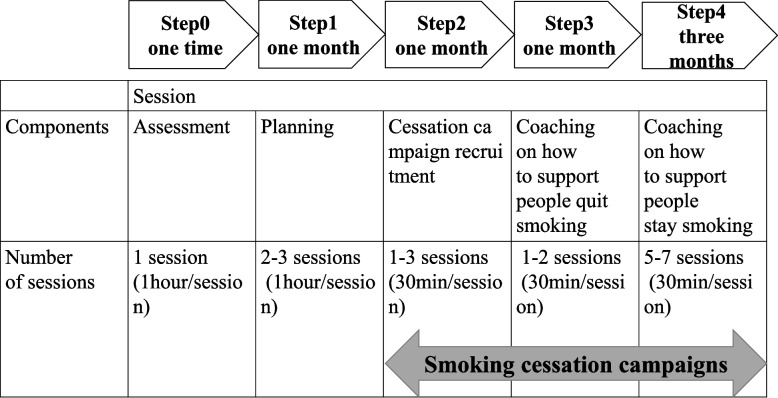
This hybrid type II cluster randomized effectiveness implementation trial (eSMART-TC) aims to examine the effects of interactive assistance for SME management on health and implementation outcomes. We will provide interactive assistance to employers and health managers for 6 months, aiming to promote the utilization of reimbursed smoking cessation treatments by public health insurance and to implement smoke-free workplaces. The intervention will consist of three strategies: supporting employees through campaigns, tailored ongoing facilitation, and ensuring executive engagement and support. The primary health and implementation outcomes will be salivary cotinine-validated 7-day point-prevalence abstinence rate, and the adoption of two recommended measures (promoting utilization of smoking cessation treatment and implementing smoke-free workplaces) 6 months after the initial session, respectively. Other outcomes for implementation (e.g., penetration of smoking cessation clinic visits), health (e.g., salivary cotinine-validated 7-day point-prevalence abstinence rate at 12 months), and process (e.g., adherence and potential moderating factors) will be collected via questionnaires, interviews, logbooks, and interventionists' notes at 6 and 12 months. An economic analysis will be undertaken to assess the cost-effectiveness of the implementation interventions at 12 months.
This will be the first cluster randomized controlled trial to evaluate the effectiveness of an implementation intervention with interactive assistance for employers and health managers in SMEs on smoking cessation and implementation of evidence-based tobacco control measures in SMEs. The findings of this trial targeting management in SMEs have the potential to accelerate the implementation of evidence-based smoking cessation methods as well as abstinence rates among employees in SMEs across Japan.
The study protocol has been registered in the UMIN Clinical Trials Registry (UMIN-CTR; ID: UMIN000044526). Registered on 06/14/2021.
在日本,烟草控制应成为更高的公共卫生优先事项。一些工作场所提供戒烟支持,并将员工与有效的戒烟治疗机构(如门诊诊所)联系起来。然而,日本的烟草控制措施尚未得到充分实施,尤其是在资源有限的中小企业。组织承诺和持续一致的领导对于促进措施实施至关重要,但关于支持组织领导者是否会导致员工健康行为改变的研究有限。
这项混合型II类整群随机有效性实施试验(eSMART-TC)旨在研究对中小企业管理层的互动式协助对健康及实施结果的影响。我们将为雇主和健康管理人员提供为期6个月的互动式协助,旨在促进公共医疗保险报销的戒烟治疗的利用,并实施无烟工作场所。干预措施将包括三项策略:通过宣传活动支持员工、进行量身定制的持续促进以及确保管理层的参与和支持。主要的健康和实施结果将分别是唾液可替宁验证的7天点患病率戒烟率,以及在初次会议6个月后采用两项推荐措施(促进戒烟治疗的利用和实施无烟工作场所)。实施方面的其他结果(如戒烟门诊就诊的渗透率)、健康方面的结果(如12个月时唾液可替宁验证的7天点患病率戒烟率)以及过程方面的结果(如依从性和潜在调节因素)将在6个月和12个月时通过问卷调查、访谈、日志和干预人员记录收集。将进行经济分析以评估12个月时实施干预措施的成本效益。
这将是第一项整群随机对照试验,旨在评估对中小企业雇主和健康管理人员进行互动式协助的实施干预措施在中小企业戒烟及实施循证烟草控制措施方面的有效性。这项针对中小企业管理层的试验结果有可能加速循证戒烟方法在日本各地中小企业的实施以及员工的戒烟率。
该研究方案已在UMIN临床试验注册中心(UMIN-CTR;ID:UMIN000044526)注册。于2021年6月14日注册。