Faculty of Medicine, University of Khartoum, ElQasr Ave, P.O. Box 103, Khartoum, Sudan.
BMC Med Educ. 2023 Jun 7;23(1):418. doi: 10.1186/s12909-023-04415-w.
The medical profession is one of the most highly respected and desired professions among students worldwide, most likely because it provides opportunities for both a financially and socially rewarding career. However, while it has been quite established that factors such as self-interest, family pressure, friend pressure, and socioeconomic status do influence the choice of medicine among students worldwide, the exact reasons for an individual to join a medical school may actually vary worldwide. The aim of this study was to comprehensively explore factors influencing medical students to opt in/out medical careers in Sudan.
An institutional based descriptive cross-sectional study was conducted at University of Khartoum in the year 2022 with a random sample of 330 students that was obtained from the medical students at the The University of Khartoum, Faculty of Medicine using stratified random sampling.
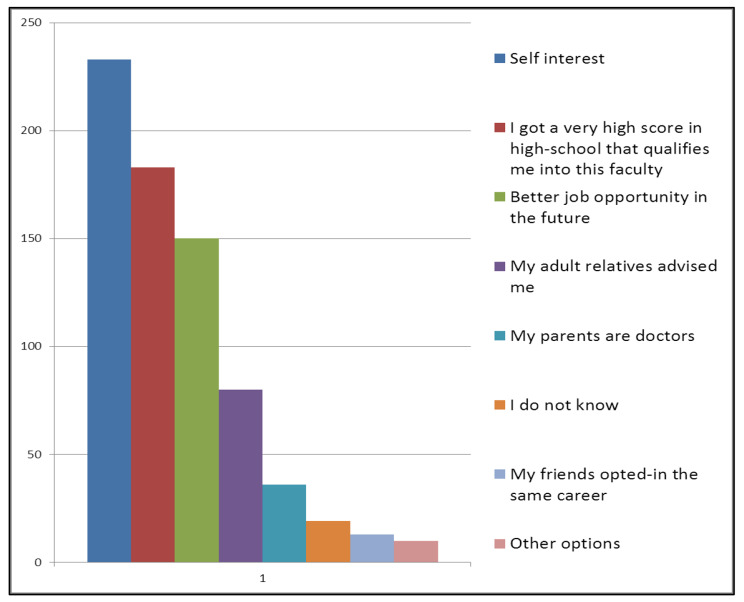
Self-interest was the most common factor influencing opting in (choosing) medical profession (70.6%) (n = 233), followed by getting a very high score in high-school that qualifies into the faculty (55.5%) (n = 183). Regarding the factors affecting medical students' choices, parental pressure was the main factor (37.0%) (n = 122), followed by other relatives' pressure (12.4%) (n = 41), and 4.2% (n = 14) chose Peer pressure. 59.7% (n = 197) of the participants stated that they were not affected by any of these factors. Most of the participants felt that the general perception of the medical profession by society is that it is prestigious and has good career opportunities, only 5.8% (n = 19) believed that it is "Not appreciated at all" by the society. A statistically significant association was found between the type of admission & parent pressure (p value 0.01). out of 330 participants, (56.1%) (n = 185) have opted out i.e. lost their interest or regretted their choice of medical career. Academic difficulties was the most common factor causing students to opt-out of the medical career (37%) (n = 122) followed by Multiple suspensions of education (35.2%) (n = 116), Current political & security conflicts in Sudan (29.7%) (n = 98), Poor quality of education (24.8%). The proportion of students having regrets for the medical profession was significantly higher among females. Over one third of the participants reported having depressive symptoms more than half days of the week. No statically significant correlation was established between the academic level and having these depressive symptoms and no statistically significant correlation was established between the decision to opt-out and the academic level (class) of the individuals (P = 0.105).
Over half of Sudanese medical students at the University of Khartoum have already lost their interest or regretted their choice of medical career choice. Whether these future doctor chose to drop out or continue their path in the medical career suggests that they are more prone to serious hardships in their future careers. A careful comprehensive approach should further explore and try to offer solutions for problems like "Academic difficulties", "multiple suspension of education", and "poor quality of education" for they were the most common factors that caused medical students to opt out of the medical career.
医学专业是全球学生中最受推崇和向往的专业之一,这很可能是因为它提供了既有经济回报又有社会回报的职业机会。然而,尽管已经相当确定,像自身利益、家庭压力、朋友压力和社会经济地位等因素确实会影响全球学生选择医学专业,但个人选择医学专业的具体原因实际上可能因国家而异。本研究的目的是全面探讨影响苏丹医学生选择/退出医学职业的因素。
这是一项 2022 年在喀土穆大学进行的基于机构的描述性横断面研究,采用分层随机抽样方法,从喀土穆大学医学院的医学生中随机抽取了 330 名学生作为研究对象。
自身利益是选择(选择)医学专业的最常见因素(70.6%)(n=233),其次是在高中获得非常高的分数,有资格进入医学院(55.5%)(n=183)。关于影响医学生选择的因素,父母的压力是主要因素(37.0%)(n=122),其次是其他亲戚的压力(12.4%)(n=41),4.2%(n=14)选择同伴压力。59.7%(n=197)的参与者表示他们不受这些因素中的任何一个的影响。大多数参与者认为社会对医学职业的普遍看法是它具有声望且有良好的职业机会,只有 5.8%(n=19)认为它“一点也不受欢迎”。研究发现,入学类型与父母压力之间存在统计学显著关联(p 值 0.01)。在 330 名参与者中,(56.1%)(n=185)已经退出,即对医学职业失去兴趣或后悔选择了医学职业。学术困难是导致学生退出医学职业的最常见因素(37%)(n=122),其次是多次教育中断(35.2%)(n=116)、当前苏丹的政治和安全冲突(29.7%)(n=98)、教育质量差(24.8%)。女性对医学专业的后悔率明显更高。超过三分之一的参与者报告每周有超过一半的日子出现抑郁症状。学术水平与这些抑郁症状之间没有建立统计学上显著的相关性,个人(班级)的退出决定与学术水平之间也没有建立统计学上显著的相关性(P=0.105)。
喀土穆大学超过一半的苏丹医学生已经对他们的医学职业选择失去了兴趣或后悔。这些未来的医生是否选择退出或继续他们的医学职业道路,表明他们在未来的职业生涯中更有可能遇到严重的困难。应进一步采用谨慎的全面方法来探讨和尝试解决“学术困难”、“多次教育中断”和“教育质量差”等问题,因为这些是导致医学生退出医学职业的最常见因素。


