Population Health Program, QIMR Berghofer Medical Research Institute, Brisbane, Australia.
School of Public Health, The University of Queensland, Brisbane, Australia.
Gut Microbes. 2023 Jan-Dec;15(1):2221429. doi: 10.1080/19490976.2023.2221429.
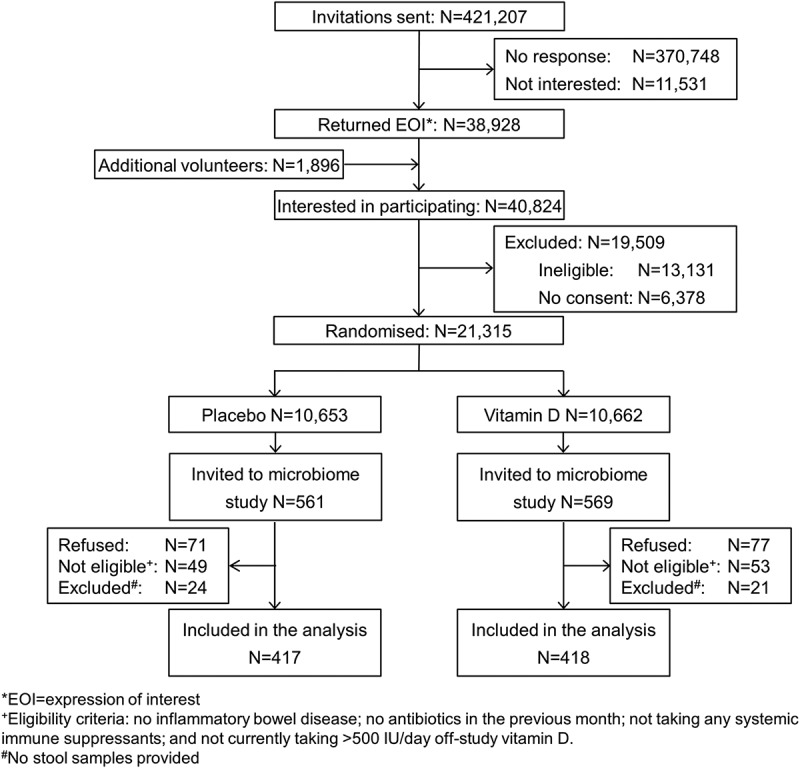
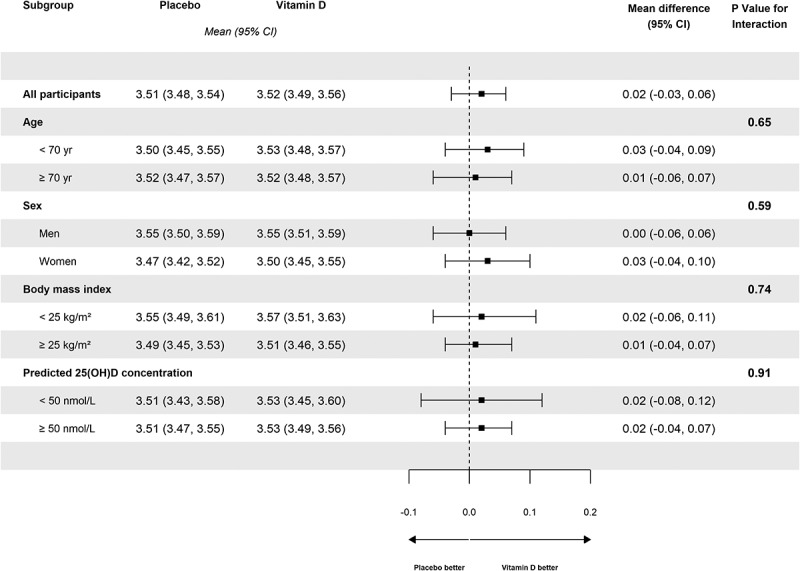
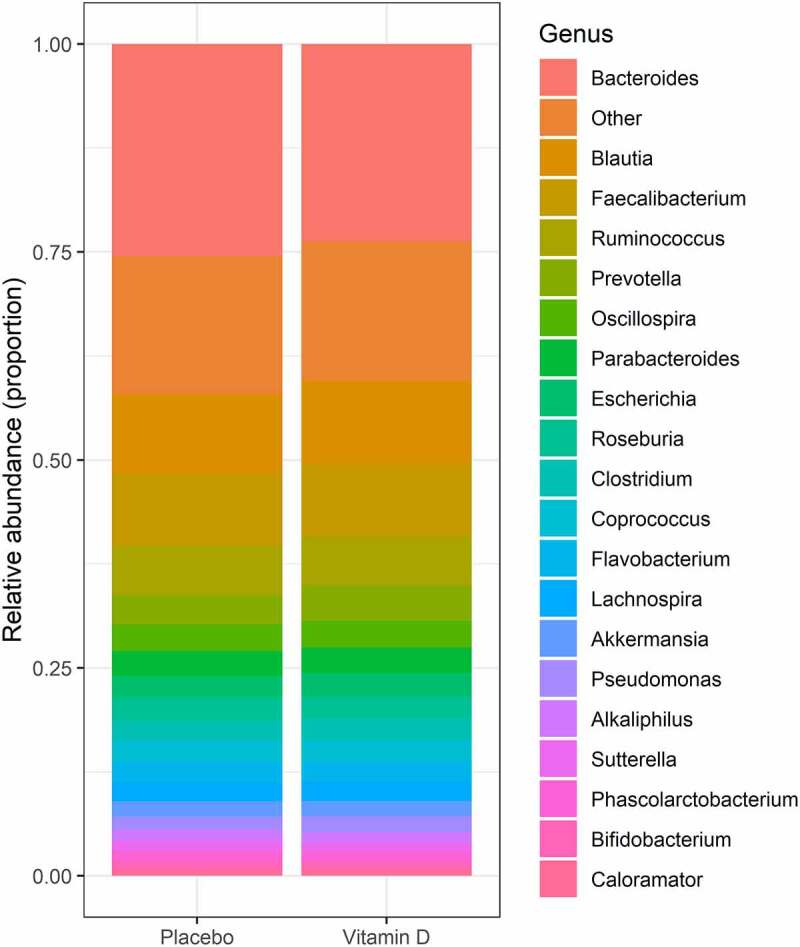
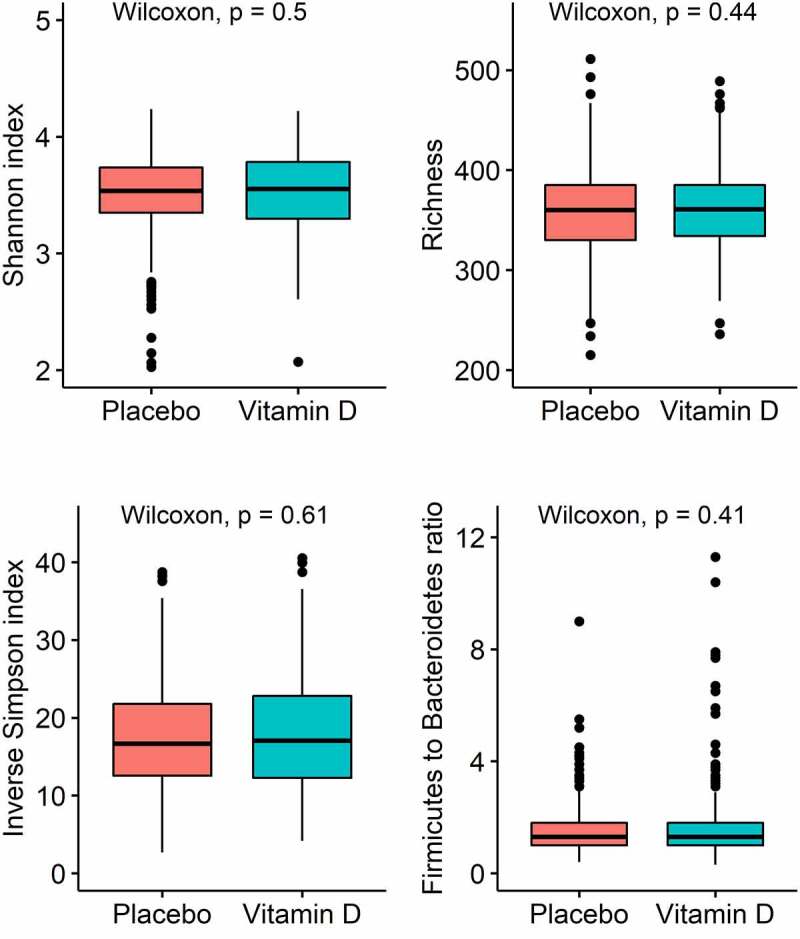
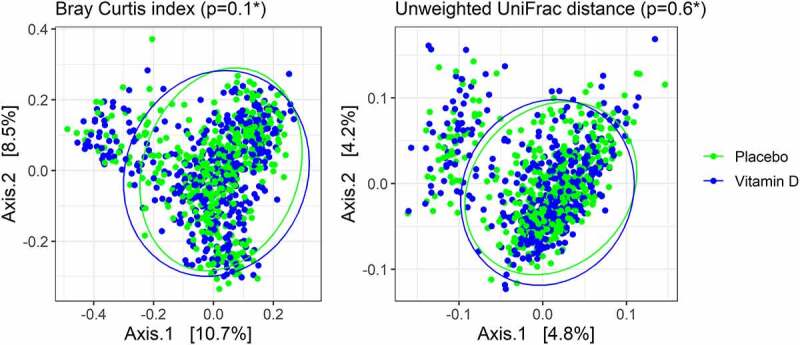
Observational studies suggest a link between vitamin D and the composition of the gut microbiome, but there is little evidence from randomized controlled trials of vitamin D supplementation. We analyzed data from the D-Health Trial, a randomized, double-blind, placebo-controlled trial. We recruited 21,315 Australians aged 60-84 y and randomized them to 60,000 IU of vitamin D or placebo monthly for 5 y. Stool samples were collected from a sample of 835 participants (417 in the placebo and 418 in the vitamin D group) approximately 5 y after randomization. We characterized the gut microbiome using 16S rRNA gene sequencing. We used linear regression to compare alpha diversity indices (i.e. Shannon index (primary outcome), richness, inverse Simpson index), and the ratio of Firmicutes to Bacteroidetes between the two groups. We analyzed between-sample (beta) diversity (i.e. Bray Curtis distance and UniFrac index) using principal coordinate analysis and used PERMANOVA to test for significant clustering according to randomization group. We also assessed the difference in the abundance of the 20 most abundant genera between the two groups using negative binomial regression model with adjustment for multiple testing. Approximately half the participants included in this analysis were women (mean age 69.4 y). Vitamin D supplementation did not alter the Shannon diversity index (mean 3.51 versus 3.52 in the placebo and vitamin D groups, respectively, = 0.50). Similarly, there was little difference between the groups for other alpha diversity indices, the abundance of different genera, and the Firmicutes-to-Bacteroidetes ratio. We did not observe clustering of bacterial communities according to randomization group. In conlusion, monthly doses of 60,000 IU of vitamin D supplementation for 5 y did not alter the composition of the gut microbiome in older Australians.
观察性研究表明维生素 D 与肠道微生物组的组成之间存在关联,但维生素 D 补充的随机对照试验证据很少。我们分析了 D-Health 试验的数据,这是一项随机、双盲、安慰剂对照试验。我们招募了 21315 名年龄在 60-84 岁的澳大利亚人,并将他们随机分为每月接受 60000IU 维生素 D 或安慰剂治疗 5 年。大约在随机分组后 5 年,从 835 名参与者(安慰剂组 417 名,维生素 D 组 418 名)中采集了粪便样本。我们使用 16S rRNA 基因测序来描述肠道微生物组。我们使用线性回归比较两组之间的 alpha 多样性指数(即 Shannon 指数(主要结果)、丰富度、倒数 Simpson 指数)和厚壁菌门与拟杆菌门的比例。我们使用主坐标分析比较了组间(beta)多样性(即 Bray Curtis 距离和 UniFrac 指数),并使用 PERMANOVA 测试根据随机分组的显著聚类。我们还使用负二项式回归模型评估了两组之间 20 个最丰富属的丰度差异,该模型对多重检验进行了调整。本分析中约有一半参与者为女性(平均年龄 69.4 岁)。维生素 D 补充并未改变 Shannon 多样性指数(安慰剂组和维生素 D 组分别为 3.51 和 3.52, = 0.50)。同样,两组之间的其他 alpha 多样性指数、不同属的丰度和厚壁菌门与拟杆菌门的比例差异也很小。我们没有观察到根据随机分组的细菌群落聚类。总之,在 5 年的时间里,每月补充 60000IU 的维生素 D 并没有改变澳大利亚老年人肠道微生物组的组成。