Walsh Kyle M, Price Mackenzie, Neff Corey, Komisarow Jordan M, Wimberly Courtney E, Kruchko Carol, Barnholtz-Sloan Jill S, Ostrom Quinn T
Department of Neurosurgery, Duke University School of Medicine, Durham, North Carolina, USA.
The Preston Robert Tisch Brain Tumor Center, Duke University School of Medicine, Durham, North Carolina, USA.
Neurooncol Adv. 2023 Jun 3;5(Suppl 1):i5-i12. doi: 10.1093/noajnl/vdad020. eCollection 2023 May.
Previous research has identified older age, African-American race, and female sex as meningioma risk factors, but there is limited information on their joint effects, or on how these demographic factors vary across strata of tumor grade.
The Central Brain Tumor Registry of the United States (CBTRUS) is a population-based registry combining data from the CDC's National Program of Cancer Registries and NCI's Surveillance, Epidemiology and End Results Program which covers ~100% of the U.S. population and aggregates incidence data on all primary malignant and nonmalignant brain tumors. These data were used to explore the joint impacts of sex and race/ethnicity on average annual age-adjusted incidence rates of meningioma. We calculated meningioma incidence rate ratios (IRRs) by sex and race/ethnicity, across strata of age and tumor grade.
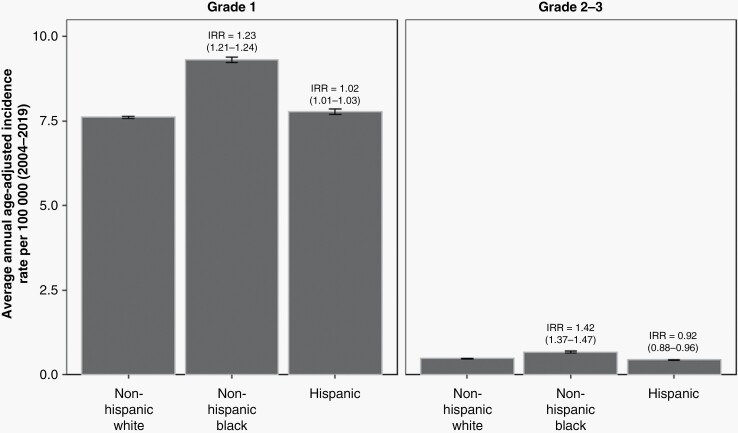
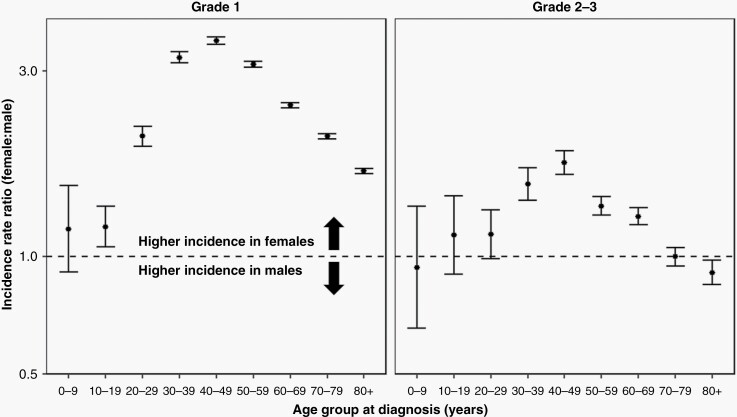
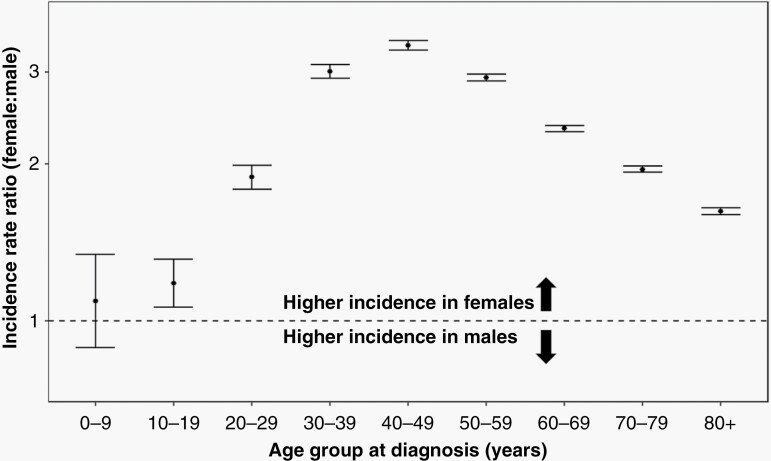
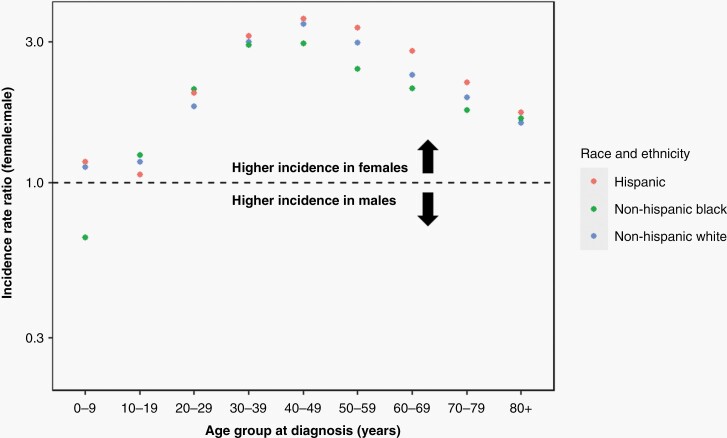
Compared to individuals who are non-Hispanic White, individuals who are non-Hispanic Black had significantly higher risk of grade 1 (IRR = 1.23; 95% CI: 1.21-1.24) and grade 2-3 meningioma (IRR = 1.42; 95% CI: 1.37-1.47). The female-to-male IRR peaked in the fifth decade of life across all racial/ethnic groups and tumor grades, but was 3.59 (95% CI: 3.51-3.67) for WHO grade 1 meningioma and 1.74 (95% CI: 1.63-1.87) for WHO grade 2-3 meningioma.
This study reveals the joint effects of sex and race/ethnicity on meningioma incidence throughout the lifespan and across strata of tumor grade, highlighting incidence disparities among females and African-Americans that may inform future strategies for tumor interception.
先前的研究已确定年龄较大、非裔美国人种族和女性性别为脑膜瘤的危险因素,但关于它们的联合效应,或这些人口统计学因素在肿瘤分级各层中的变化情况,信息有限。
美国中枢脑肿瘤登记处(CBTRUS)是一个基于人群的登记处,它整合了疾病控制与预防中心的国家癌症登记项目和美国国立癌症研究所的监测、流行病学和最终结果项目的数据,覆盖了约100%的美国人口,并汇总了所有原发性恶性和非恶性脑肿瘤的发病率数据。这些数据用于探讨性别和种族/族裔对脑膜瘤年龄调整后平均年发病率的联合影响。我们按性别和种族/族裔、年龄层和肿瘤分级计算了脑膜瘤发病率比值(IRR)。
与非西班牙裔白人相比,非西班牙裔黑人患1级脑膜瘤(IRR = 1.23;95%置信区间:1.21 - 1.24)和2 - 3级脑膜瘤(IRR = 1.42;95%置信区间:1.37 - 1.47)的风险显著更高。在所有种族/族裔群体和肿瘤分级中,女性与男性的IRR在生命的第五个十年达到峰值,但对于世界卫生组织1级脑膜瘤为3.59(95%置信区间:3.51 - 3.67),对于世界卫生组织2 - 3级脑膜瘤为1.74(95%置信区间:1.63 - 1.87)。
本研究揭示了性别和种族/族裔在整个生命周期和肿瘤分级各层中对脑膜瘤发病率的联合影响,突出了女性和非裔美国人之间的发病率差异,这可能为未来的肿瘤拦截策略提供参考。