Cote David J, Wang Rong, Morimoto Libby M, Metayer Catherine, Stempel Jessica, Zada Gabriel, Ma Xiaomei, Wiemels Joseph L
Department of Neurosurgery, Keck School of Medicine of the University of Southern California, Los Angeles, California, USA.
Center for Genetic Epidemiology, Norris Comprehensive Cancer Center, University of Southern California, Los Angeles, California, USA.
Neurooncol Adv. 2022 Nov 5;4(1):vdac173. doi: 10.1093/noajnl/vdac173. eCollection 2022 Jan-Dec.
We evaluated the potential role of birth characteristics in the etiology of early-onset meningioma.
Leveraging a population-based linkage of California birth records (from 1978 to 2015) and cancer registry data (from 1988 to 2015), we identified 362 nonmalignant meningioma cases aged 0-37 years and selected 18 100 controls matched on year of birth. Cases and controls were compared with regard to birth characteristics, with adjusted odds ratios (ORs) and 95% confidence intervals (CIs) estimated from unconditional multivariable logistic regression models. We also conducted stratified analyses by race/ethnicity and age.
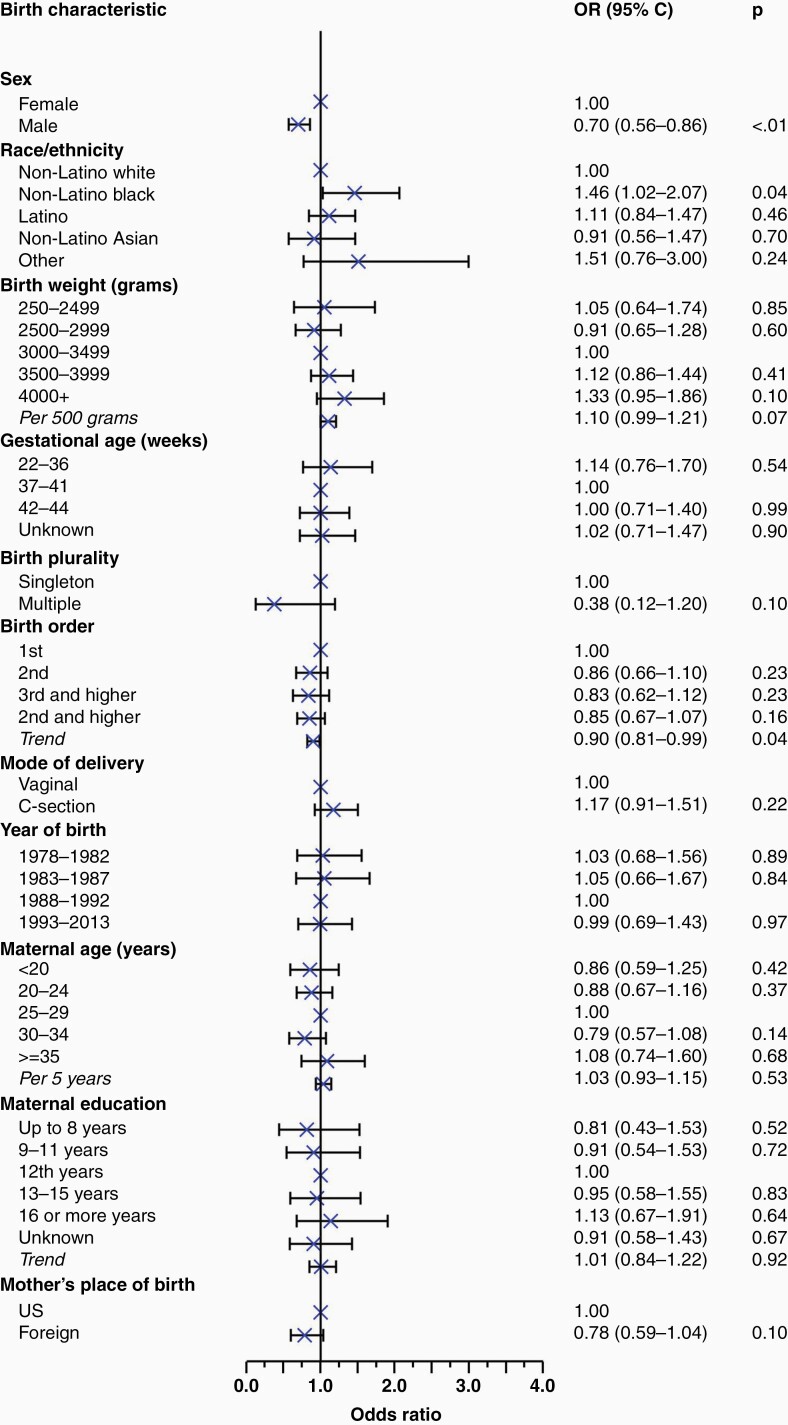
Female sex (compared to male: OR = 1.43, 95% CI: 1.16 to 1.79; < .01) and Black race (compared to White: OR = 1.46, 95% CI: 1.02 to 2.07; = .04) were associated with higher risk of meningioma. Higher birth order (OR = 0.90, 95% CI: 0.81 to 0.99 per additional birth position; = .04) was associated with a lower risk. No significant associations were observed between birthweight, gestational age, delivery mode, maternal age, or maternal education and meningioma risk. In the non-Latino White subgroup, higher birthweight was associated with a higher risk of meningioma (OR = 1.20, 95% CI: 1.02 to 1.41 per 500 grams; = .03), but this was not recapitulated in the Latino subgroup. In age-stratified analyses, female sex was a risk factor for those diagnosed at the age of 20-37 years but not among younger individuals.
In this large population-based study less prone to selection and recall bias, higher birth order was associated with a reduced risk of early-onset meningioma, while female sex and Black race were linked to an increased risk. There were also indications of differential associations by race/ethnicity and age of diagnosis.
我们评估了出生特征在早发型脑膜瘤病因学中的潜在作用。
利用加利福尼亚州出生记录(1978年至2015年)与癌症登记数据(1988年至2015年)的基于人群的关联,我们确定了362例年龄在0至37岁之间的非恶性脑膜瘤病例,并选择了18100名按出生年份匹配的对照。比较病例组和对照组的出生特征,通过无条件多变量逻辑回归模型估计调整后的优势比(OR)和95%置信区间(CI)。我们还按种族/民族和年龄进行了分层分析。
女性(与男性相比:OR = 1.43,95% CI:1.16至1.79;P <.01)和黑人种族(与白人相比:OR = 1.46,95% CI:1.02至2.07;P =.04)与脑膜瘤风险较高相关。出生顺序较高(每增加一个出生位次,OR = 0.90,95% CI:0.81至0.99;P =.04)与风险较低相关。未观察到出生体重、孕周、分娩方式、母亲年龄或母亲教育程度与脑膜瘤风险之间存在显著关联。在非拉丁裔白人亚组中,出生体重较高与脑膜瘤风险较高相关(每500克,OR = 1.20,95% CI:1.02至1.41;P =.03),但在拉丁裔亚组中未观察到这一情况。在年龄分层分析中,女性是20至37岁诊断病例的危险因素,但在较年轻个体中并非如此。
在这项不太容易出现选择和回忆偏倚的大型基于人群的研究中,出生顺序较高与早发型脑膜瘤风险降低相关,而女性和黑人种族与风险增加相关。也有迹象表明按种族/民族和诊断年龄存在差异关联。