Amen John, Perkins Oliver, Kafchitsas Konstantinos, Reed Daniel, Norman-Taylor Fabian, Kokkinakis Michail
Division of Paediatric Orthopaedics, Department of Orthopaedic Surgery, Faculty of Medicine, Ain Shams University, Cairo, Egypt.
Evelina London Children's Hospital, Guy's and St Thomas' NHS Trust, London, UK.
J Child Orthop. 2023 Apr 2;17(3):268-275. doi: 10.1177/18632521231164983. eCollection 2023 Jun.
Decisions for postoperative immobilization after bony hip reconstructive surgery in cerebral palsy are controversial in current practice. The aim of this study was to check if choosing not to use any kind of postoperative immobilization is a safe practice.
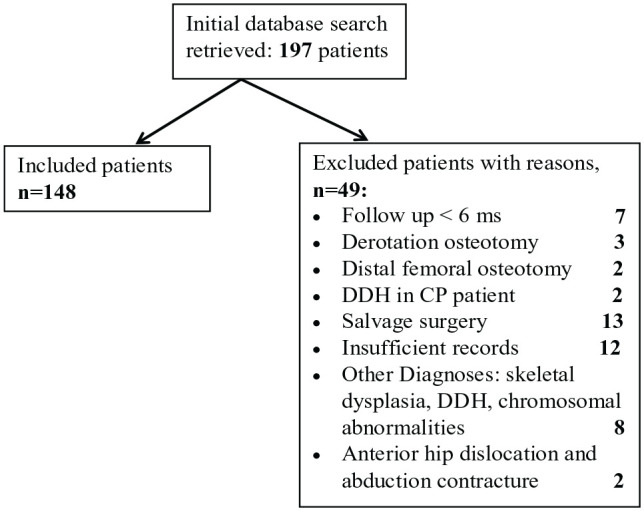
A retrospective cohort study was conducted in a pediatric orthopedic tertiary referral center. The study included 148 patients (228 hips) with cerebral palsy, who had bony hip surgery. Medical records were reviewed for incidence of complications, methods of pain control, and length of hospital stay. Three radiographic measures (neck-shaft angle, Reimers migration index, and acetabular index) were performed on preoperative and postoperative X-rays. X-rays were also checked for mechanical failure of implant, recurrent dislocation/subluxation, and fractures in the first 6 months postoperatively.
In total, 94 (64%) were male and 54 (36%) were female. Seventy-seven (52%) were Gross Motor Function Classification System V, mean age at surgery was 8.6 years (2.5-18.4 years). Length of hospital stay was 6.25 days (SD 4.64 days). Medical complications that may have prolonged hospital stay occurred in 41 patients (27.7%). Radiological measurements showed significant improvement postoperatively ( = 0.001). Seven patients (4.7%) had another surgery in first 6 months (three for recurrent dislocation/subluxation, three for implant failure, and one for ipsilateral femur fracture).
Avoiding postoperative immobilization following bony hip surgery in cerebral palsy is a safe practice and associated with reduced rate of medical and mechanical problems compared to the current literature. This approach should be utilized with optimal pain and tone management.
在目前的临床实践中,脑性瘫痪患者髋部骨重建手术后的固定决策存在争议。本研究的目的是检验不采用任何术后固定方法是否安全。
在一家儿科骨科三级转诊中心进行了一项回顾性队列研究。该研究纳入了148例接受髋部骨手术的脑性瘫痪患者(228个髋关节)。回顾病历以了解并发症发生率、疼痛控制方法和住院时间。对术前和术后的X线片进行三项影像学测量(颈干角、赖默斯移位指数和髋臼指数)。还检查术后前6个月X线片上的植入物机械故障、复发性脱位/半脱位和骨折情况。
总共94例(64%)为男性,54例(36%)为女性。77例(52%)为粗大运动功能分类系统V级,手术平均年龄为8.6岁(2.5 - 18.4岁)。住院时间为6.25天(标准差4.64天)。41例患者(27.7%)出现了可能延长住院时间的医疗并发症。影像学测量显示术后有显著改善(P = 0.001)。7例患者(4.7%)在术后前6个月再次接受手术(3例因复发性脱位/半脱位,3例因植入物失败,1例因同侧股骨骨折)。
与现有文献相比,脑性瘫痪患者髋部骨手术后避免术后固定是一种安全的做法,且医疗和机械问题发生率较低。这种方法应与最佳的疼痛和肌张力管理相结合使用。