van den Enden Antoon J M, van den Dorpel Mark M P, Bastos Marcelo B, Nuis Rutger-Jan M, Schreuder Jan J, Kardys Isabella, Lenzen Mattie J, Brugts Jasper J, Daemen Joost, Van Mieghem Nicolas M
Department of Cardiology, Thoraxcenter, Erasmus University Medical Center, Rotterdam, The Netherlands.
Struct Heart. 2022 Sep 15;6(5):100084. doi: 10.1016/j.shj.2022.100084. eCollection 2022 Oct.
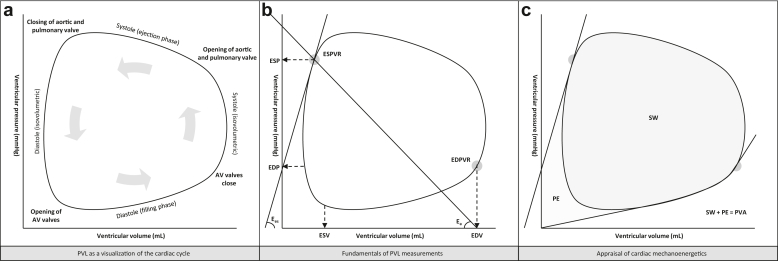
Transcatheter valvular interventions affect cardiac and hemodynamic physiology by changing ventricular (un-)loading and metabolic demand as reflected by cardiac mechanoenergetics. Real-time quantifications of these changes are scarce. Pressure-volume loop (PVL) monitoring appraises both load-dependent and load-independent compounds of cardiac physiology including myocardial work, ventricular unloading, and ventricular-vascular interactions. The primary objective is to describe changes in physiology induced by transcatheter valvular interventions using periprocedural invasive biventricular PVL monitoring. The study hypothesizes transcatheter valve interventions modify cardiac mechanoenergetics that translate into improved functional status at 1-month and 1-year follow-up.
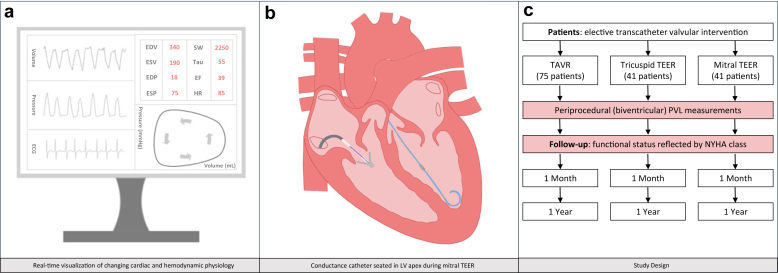
In this single-center prospective study, invasive PVL analysis is performed in patients undergoing transcatheter aortic valve replacement or tricuspid or mitral transcatheter edge-to-edge repair. Clinical follow-up is per standard of care at 1 and 12 months. This study aims to include 75 transcatheter aortic valve replacement patients and 41 patients in both transcatheter edge-to-edge repair cohorts.
The primary outcome is the periprocedural change in stroke work, potential energy, and pressure-volume area (mmHg mL). The secondary outcomes comprise changes in a myriad of parameters obtained by PVL measurements, including ventricular volumes and pressures and the end-systolic elastance-effective arterial elastance ratio as a reflection of ventricular-vascular coupling. A secondary endpoint associates these periprocedural changes in cardiac mechanoenergetics with functional status at 1 month and 1 year.
This prospective study aims to elucidate the fundamental changes in cardiac and hemodynamic physiology during contemporary transcatheter valvular interventions.
经导管瓣膜介入治疗通过改变心室(非)负荷和代谢需求来影响心脏和血流动力学生理,这可通过心脏机械能量学反映出来。对这些变化进行实时量化的研究很少。压力-容积环(PVL)监测可评估心脏生理中与负荷相关和与负荷无关的成分,包括心肌做功、心室卸载以及心室-血管相互作用。主要目的是使用围手术期有创双心室PVL监测来描述经导管瓣膜介入治疗引起的生理变化。该研究假设经导管瓣膜介入治疗可改变心脏机械能量学,进而在1个月和1年随访时改善功能状态。
在这项单中心前瞻性研究中,对接受经导管主动脉瓣置换术或三尖瓣或二尖瓣经导管缘对缘修复术的患者进行有创PVL分析。临床随访按照标准护理在1个月和12个月时进行。本研究旨在纳入75例经导管主动脉瓣置换术患者以及两个经导管缘对缘修复队列中的41例患者。
主要结局是围手术期每搏功、势能和压力-容积面积(mmHg·mL)的变化。次要结局包括通过PVL测量获得的众多参数的变化,包括心室容积和压力以及反映心室-血管耦合的收缩末期弹性-有效动脉弹性比值。次要终点将这些围手术期心脏机械能量学的变化与1个月和1年时的功能状态相关联。
这项前瞻性研究旨在阐明当代经导管瓣膜介入治疗期间心脏和血流动力学生理的根本变化。